

Number Portability Lookup
Number Portability Lookup Platform Overview
Real-Time Ported Number Detection for Accurate Carrier Routing
Number portability lookup services enable businesses to identify which network operator currently serves a mobile phone number, regardless of which carrier originally issued it. When subscribers port their numbers between carriers - exercising their regulatory right to keep phone numbers while switching providers - traditional prefix-based routing becomes unreliable and costly. Our number portability lookup platform queries authoritative portability databases in real-time, returning accurate current operator identification that ensures correct routing decisions for voice calls, SMS messages, and telecommunications billing.
Mobile number portability (MNP) regulations exist in over 70 countries worldwide, allowing consumers to retain their phone numbers when changing service providers. While beneficial for consumers, number portability creates significant routing challenges for businesses that relied on number prefix patterns to identify destination carriers. A phone number originally allocated to Carrier A might now be served by Carrier B, Carrier C, or any other operator in the market - making prefix-based assumptions increasingly inaccurate as portability adoption grows.
The Hidden Cost of Outdated Routing
In mature telecommunications markets, 30-50% of mobile numbers have been ported at least once. Routing decisions based solely on number prefixes fail catastrophically in these environments, causing messages to route through expensive interconnection paths, calls to terminate incorrectly, and billing systems to attribute traffic to wrong carriers. The financial impact is substantial: VoIP providers report 15-30% higher termination costs when routing without portability verification, while SMS aggregators experience degraded delivery rates and sender reputation damage from misrouted messages.
Number portability lookup eliminates routing uncertainty by providing definitive carrier identification before initiating communication. Every query returns the current serving operator with precise MCCMNC identification, enabling least-cost routing algorithms to select optimal termination paths, billing systems to attribute costs accurately, and delivery platforms to route through correct carrier channels.
How Number Portability Lookup Works
Our platform interfaces with national number portability databases maintained by telecommunications regulators and industry clearinghouses. These authoritative databases track every porting transaction, recording when numbers transfer between carriers and maintaining current operator assignments with high accuracy and minimal propagation delay. When you submit a number portability lookup, our system queries the appropriate national database based on number geography, retrieves the current operator assignment, and returns comprehensive carrier identification including operator name, MCCMNC code, country, and portability status.
Response times typically range from 50-500 milliseconds depending on destination country, enabling real-time integration into call setup workflows, SMS routing decisions, and interactive verification processes. For high-volume applications, our bulk processing capabilities handle millions of lookups efficiently with automatic progress tracking and completion notifications.
Comprehensive Portability Intelligence
Each number portability lookup returns detailed carrier information that supports sophisticated routing and business intelligence applications:
Current Network Operator
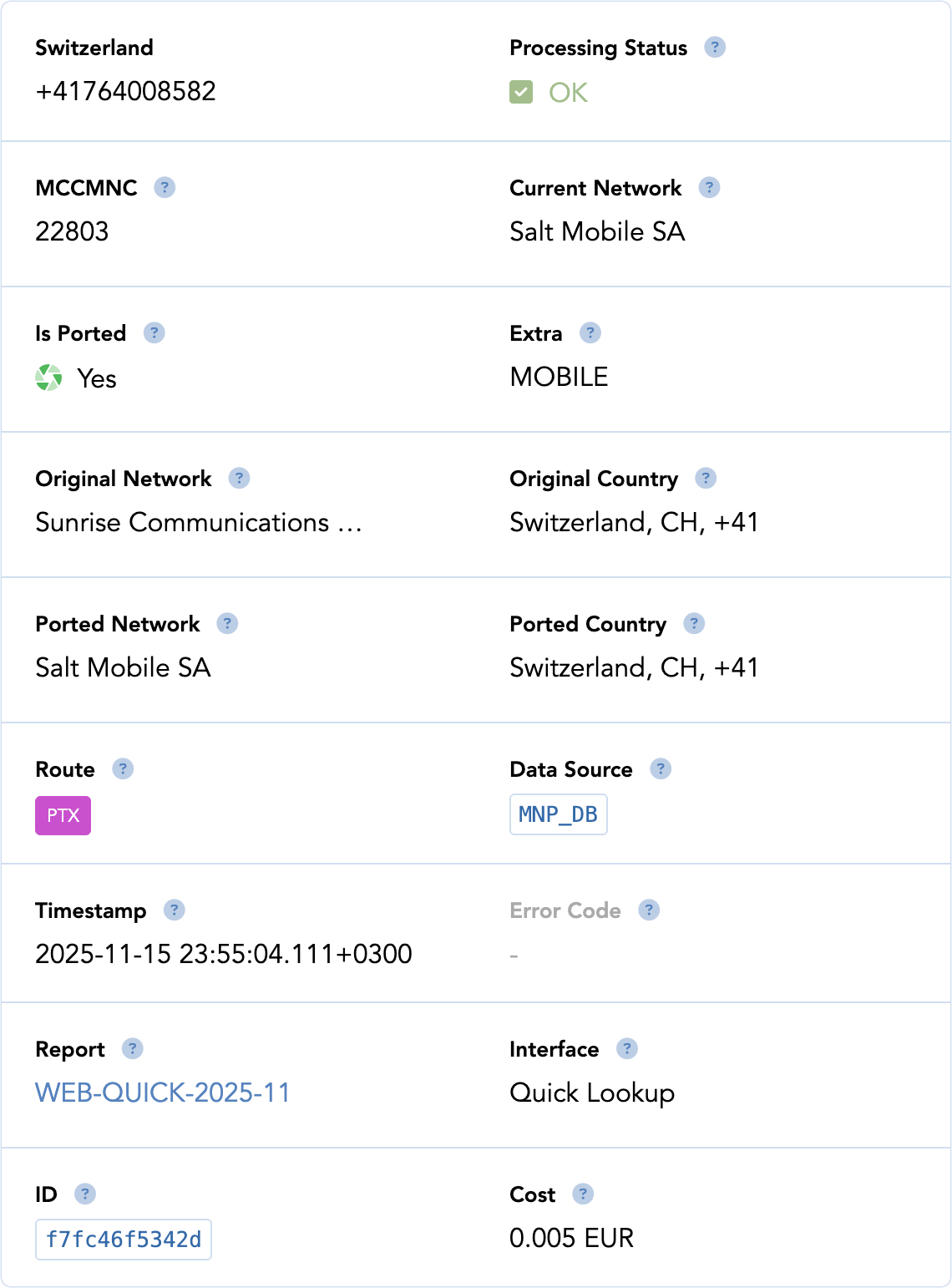
The most critical data point: which carrier currently serves this number and should receive routed traffic. Results include both human-readable operator names (e.g., 'Vodafone Germany', 'T-Mobile USA') and machine-readable MCCMNC codes (e.g., 26202, 310260) for programmatic routing table integration. Current operator identification remains accurate even after multiple porting events - if a number ported from Carrier A to Carrier B and later to Carrier C, the lookup correctly returns Carrier C as the current serving network.
Original Network Allocation
The carrier that originally received this number range from telecommunications regulators and first issued the number to a subscriber. Original allocation data enables portability detection by comparing against current operator - when these differ, the number has been ported. Historical allocation information also supports regulatory compliance, audit trails, and market analysis tracking how subscriber bases shift between carriers over time.
Portability Status
Explicit indication whether this number has been transferred between carriers: PORTED (number has changed operators) or NOT_PORTED (number remains with original allocating carrier). Portability status enables routing optimization strategies that handle native and ported numbers differently - some interconnection agreements offer preferential rates for native traffic versus ported number termination.
Platform Access Methods
Access number portability lookup capabilities through multiple interfaces optimized for different use cases and integration requirements:
Quick Lookup Interface
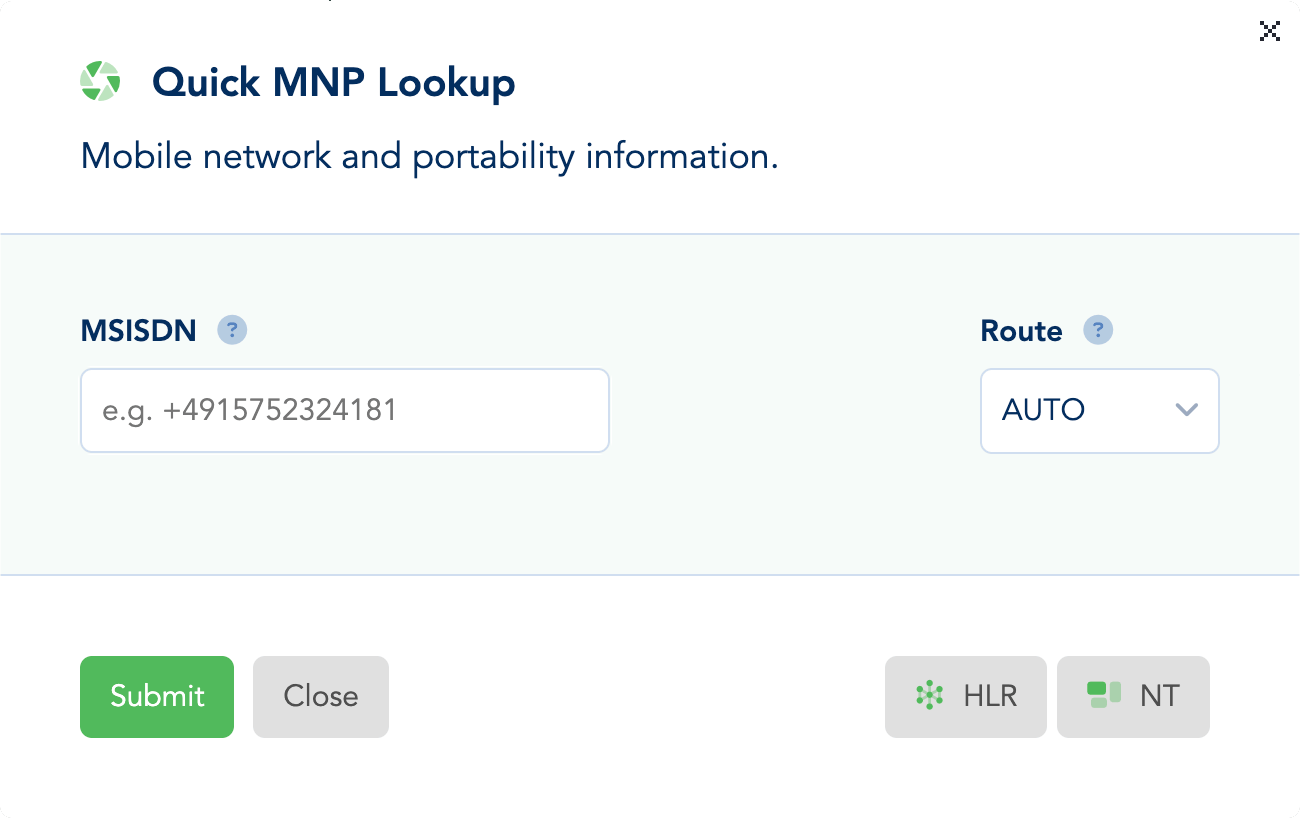
Verify individual numbers instantly through our streamlined web interface. Perfect for customer service agents, support teams, and ad-hoc verification needs where immediate results for single numbers are required without API integration. Simply enter any mobile number, and receive comprehensive portability status, current operator identification, and original network allocation within seconds.
Bulk Processing
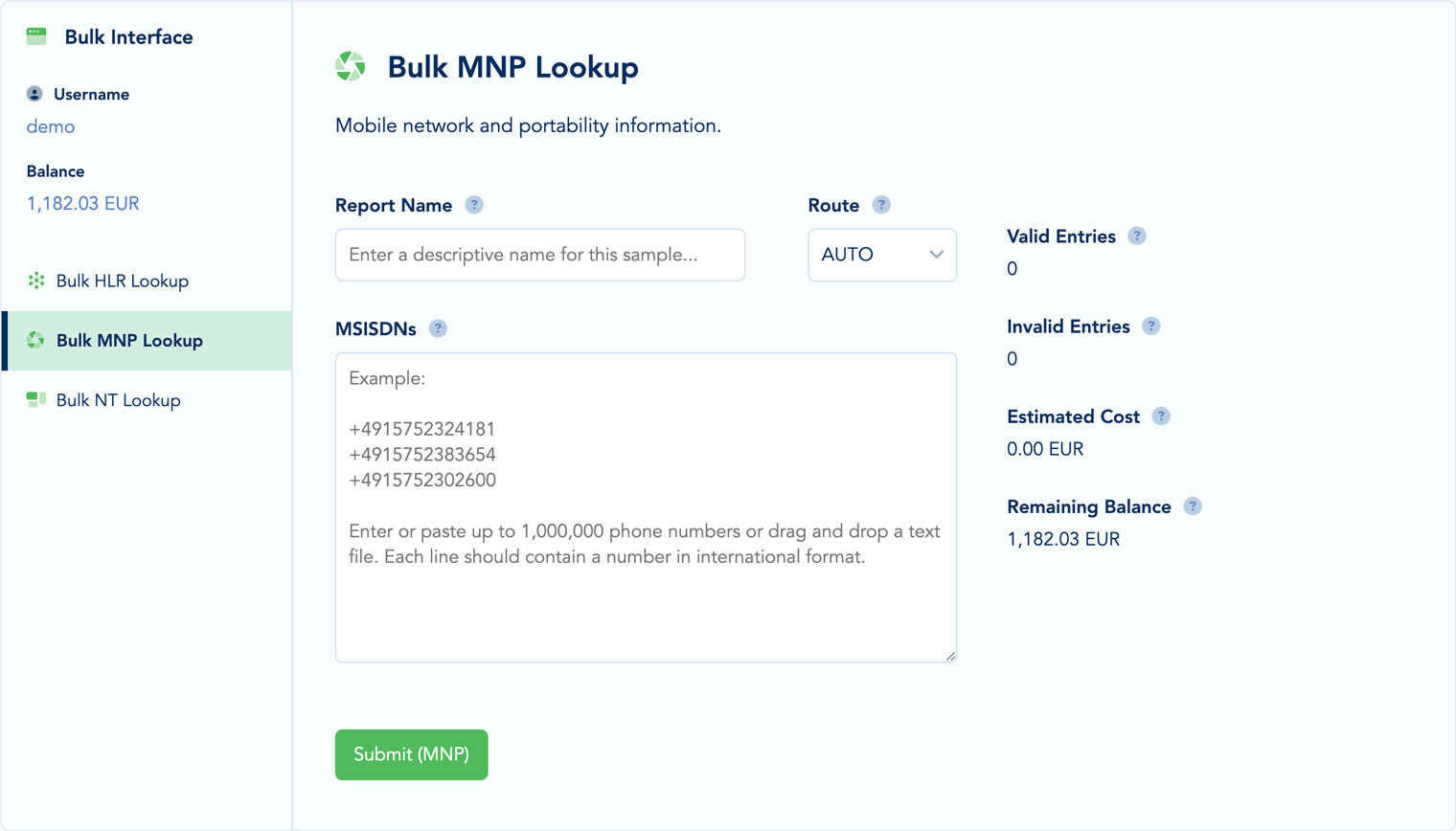
Upload files containing thousands or millions of numbers for high-speed batch processing with real-time progress monitoring. Essential for database validation, routing table updates, campaign preparation, and any scenario requiring portability verification across large number datasets. Our bulk processing infrastructure supports CSV, TXT, and Excel formats with automatic number detection and parallel query execution for maximum throughput.
REST API Integration
Integrate number portability lookup directly into your applications using our REST API with synchronous and asynchronous endpoints. Real-time API integration enables portability verification during call setup, SMS routing decisions, customer registration, and any workflow requiring programmatic carrier identification. Comprehensive API documentation provides detailed specifications, code examples, and integration patterns for common use cases.
Developer SDKs
Accelerate implementation with native SDKs for PHP, Node.js, Python, and other popular languages. SDKs provide pre-built functions, automatic authentication handling, error management, and retry logic that eliminate low-level HTTP implementation complexity.
Analytics and Reporting
Every number portability lookup is automatically logged, indexed, and aggregated into comprehensive analytics reports. Monitor portability trends across your traffic, analyze operator distribution patterns, track porting rates by country and carrier, and export detailed reports for business intelligence and compliance documentation.
Real-time dashboard monitoring provides instant visibility into lookup activity, processing status, and platform performance. Drill down into specific time periods, filter by operator or country, and generate custom reports that answer your specific business questions about number portability patterns.
Related Services
Number portability lookup complements our broader mobile intelligence platform:
HLR Lookup provides real-time connectivity status and network intelligence directly from mobile network operators' Home Location Registers - essential when you need to verify whether numbers are currently reachable, not just which carrier serves them.
MNP Lookup offers dedicated mobile number portability verification with specialized features for telecommunications operators and routing platforms.
Mobile Network Detection combines portability lookup with additional network intelligence for comprehensive carrier identification.
Phone Number Verification validates that phone numbers exist, are correctly formatted, and can receive communications.
Explore the detailed sections on this page to discover the full capabilities of our number portability lookup platform, including technical details, business applications, and integration guidance.
How Number Portability Works
Understanding Mobile Number Portability and Carrier Transfer Processes
Mobile Number Portability (MNP) allows telecommunications subscribers to retain their phone numbers when switching between network operators. This consumer protection regulation exists in over 70 countries worldwide, enabling competition by removing the friction of number changes when customers seek better service or pricing from alternative carriers. Understanding how number portability functions at a technical level helps explain why real-time portability lookup is essential for accurate carrier identification and routing optimization.
The Number Porting Process
When a subscriber decides to change carriers while keeping their existing phone number, they initiate a porting request with their new (recipient) carrier. The recipient carrier coordinates with the current (donor) carrier through regulated industry processes to transfer number ownership and routing responsibility. This porting transaction follows standardized workflows defined by national telecommunications regulators, typically completing within hours to days depending on jurisdiction.
Porting Request Initiation
The subscriber contacts their desired new carrier and requests to port their existing number. They must provide proof of ownership (typically account credentials or identity verification) and authorize the transfer from their current carrier. The recipient carrier submits a formal porting request to the national clearinghouse or directly to the donor carrier, including subscriber identification and the number to be transferred.
Validation and Authorization
The donor carrier validates the porting request, confirming the subscriber's identity and account status. They may reject requests if subscriber information doesn't match records, if outstanding balances exist, or if the number is under contractual restrictions. Upon validation, the donor carrier authorizes the port and prepares to release the number on the scheduled porting date.
Database Updates and Routing Changes
On the porting execution date, the national number portability database is updated to reflect the new operator assignment. All telecommunications carriers and routing systems query this database to determine correct routing - calls and messages to the ported number now route to the recipient carrier instead of the original allocating network. The subscriber's service seamlessly transfers to the new carrier, typically with only brief interruption during the cutover window.
National Portability Databases
Every country implementing number portability maintains an authoritative database tracking all porting transactions and current operator assignments. These databases are operated by telecommunications regulators, industry consortiums, or designated clearinghouse providers, serving as the single source of truth for number-to-carrier mappings.
Database Architecture
Portability databases maintain records for every allocated mobile number in the national numbering plan, indicating either the original allocating carrier (for non-ported numbers) or the current serving carrier (for ported numbers). When porting transactions occur, database updates propagate to all connected carriers and routing systems, ensuring consistent routing decisions across the telecommunications ecosystem. Update latency varies by implementation - some systems propagate changes within minutes, while others batch updates hourly or daily. Our platform connects to the most current data sources available in each market.
Query Mechanisms
Telecommunications carriers query portability databases during call setup and message routing to determine correct termination paths. These queries happen automatically within network infrastructure, invisible to end users but critical for successful communication delivery. Our number portability lookup service provides the same authoritative data through accessible interfaces - web, API, and bulk processing - enabling any business to leverage portability intelligence regardless of their telecommunications infrastructure.
Why Prefix-Based Routing Fails
Before number portability, phone number prefixes reliably indicated network operators. Number ranges were allocated to specific carriers, and the leading digits of any number identified its home network. This prefix-based system enabled simple routing tables: numbers starting with certain digits route to Carrier A, others to Carrier B, and so on.
Number portability fundamentally breaks this assumption. A number originally allocated to Carrier A (and bearing Carrier A's prefix) might now be served by Carrier B, Carrier C, or any other operator in the market. Routing based on prefix alone would send traffic to the original carrier, which must then redirect to the current serving network - adding latency, complexity, and interconnection costs. Or worse, the original carrier may reject traffic entirely for numbers they no longer serve, causing delivery failures and service disruptions.
Portability Adoption Rates
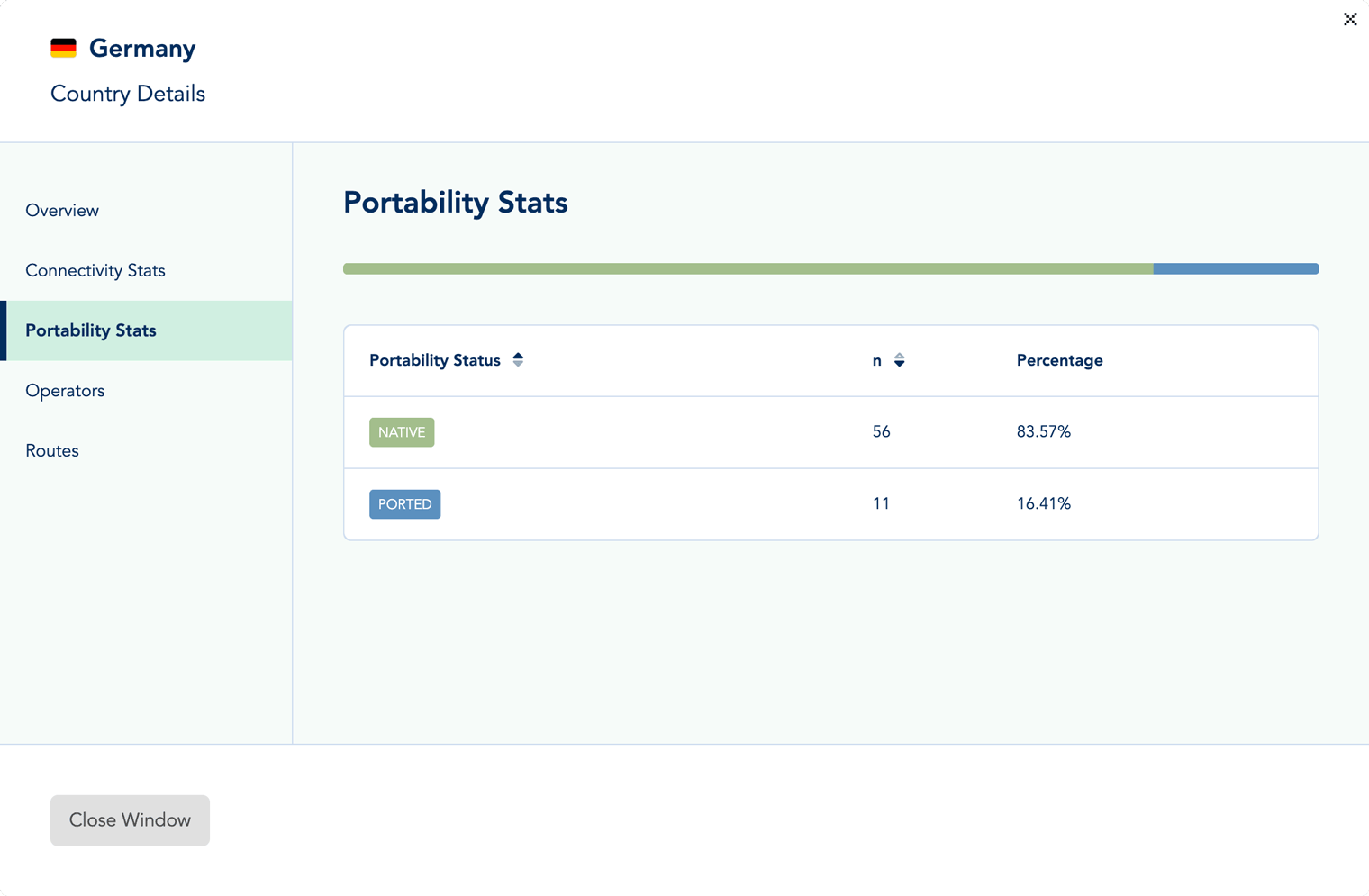
In markets with mature portability implementations, 30-50% of mobile numbers have been ported at least once. Germany reports approximately 40% ported numbers, the UK exceeds 35%, and even newer portability markets show rapidly growing porting volumes as consumers discover the option. With such substantial portions of number ranges affected, prefix-based routing becomes essentially random for cost optimization - you cannot know whether a given number has been ported without checking.
Real-Time vs Cached Lookups
Number portability lookup implementations vary in data freshness based on their connection to source databases and caching strategies. Understanding these differences helps you select appropriate lookup methods for your accuracy requirements and cost constraints.
Real-Time Database Queries
Real-time portability lookups query authoritative national databases directly, returning the most current operator assignment available. This approach guarantees maximum accuracy - if a number ported yesterday, today's lookup reflects the change. Real-time queries typically complete in 50-500 milliseconds depending on database location and network latency, suitable for call-setup timing requirements and interactive verification workflows.
Cached Data Approaches
Some portability services maintain local caches of national database snapshots, querying cached data instead of live sources. Caching enables faster response times and reduced per-query costs, but introduces staleness risk - recently ported numbers may show outdated operator assignments until cache refreshes occur. Cache refresh intervals vary from hourly to daily depending on provider and pricing tier, creating accuracy tradeoffs that may be acceptable for some use cases but problematic for real-time routing decisions.
Our Platform Approach
Our number portability lookup platform prioritizes accuracy through direct connections to authoritative databases while optimizing for response time through intelligent query routing and connection pooling. We continuously monitor database update propagation timing across markets, ensuring our responses reflect the most current data available from each national portability system. For bulk processing workloads, we balance throughput against data freshness to deliver optimal accuracy at volume pricing.
Global Coverage Considerations
Number portability implementations differ significantly across countries in regulatory framework, technical architecture, and data accessibility. Some markets provide open access to portability databases, enabling any licensed entity to perform lookups. Others restrict access to domestic carriers or impose complex licensing requirements.
Our platform navigates these complexities on your behalf, maintaining the necessary relationships, licenses, and technical integrations to provide portability lookup across all major markets. Contact our team to discuss specific country coverage requirements for your use case.
Integration with HLR Lookups
Number portability lookup and HLR Lookup provide complementary intelligence for different routing decisions.
Portability lookup answers: 'Which carrier currently serves this number?' - essential for routing decisions and cost optimization. HLR Lookup answers: 'Is this number currently reachable?' - essential for delivery optimization and database validation.
Many applications benefit from combining both services: use portability lookup for routing path selection, then HLR lookup to verify reachability before committing delivery resources. Our platform supports both services through unified interfaces, enabling integrated workflows that leverage the full spectrum of mobile network intelligence.
Number Portability Quick Lookup Interface
Instant Single-Number Portability Verification
The Quick Lookup interface provides immediate number portability verification for individual mobile phone numbers through an intuitive web-based form. Designed for customer service representatives, support teams, routing engineers, and anyone needing instant carrier identification, this streamlined tool delivers comprehensive portability data within seconds without requiring API integration or technical development.
Simply enter a mobile phone number in international format (e.g., +491788735000, +14156226819), and receive complete portability status, current network operator identification, and original carrier allocation instantly. The interface accepts numbers in various formats and automatically normalizes them to E.164 standard format before performing the lookup.
Key Features
Instant Results
Receive complete portability data typically within 50-500 milliseconds, depending on the target country and database response time. Our platform maintains persistent connections to national portability databases worldwide, minimizing query latency and ensuring rapid response times even during peak traffic periods. For customer service agents verifying carrier information during live calls, or support teams troubleshooting routing issues, these sub-second response times enable real-time decision making without customer wait times.
Flexible Number Input
The system intelligently accepts mobile numbers in various formats: with or without country codes, with spaces or hyphens, using leading zeros or plus signs. This flexible parsing eliminates format friction - agents can copy-paste numbers directly from emails, CRM fields, or customer messages without manual reformatting. Supported input formats include: +491234567890, 00491234567890, 01234567890 (with country context), +49 123 456 7890 (with spaces), and mixed variations. The number input field provides instant visual feedback, showing the normalized E.164 format and flagging potential errors before submission.
Storage Assignment
Optionally assign lookups to named storage containers for automatic organization and aggregated reporting. Quick lookups default to monthly storage containers (e.g., "QUICK-LOOKUP-MNP-2025-01"), making it easy to track usage patterns and generate time-based reports. Override the default by specifying custom storage names for project-specific organization: assign lookups to "SUPPORT-TICKETS-JANUARY" or "CLIENT-ROUTING-AUDIT" for precise categorization.
Cost Transparency
The interface displays estimated lookup cost before execution, allowing you to confirm pricing matches expectations and verify sufficient account balance. Cost transparency prevents billing surprises and enables informed decisions about lookup frequency when balancing verification needs against budget constraints.
Comprehensive Result Display
Upon completion, the Quick Lookup interface displays detailed portability results in an organized, readable format optimized for quick comprehension. Results include both human-readable summaries and technical identifiers, making them accessible to non-technical users while providing depth for telecommunications professionals.
Portability Status Indicator
Prominently displayed portability status provides immediate clarity on whether the number has been transferred between carriers. PORTED indicates the number has moved from its original allocating carrier to a different network operator. NOT_PORTED confirms the number remains with its original carrier. Color-coded status indicators enable at-a-glance interpretation, supporting rapid decision-making without detailed result analysis.
Current Network Operator
Complete current operator information appears including commercial operator name, country of operation, and MCCMNC code for programmatic identification. This is the carrier currently serving the subscriber and the correct routing destination for calls and messages to this number. For ported numbers, the current operator differs from the original allocating network, revealing the porting transaction.
Original Network Allocation
The original network information shows which carrier first issued this number when the number range was allocated by telecommunications regulators. Comparing original versus current operator reveals portability history - matching operators indicate a non-ported native number, while different operators confirm porting has occurred.
Query Metadata
Each result includes comprehensive metadata: timestamp documenting when the lookup executed, unique lookup identifier for reference, storage container assignment, and the exact cost charged. Metadata creates audit trails for compliance, enables cost tracking for billing, and supports troubleshooting by correlating results with execution context.
Use Cases for Quick Lookup
The number portability quick lookup interface serves diverse verification scenarios where immediate carrier identification for individual numbers is needed.
Routing Verification and Troubleshooting
When calls or messages fail to reach specific numbers, Quick Lookup reveals whether routing issues stem from incorrect carrier assumptions. If your routing tables show a number as belonging to Carrier A but the lookup reveals it has ported to Carrier B, you've identified the routing misconfiguration causing delivery failures. Network operations teams use Quick Lookup to verify routing table accuracy for specific number ranges and troubleshoot customer-reported delivery problems.
Customer Service Support
Support agents can instantly verify which carrier serves a customer's mobile number, enabling accurate guidance about carrier-specific features, network coverage, or interconnection issues. When customers report unexpected charges from calls to specific numbers, portability lookup confirms whether the number has ported to a carrier with different interconnection rates, explaining billing variations.
Billing Dispute Resolution
For telecommunications billing disputes involving carrier identification, Quick Lookup provides authoritative verification of which operator served a number at the time of communication. This evidence supports accurate billing reconciliation between carriers and helps resolve customer disputes about unexpected interconnection charges.
Lead Qualification
Sales and marketing teams can verify carrier information for high-value leads, ensuring contact attempts route correctly and identifying any carrier-specific considerations for outreach strategy. Knowing a prospect's current carrier enables network-specific messaging strategies and helps avoid routing through expensive interconnection paths for sales calls.
Compliance and Audit
Compliance officers can verify carrier assignments for regulatory documentation, creating audit trails that demonstrate accurate carrier identification in telecommunications operations. Quick Lookup provides timestamped verification records suitable for compliance reporting and regulatory inquiry responses.
Dashboard Integration
All Quick Lookups are automatically logged and appear in your Dashboard recent activity feed, providing immediate access to lookup history and enabling quick re-review of past queries. Results are indexed in real-time, making them searchable through the lookup history interface and exportable via CSV reports.
Quick Lookups contribute to your monthly usage statistics and are included in all analytics reports, allowing you to track verification patterns and analyze portability trends over time.
Number Portability Bulk Processing
High-Volume Portability Verification for Enterprise Workloads
The bulk processing interface enables verification of thousands or millions of mobile numbers for portability status with real-time progress monitoring and automatic completion notifications. Essential for database validation, routing table updates, campaign preparation, and any scenario requiring portability verification across large number datasets, our enterprise bulk processing infrastructure handles massive workloads efficiently while maintaining data accuracy.
Upload files containing your numbers, monitor processing status live through the dashboard, and download comprehensive results immediately upon completion or access them later through organized storage containers.
Supported File Formats
Our bulk processing interface accepts multiple file formats to accommodate different data sources and workflow requirements:
CSV Files
Comma-separated value files are the most common format for bulk number uploads. The system automatically detects number columns, handling files with headers or raw number lists. For multi-column CSVs, specify which column contains the phone numbers or let the system auto-detect based on content analysis.
Text Files
Plain text files with one number per line are processed directly without column parsing complexity. This format works well for simple number lists exported from other systems.
Excel Files
Microsoft Excel files (.xlsx, .xls) are supported for users working primarily in spreadsheet environments. Specify the worksheet and column containing numbers, or use auto-detection.
Processing Workflow
File Upload and Validation
Upload your file through the web interface using drag-and-drop or file browser selection. The system immediately validates file format, parses content, and displays the detected number count for confirmation before processing begins. Number format validation identifies and flags malformed entries, allowing you to review potential issues before committing to processing. Invalid formats are logged separately from successful lookups.
Storage Assignment
Assign the bulk job to a named storage container for organized result management. Storage names like 'DATABASE-CLEANUP-Q1' or 'ROUTING-TABLE-UPDATE-2025' keep results organized and easily retrievable. Proper storage assignment ensures results aggregate correctly in analytics reports and remain accessible for future reference without mixing with other jobs.
Parallel Processing
Upon job submission, our distributed processing infrastructure executes lookups in parallel across multiple workers, maximizing throughput while maintaining result accuracy. Processing speed scales with file size - small files complete in seconds, while multi-million number files process at sustained high throughput rates, typically completing within hours rather than days.
Progress Monitoring
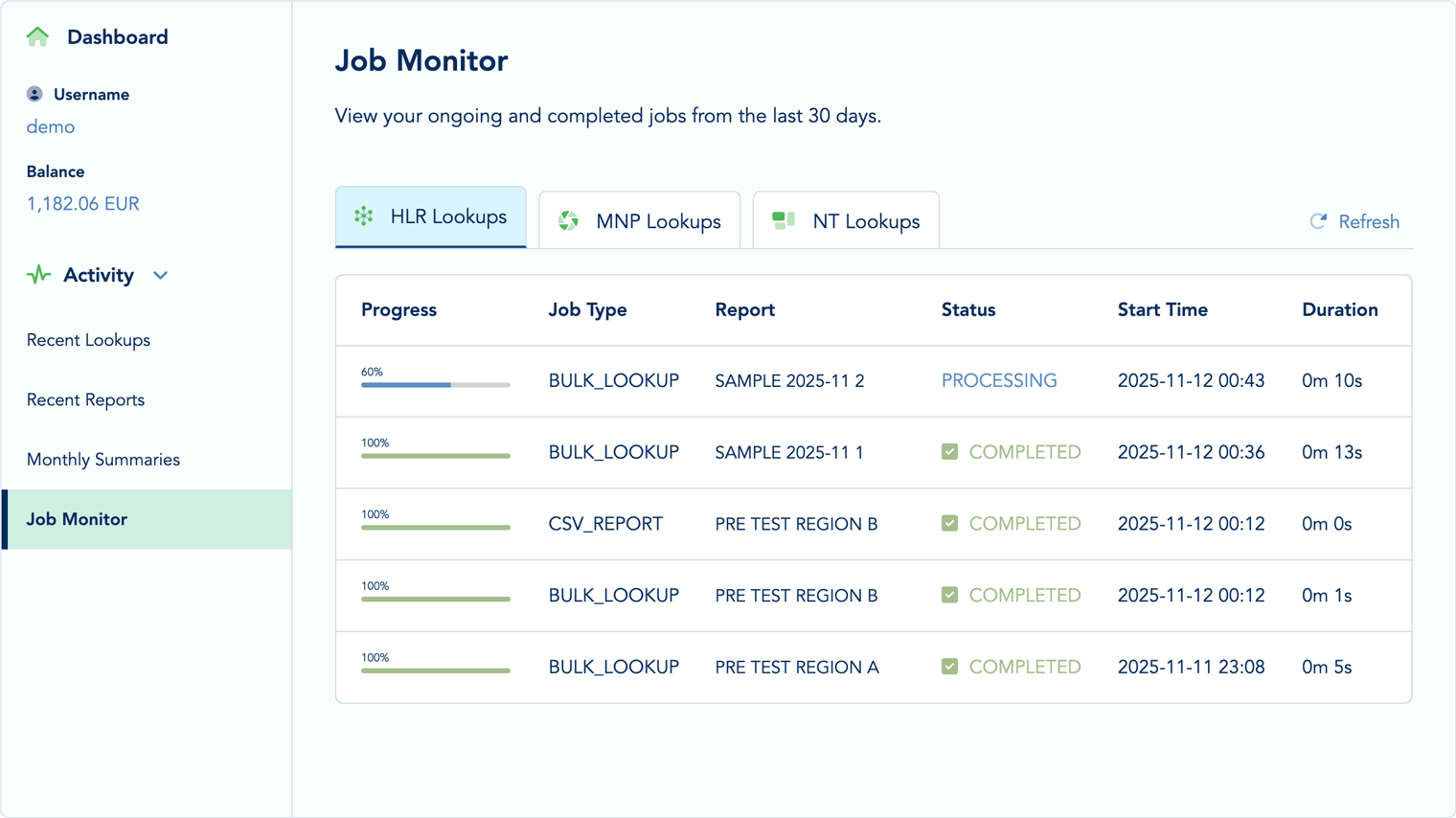
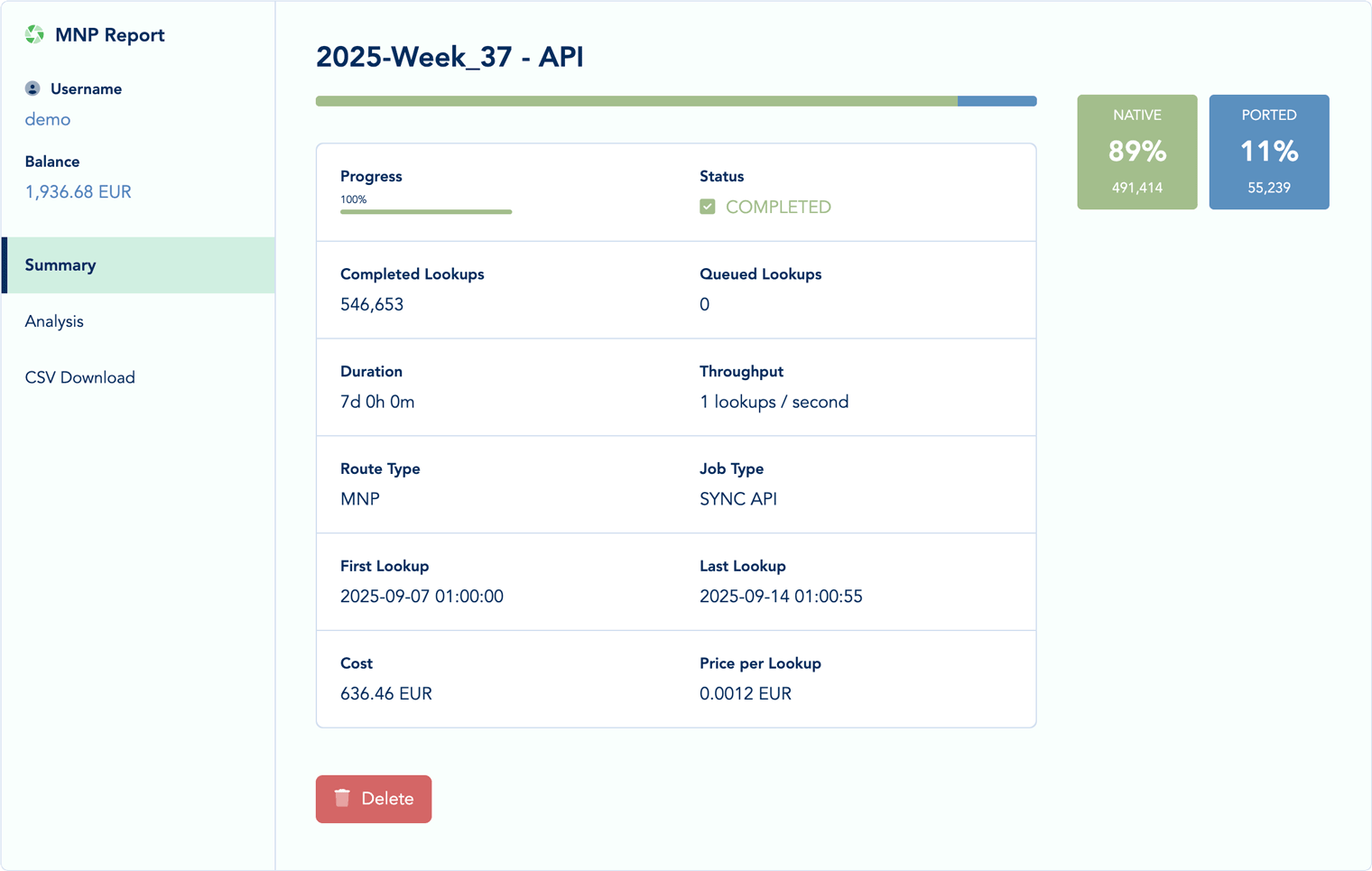
Monitor processing status in real-time through the job progress interface. Visual progress indicators show completion percentage, estimated time remaining, and processing rate statistics. The job monitor updates automatically without page refresh, providing continuous visibility into bulk processing status.
Completion Notifications
Receive email notifications when bulk jobs complete, eliminating the need to monitor progress continuously. Notifications include job summary statistics and direct links to download results. Configure notification preferences to receive alerts for successful completions, processing errors, or both depending on your monitoring requirements.
Result Retrieval
Immediate Download
Download complete results immediately upon job completion in CSV format. Result files include all input numbers with corresponding portability status, current operator, original operator, and lookup metadata. CSV exports are formatted for easy import into databases, spreadsheets, or routing systems, with consistent column structure regardless of input file format.
Storage Container Access
Results remain accessible through the assigned storage container indefinitely. Access historical bulk job results at any time through the storage interface, enabling re-downloads, analysis, and audit trail maintenance. Storage containers aggregate results from multiple jobs with the same name, enabling cumulative analysis across related verification activities.
Analytics Integration
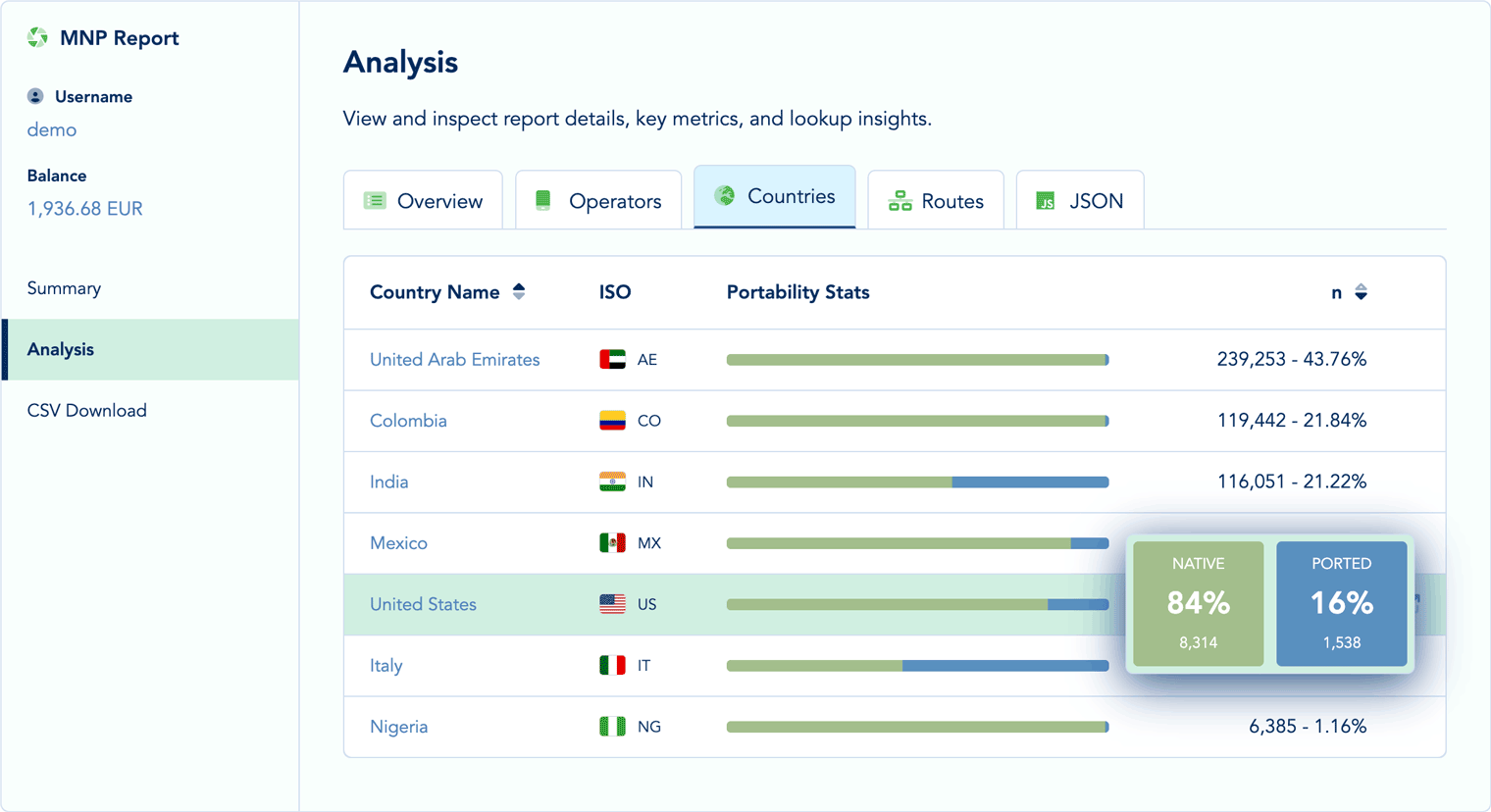
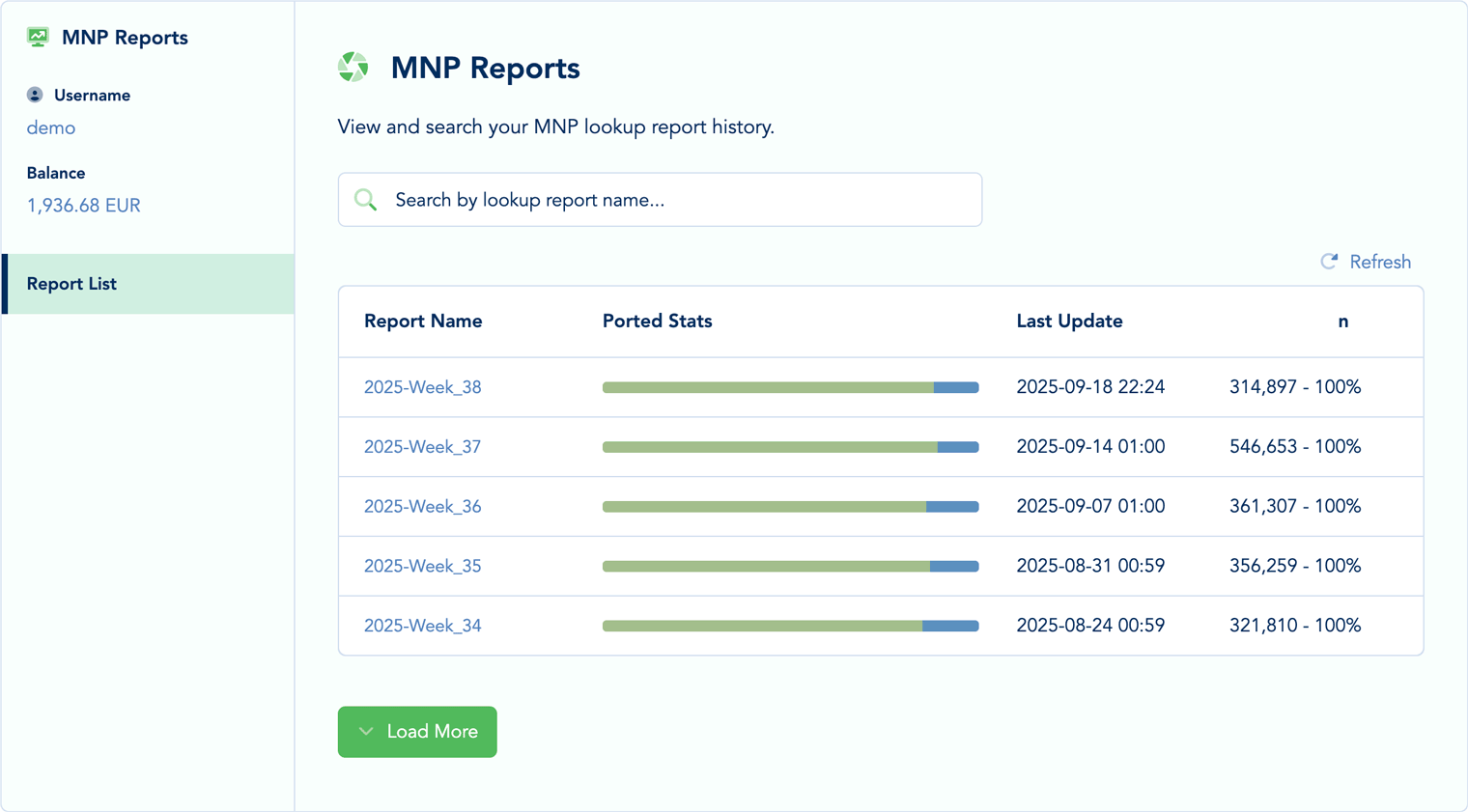
Bulk processing results automatically feed into the analytics platform, generating aggregate statistics on portability rates, operator distribution, and trend analysis. View visual breakdowns of ported versus native numbers, analyze carrier distribution across your verified numbers, and track how portability patterns change over time through successive bulk verification jobs.
Enterprise Use Cases
Routing Table Validation
Telecommunications providers use bulk portability verification to validate and update routing tables, ensuring least-cost routing algorithms have accurate current operator data for all destination numbers. Schedule periodic bulk verification of your routing table number ranges to identify ported numbers requiring routing updates, preventing misrouting and interconnection cost overruns.
Database Quality Management
Marketing and CRM databases accumulate stale carrier information as subscribers port numbers over time. Bulk verification identifies numbers where carrier assumptions have become incorrect. Regular database validation through bulk portability lookup ensures your systems maintain accurate carrier attribution for segmentation, routing, and billing purposes.
Campaign Preparation
Before launching large SMS or voice campaigns, verify portability status for all target numbers to ensure correct routing paths and accurate cost forecasting. Pre-campaign verification identifies numbers requiring special routing treatment due to porting, enabling cost optimization and delivery path planning before campaign execution.
Regulatory Compliance Audits
Telecommunications regulators and carriers use bulk verification to audit portability database accuracy, verify interconnection billing, and document compliance with number portability regulations. Bulk processing provides the evidence base for regulatory reporting and dispute resolution regarding carrier identification and routing accuracy.
API-Based Bulk Processing
For programmatic integration, our REST API supports asynchronous bulk submission endpoints that accept number arrays or file uploads and return job identifiers for status polling and result retrieval. API-based bulk processing enables automated workflows where verification jobs trigger based on schedule, data changes, or upstream system events without manual intervention. Comprehensive API documentation provides detailed specifications for bulk submission endpoints, status polling patterns, and result retrieval methods.
Processing Limits and Pricing
Bulk processing accommodates files from dozens to millions of numbers with consistent per-lookup pricing regardless of volume. Large volume customers benefit from tiered pricing that reduces per-lookup costs as monthly volumes increase. Contact our sales team for enterprise pricing discussions. Processing throughput scales automatically based on job size and platform capacity, with no additional charges for parallel processing or expedited completion.
Number Portability Lookup Result Details
Understanding Portability Data Fields and Their Business Applications
Every number portability lookup returns a comprehensive dataset containing carrier identification, portability status, and metadata that enables accurate routing decisions, billing reconciliation, and business intelligence applications. Understanding these data fields and how to interpret them is essential for maximizing the value of portability verification in your telecommunications operations.
Below is a complete breakdown of all data fields returned by number portability lookups, including their business significance and practical applications.
Core Identification Fields
MSISDN (Mobile Phone Number)
The queried mobile phone number in E.164 international format (e.g., +491788735000). This is the primary identifier for the lookup and represents the publicly dialable phone number being verified. E.164 format is the international standard for telephone numbering, consisting of country code followed by national number, with maximum length of 15 digits. All lookup results normalize numbers to E.164 format regardless of input format, ensuring consistency across API responses, CSV exports, and database records.
Lookup ID
A unique identifier assigned to this specific lookup for reference, troubleshooting, and support inquiries. This ID remains permanently associated with the lookup record and appears in all reports, exports, and API responses. When contacting support about specific queries or billing questions, providing the lookup ID enables immediate record retrieval.
Timestamp
The exact date and time when the portability query was executed, including timezone information. Essential for audit trails, time-series analysis, and correlating portability status with specific business events. Timestamps document when verification occurred, supporting compliance requirements and enabling historical analysis of portability changes over time.
Portability Status
Ported Status
The most critical field for routing decisions: indicates whether this number has been transferred between network operators. Values: PORTED (number has been transferred from original carrier to a different operator) or NOT_PORTED (number remains with its original allocating carrier).
PORTED status indicates the number's current serving operator differs from the carrier that originally allocated the number range. Routing decisions must target the current operator, not the original allocation. NOT_PORTED status confirms the number remains native to its original carrier. The original and current operators are identical, and prefix-based routing assumptions remain valid.
Portability status enables differentiated routing strategies - some interconnection agreements offer preferential rates for native traffic versus ported number termination.
Current Network Operator
The current operator fields identify which carrier currently serves this subscriber and should receive routed traffic. For routing and delivery purposes, always target the current network, regardless of original allocation or number prefix patterns.
Current Operator Name
The human-readable commercial brand of the mobile network currently serving this subscriber - examples include "Vodafone Germany", "T-Mobile USA", "Orange France". Operator names reflect current commercial branding and are updated automatically when carriers rebrand or merge. Use operator names for customer-facing communications and human-readable reports where recognizable carrier identities improve comprehension.
Current MCCMNC Code
The 5- or 6-digit numeric identifier uniquely identifying the current network operator worldwide, combining Mobile Country Code (MCC) with Mobile Network Code (MNC). Examples: 26202 (Vodafone Germany), 310260 (T-Mobile USA), 20810 (Orange France). MCCMNC codes are the authoritative standard for programmatic network identification - stable even when commercial names change through mergers or rebranding. Use MCCMNC codes for routing table keys, billing system integration, and any programmatic logic requiring reliable operator identification.
Current Country
The country where the current serving operator is registered, provided as both human-readable name and ISO 3166-1 alpha-2 code. Country identification supports geographic filtering, regulatory compliance checks, and international routing decisions.
Original Network Allocation
The original allocation fields identify which carrier first received this number range from telecommunications regulators and originally issued the number. For non-ported numbers, original and current operators are identical. For ported numbers, comparing these fields reveals the porting transaction.
Original Operator Name
The commercial name of the carrier that originally allocated this number when the number range was first assigned by regulators. Historical allocation data supports regulatory compliance, audit trails, and market analysis tracking subscriber migration between carriers.
Original MCCMNC Code
The MCCMNC code of the original allocating carrier, enabling programmatic comparison against current operator to detect portability. When original MCCMNC differs from current MCCMNC, the number has been ported. When they match, the number remains native to its original carrier.
Original Country
The country where the original allocating operator is registered. For domestic ports, this matches the current country. International porting (where permitted) would show different countries.
Metadata and Transaction Details
Storage Container
The named storage container where this lookup was filed for organization and aggregated reporting. Storage assignment enables organized result management, project-specific categorization, and aggregated analytics across related lookups.
Per-Lookup Cost
The exact amount charged for this individual lookup, displayed as a precise EUR value. Per-lookup cost tracking is essential for client billing when reselling verification services, ROI analysis, and budget management.
Processing Duration
The time elapsed between query submission and response receipt, typically 50-500 milliseconds for portability lookups. Duration tracking helps identify performance issues, set realistic timeout values for integrations, and compare response times across different destination countries.
Submission Interface
Documents how this lookup was submitted: web interface, synchronous API, or asynchronous bulk API. Interface tracking reveals usage patterns and supports troubleshooting by correlating issues with specific submission methods.
Portability Statistics
When viewing aggregated results from bulk processing or storage containers, additional statistical fields summarize portability patterns across the dataset:
Portability Rate
The percentage of verified numbers that have been ported from their original carriers. High portability rates indicate markets where prefix-based routing assumptions are particularly unreliable.
Operator Distribution
Breakdown showing how verified numbers distribute across current serving operators, revealing market share patterns and carrier concentration within your number portfolio.
Porting Flows
Analysis showing which original operators lost subscribers to which current operators, revealing competitive dynamics and carrier migration patterns.
Data Quality Considerations
Portability data accuracy depends on the freshness of national database updates and the propagation timing of porting transactions. Most porting events are reflected in lookup results within hours of execution, though some jurisdictions may have longer update cycles. For time-critical routing decisions, consider the small possibility that very recent ports (within last 24-48 hours) may not yet be reflected in database records.
Number Portability Lookup Dashboard
Real-Time Monitoring and Activity Management
The Dashboard provides centralized visibility into your number portability lookup activity, offering real-time monitoring of recent lookups, bulk processing job status, report generation, and account usage summaries. Designed for operational oversight and quick access to verification history, the Dashboard enables teams to monitor portability lookup activity, track processing progress, and access results without navigating complex menu structures.
Recent Lookups Feed
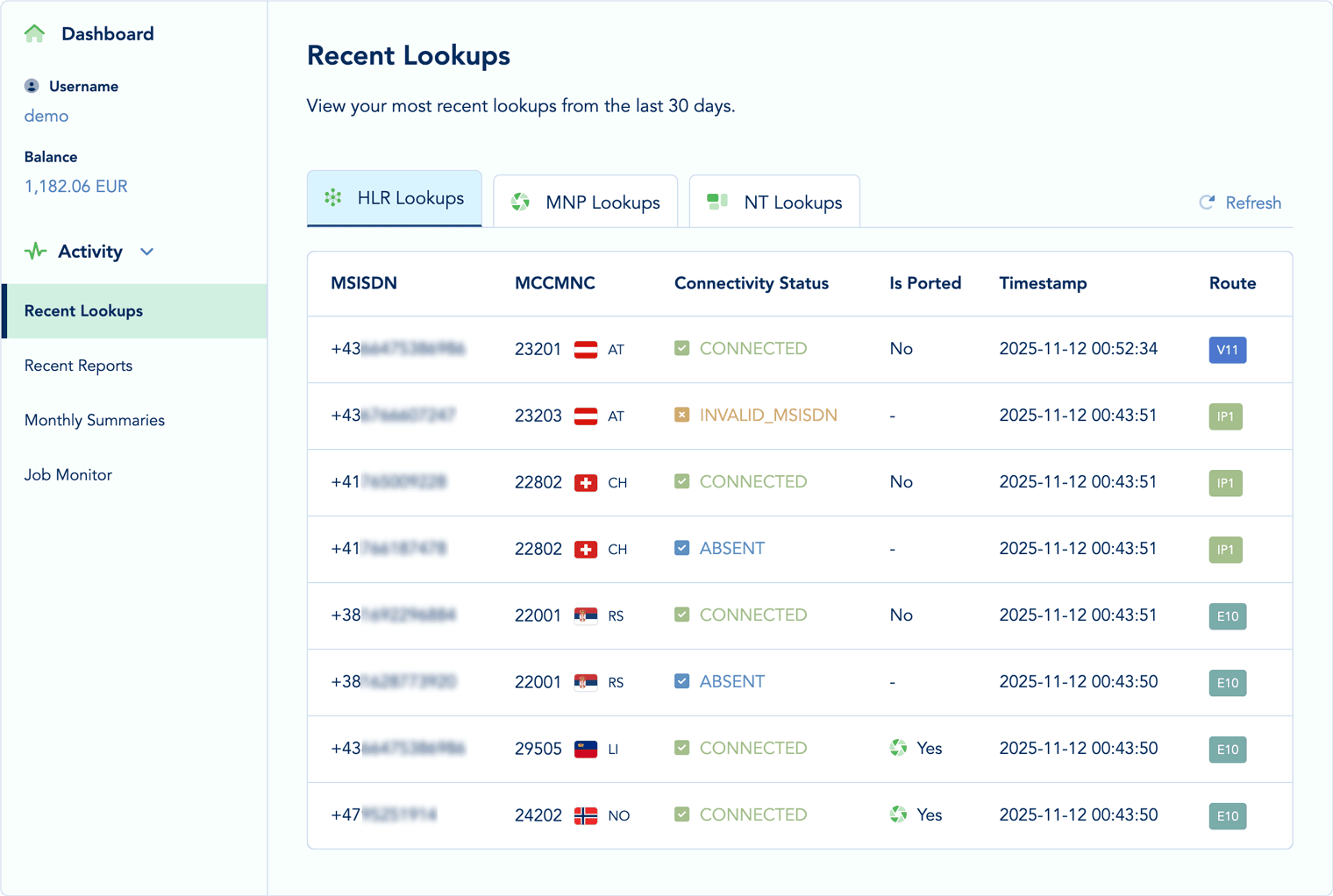
The recent lookups feed displays your most recent portability verifications in chronological order, providing immediate visibility into lookup activity across all submission methods - quick lookups, bulk processing, and API calls. Each entry shows the verified MSISDN, portability status (PORTED or NOT_PORTED), current operator identification, timestamp, and storage assignment.
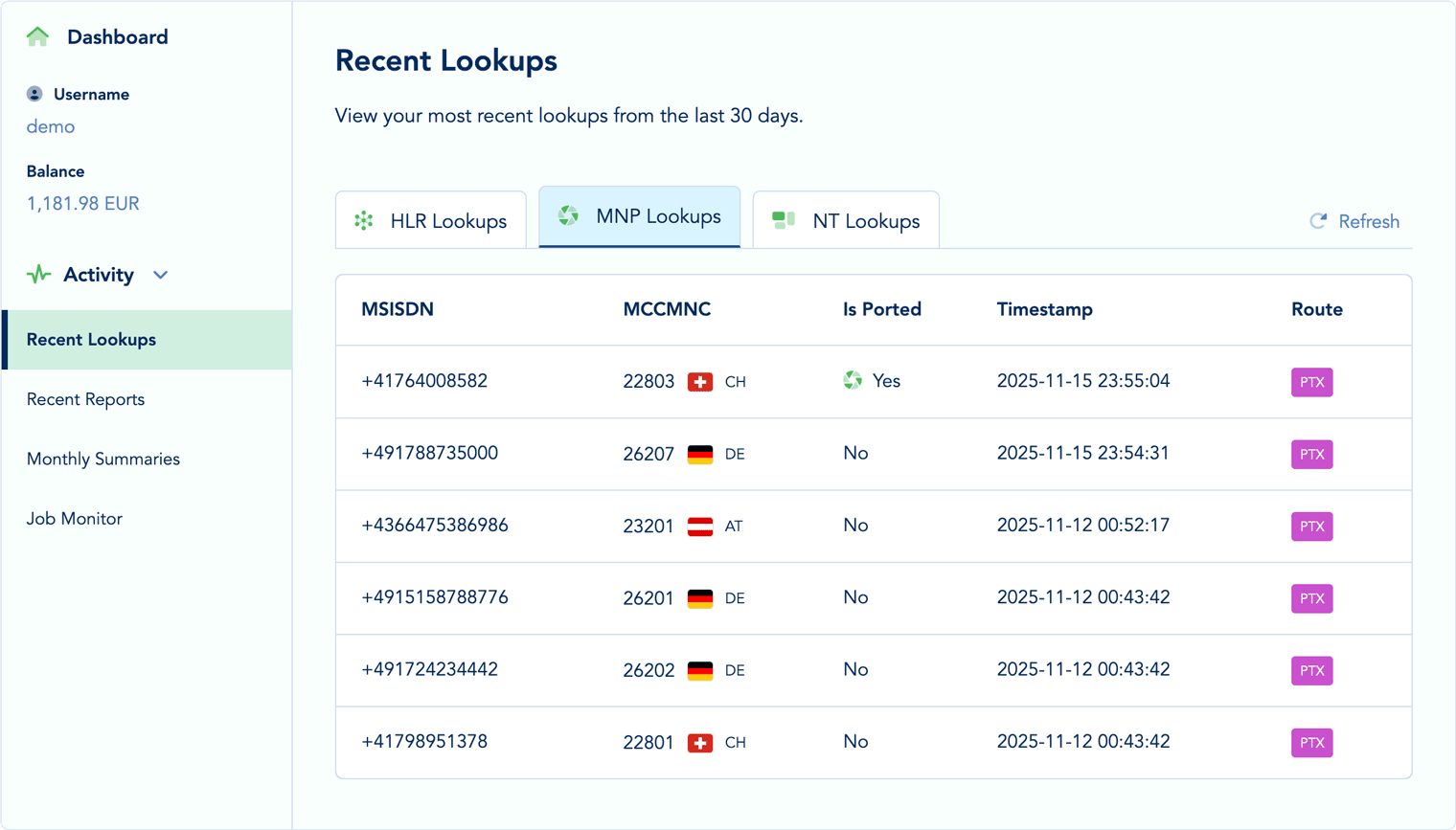
Click any lookup entry to expand detailed results including original operator information, MCCMNC codes, processing duration, and lookup metadata. The feed updates in real-time as new lookups complete, providing continuous visibility without manual refresh.
Filtering and Search
Filter the recent lookups feed by date range, portability status, operator, or storage container to focus on specific verification activity. Search functionality enables quick location of specific numbers within your lookup history, supporting customer service inquiries and audit requests.
Bulk Processing Job Monitor
The job monitor tracks all active and recent bulk processing jobs, displaying progress status, completion percentages, and estimated completion times for running jobs. Monitor multiple concurrent bulk jobs simultaneously, with visual indicators distinguishing queued, processing, completed, and failed job states.
Job Status States
Jobs progress through defined states: QUEUED (awaiting processing resources), PROCESSING (actively executing lookups), COMPLETED (finished successfully with results available), or FAILED (encountered errors requiring attention). Click any job to view detailed statistics including number counts, success rates, error breakdowns, and direct links to download results.
Progress Visualization
Running jobs display real-time progress bars showing completion percentage, numbers processed, and estimated time remaining based on current processing rate. Progress updates stream automatically without page refresh, providing continuous visibility into bulk verification status.
Reports and Exports
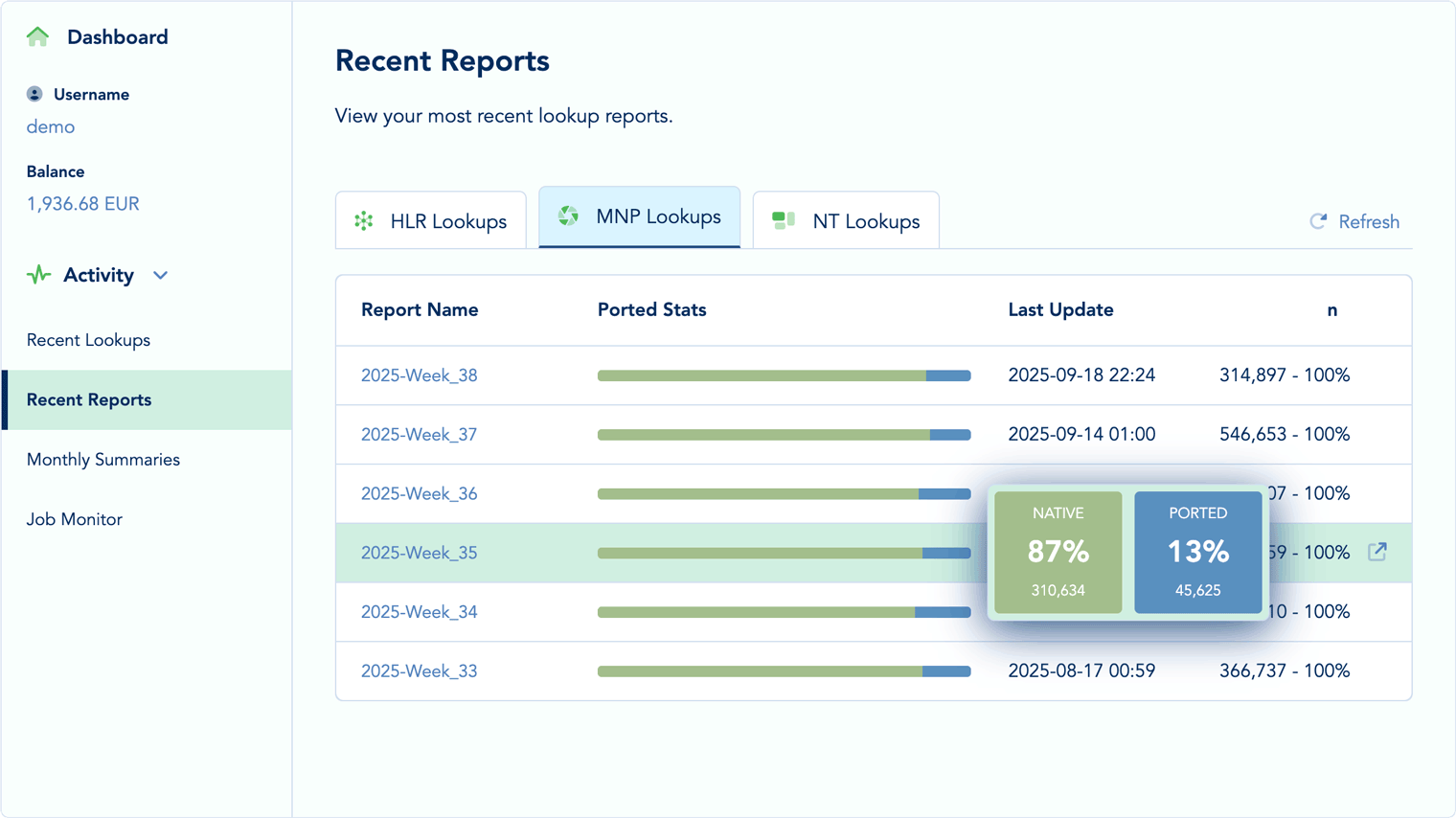
Access generated reports and export files through the reports section, providing centralized management of portability analysis outputs and data exports. Download completed bulk job results, scheduled analytics reports, and custom exports from a single interface.
Report Types
Multiple report formats are available: CSV exports for data processing and analysis, PDF summaries for management reporting, and JSON outputs for programmatic consumption. Reports include comprehensive metadata documenting generation parameters, date ranges, and filter criteria applied during creation.
Monthly Summaries
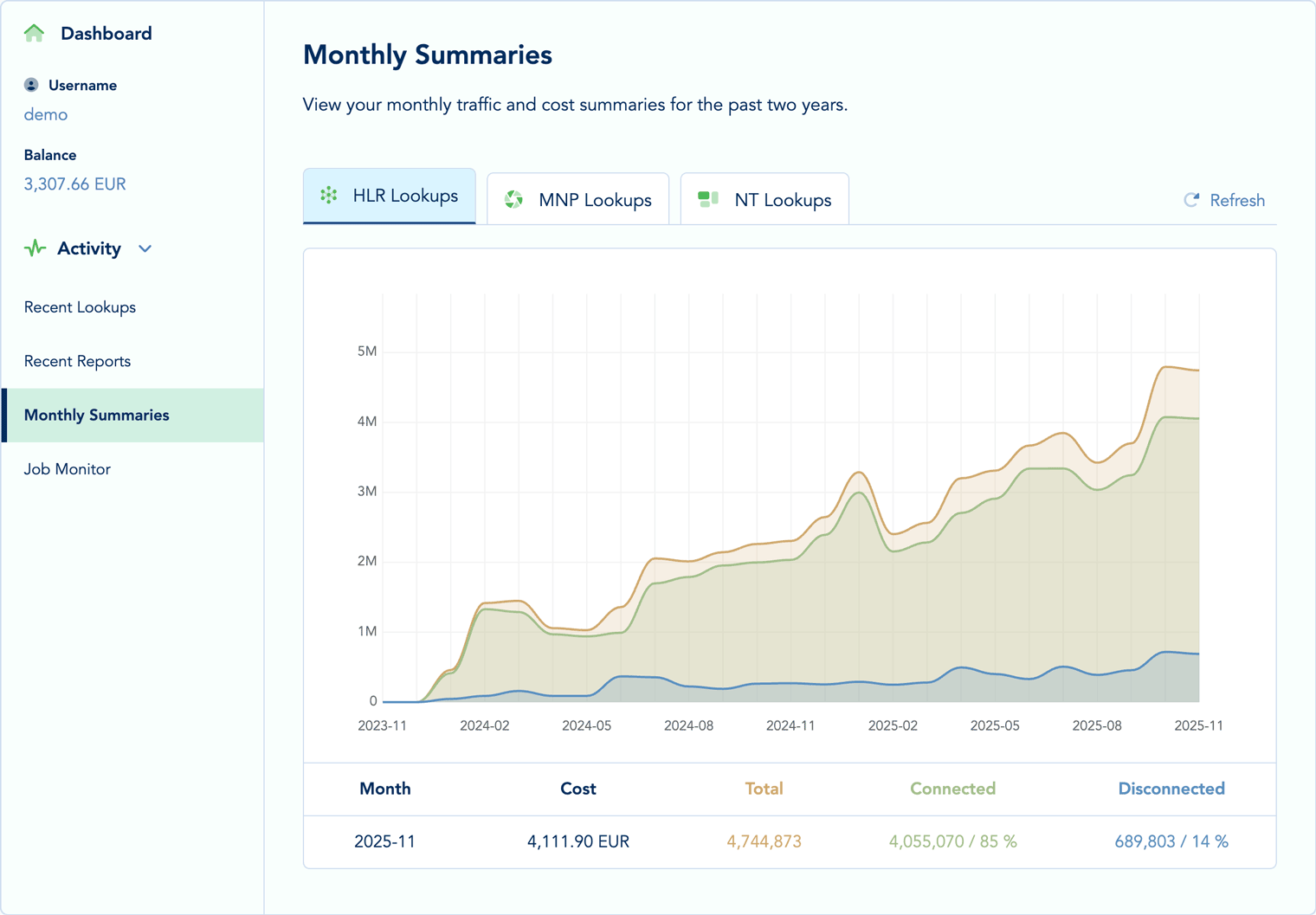
Monthly summary cards provide at-a-glance visibility into aggregate portability verification activity across billing periods. Each summary displays total lookups performed, portability rate observed, operator distribution, cost totals, and comparison against previous periods.
Trend Indicators
Visual trend indicators highlight changes from previous periods - increasing lookup volumes, shifting portability rates, or changing operator distributions. Trend analysis helps identify seasonal patterns, growth trajectories, and anomalies requiring investigation.
Account Usage Overview
The account overview section displays current balance, recent transactions, and usage statistics enabling financial monitoring and capacity planning. Monitor credit consumption against budget thresholds with configurable alerts for low balance warnings.
Usage Patterns
Visualize lookup volume patterns across time periods - hourly, daily, weekly distributions - revealing operational rhythms and peak usage periods. Usage pattern analysis supports capacity planning for API integrations and helps identify opportunities for workflow optimization.
Integration with Analytics
Dashboard data feeds directly into comprehensive analytics reports for deeper analysis of portability trends, operator distribution, and verification patterns. Navigate from Dashboard overview directly to detailed analytics views for specific time periods, operators, or storage containers. The Dashboard provides operational visibility, while Analytics delivers the deep insights for strategic decision-making and trend analysis.
Number Portability Analytics and Reports
Transform Portability Data into Actionable Business Intelligence
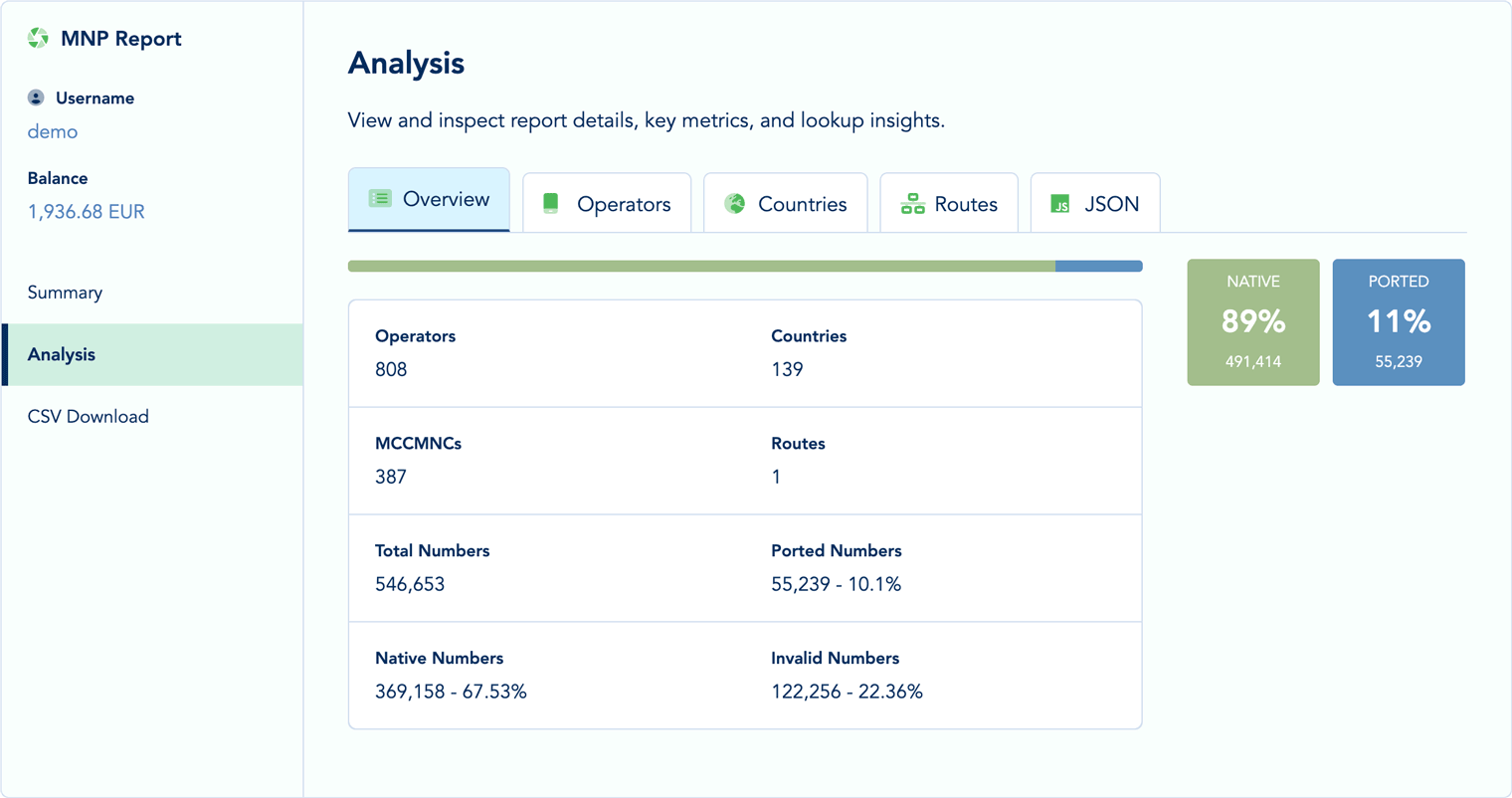
The analytics platform transforms raw portability lookup data into meaningful insights through visual dashboards, trend analysis, operator distribution charts, and customizable reports. Understand portability patterns across your verification activity, identify market trends, optimize routing strategies, and generate compliance documentation - all from comprehensive analytics built automatically from your lookup data.
Every number portability lookup is automatically indexed and aggregated into analytics pipelines, requiring no additional configuration to start gaining insights from your verification activity.
Portability Rate Analysis
Track portability rates across your verified number populations to understand what percentage of numbers have been transferred between carriers. High portability rates indicate markets where prefix-based routing assumptions are particularly unreliable, justifying increased investment in real-time portability verification.
Time-Series Trends
Visualize how portability rates change over time - daily, weekly, monthly trends reveal whether your verified number populations are becoming more or less ported. Rising portability rates may indicate increasing market churn or shifts in your customer acquisition channels toward segments with higher porting propensity.
Geographic Variations
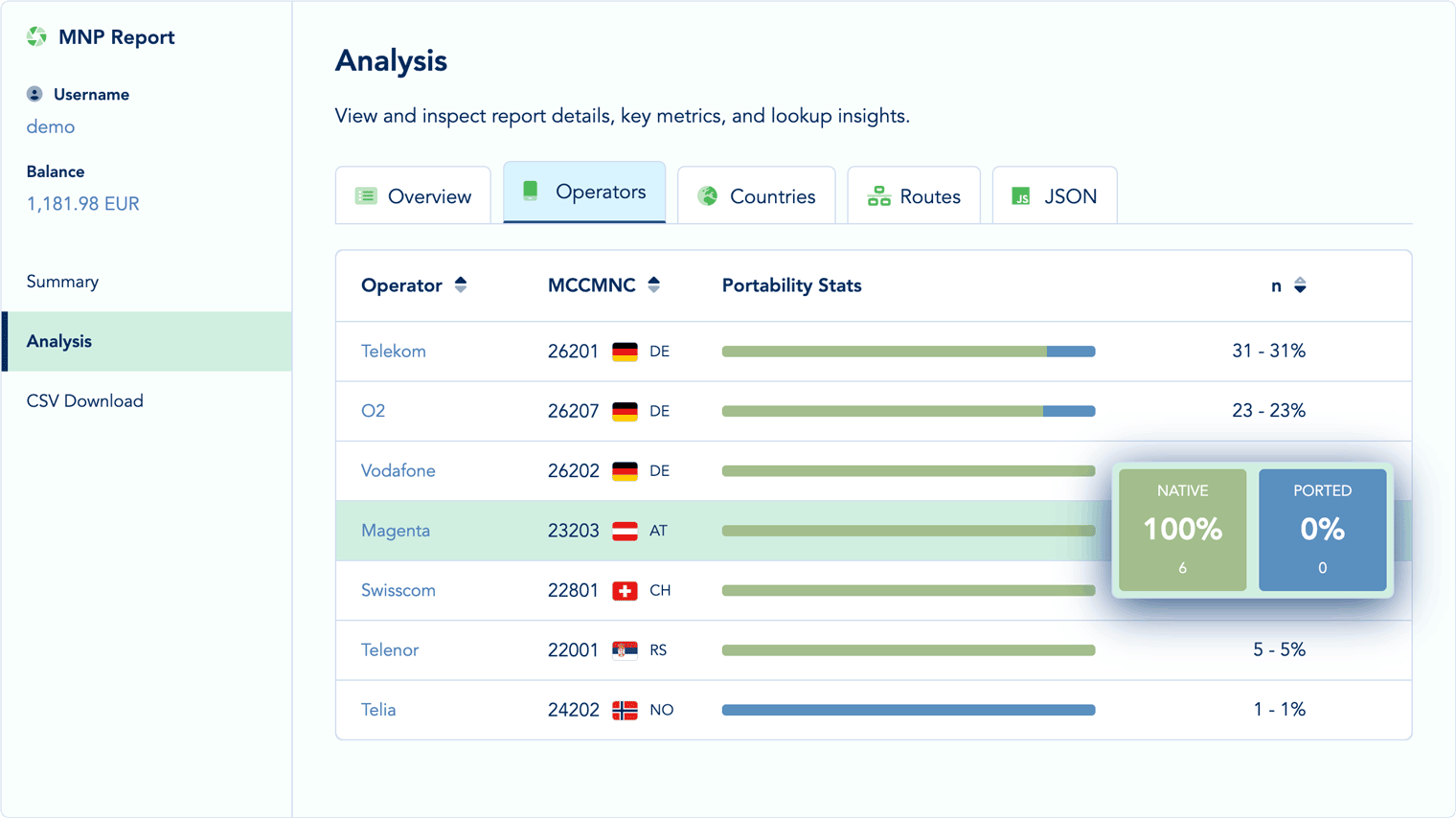
Compare portability rates across countries and regions to understand market-specific dynamics. Mature European markets typically show 30-50% portability, while newer implementations may show lower rates. Geographic analysis helps calibrate routing strategies and verification investments based on actual portability prevalence in your target markets.
Operator Distribution Analysis
Analyze how your verified numbers distribute across current serving operators, revealing market share patterns and carrier concentration within your number portfolio.
Current vs Original Operators
Compare distribution across current serving operators against original allocating operators to visualize subscriber migration patterns. Operators gaining market share through portability show higher current percentages than original allocations, while operators losing subscribers show the opposite pattern.
Porting Flow Analysis
Detailed porting flow analysis shows which original operators lost subscribers to which current operators, revealing competitive dynamics and migration patterns. Understanding porting flows helps anticipate future portability trends and optimize routing agreements with carriers experiencing subscriber growth.
Portability Deep Dive
The deep dive analysis provides granular exploration of portability patterns, enabling drill-down from aggregate statistics to individual lookup details. Filter by time period, operator, country, or storage container to focus analysis on specific segments of your verification activity.
Segment Comparison
Compare portability metrics across different segments - customer types, acquisition channels, geographic regions - to identify variations in portability patterns. Segment analysis reveals whether certain customer populations exhibit higher portability rates, informing targeted verification strategies and routing optimizations.
Storage Container Analytics
When you organize lookups into named storage containers, each container generates dedicated analytics aggregating all lookups within that grouping. Storage-based analytics enable project-specific analysis, client-level reporting, and campaign performance evaluation.
Cross-Storage Comparison
Compare portability metrics across storage containers to identify variations between projects, clients, or time periods. Cross-storage analysis helps identify which verification activities yield highest portability detection rates or reveal unusual patterns requiring investigation.
Report Generation
Generate comprehensive reports documenting portability verification activity for management review, client deliverables, regulatory compliance, and internal analysis.
Scheduled Reports
Configure automated report generation on daily, weekly, or monthly schedules. Reports are generated automatically and delivered via email or made available for download through the dashboard. Scheduled reporting ensures stakeholders receive regular updates without manual report generation effort.
Custom Report Parameters
Define custom reports with specific date ranges, operator filters, storage containers, and metric selections tailored to your reporting requirements. Save report templates for recurring generation with consistent parameters across reporting periods.
Data Export
Export portability data in multiple formats for integration with external business intelligence tools, databases, and analysis platforms.
CSV Export
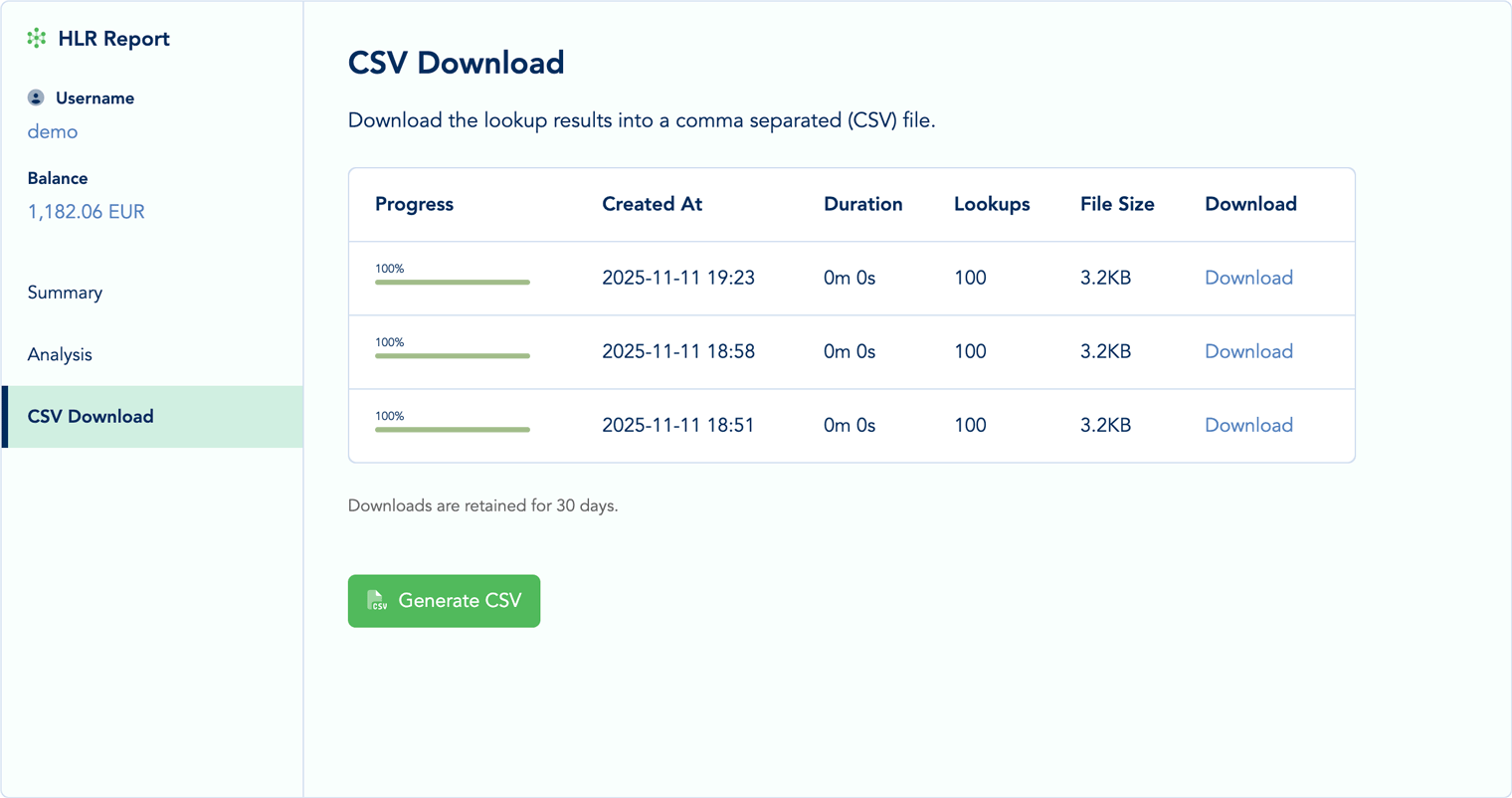
Export detailed lookup records in CSV format for spreadsheet analysis, database import, or processing with external tools. CSV exports include all data fields with consistent formatting suitable for automated processing pipelines.
JSON Export
Retrieve structured JSON data through the REST API for programmatic integration with business intelligence platforms, data warehouses, and custom analytics applications.
PDF Reports
Generate formatted PDF reports with charts, tables, and summary statistics suitable for management presentations, client deliverables, and compliance documentation.
Integration with Platform Analytics
Number portability analytics integrate with the broader platform analytics system, enabling unified reporting across portability lookups, HLR lookups, and other verification services. Unified analytics provide comprehensive visibility into all mobile number verification activity, supporting holistic operational monitoring and business intelligence.
Number Portability API Integration
Programmatic Access to Portability Verification Services
Integrate number portability lookup directly into your applications using our REST API, enabling automated verification during call routing, SMS delivery decisions, customer registration, and any workflow requiring programmatic carrier identification. Our API provides both synchronous endpoints for real-time verification and asynchronous endpoints for bulk processing, supporting diverse integration patterns and volume requirements.
Comprehensive API documentation provides detailed specifications, code examples, authentication guidance, and integration patterns for common use cases.
API Endpoints
Synchronous Lookup
The synchronous endpoint accepts individual MSISDNs and returns portability results in real-time, typically within 50-500 milliseconds. Ideal for call setup workflows, interactive verification scenarios, and any use case requiring immediate carrier identification before proceeding.
Request format accepts the mobile number and optional parameters for storage assignment and callback URLs. Response includes complete portability data: current operator, original operator, portability status, MCCMNC codes, and lookup metadata.
Asynchronous Bulk Submission
The asynchronous endpoint accepts arrays of MSISDNs or file uploads for batch processing, returning a job identifier for status polling and result retrieval. Suitable for database validation, routing table updates, and high-volume verification where processing time is less critical than throughput.
Submit bulk jobs via API, poll status endpoints for progress updates, and retrieve results through dedicated download endpoints or webhook callbacks upon completion.
Authentication
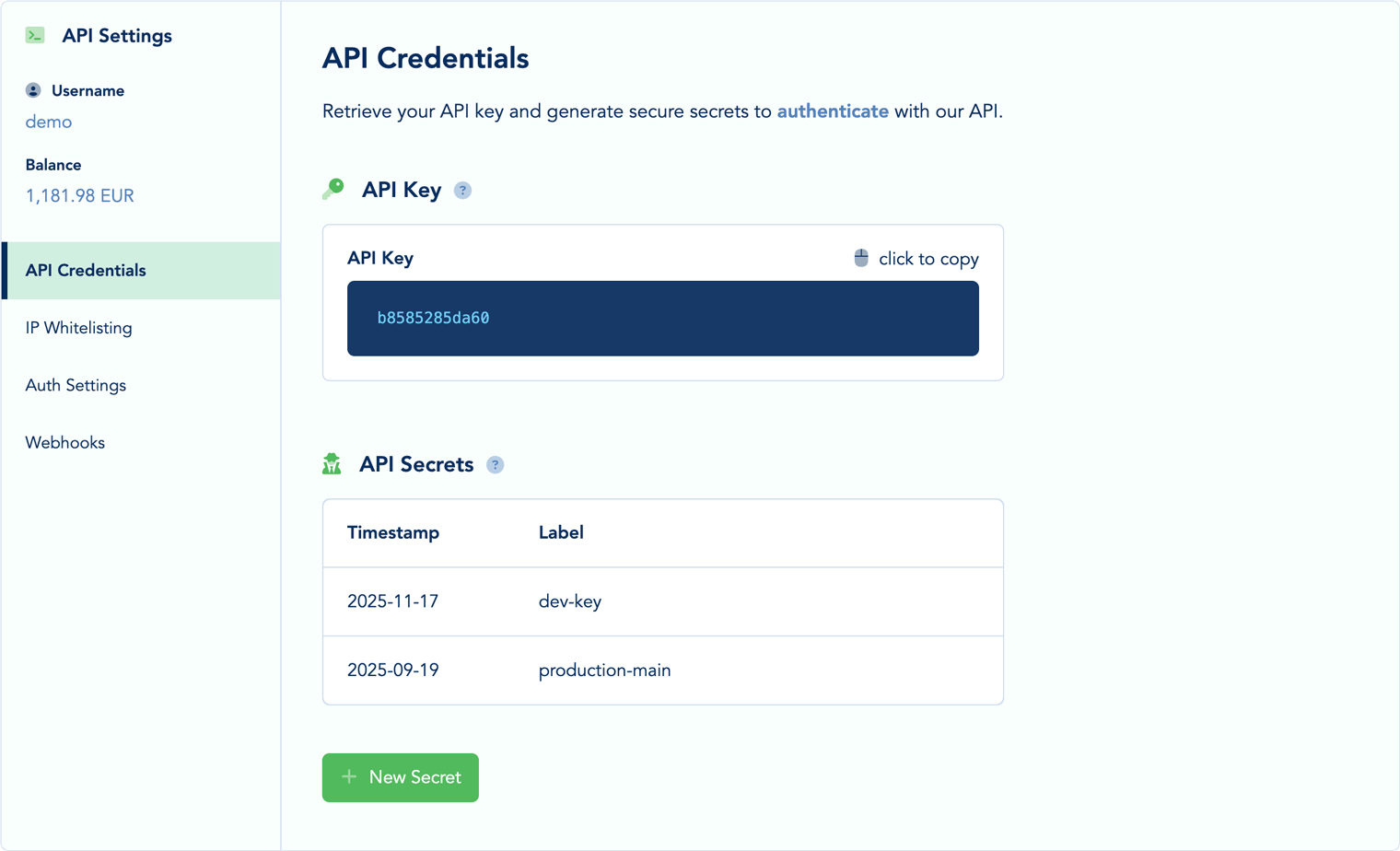
API access requires authentication using API credentials generated through your account settings. Each request must include valid authentication headers - either API key authentication for simple integrations or OAuth tokens for advanced security requirements.
API Key Authentication
The simplest authentication method: include your API key in the request header. Generate API keys through the account settings interface, with options for key rotation and access restriction. API keys can be scoped to specific capabilities (read-only vs full access) and IP address ranges for security hardening.
IP Whitelisting
Enhance security by restricting API access to specific IP addresses or ranges. Only requests originating from whitelisted IPs will be accepted, preventing unauthorized access even if credentials are compromised. Configure IP whitelists through the account settings interface, supporting individual addresses, CIDR ranges, and multiple entries for distributed systems.
Response Format
All API responses use JSON format with consistent structure across endpoints. Successful lookups return portability data in standardized fields; errors return descriptive codes and messages for troubleshooting.
200 OK
{
   "id":"e428acb1c0ae",
   "msisdn":"+14156226819",
   "query_status":"OK",
   "mccmnc":"310260",
   "mcc":"310",
   "mnc":"260",
   "is_ported":true,
   "original_network_name":"Verizon Wireless:6006 - SVR/2",
   "original_country_name":"United States",
   "original_country_code":"US",
   "original_country_prefix":"+1415",
   "ported_network_name":"T-Mobile US:6529 - SVR/2",
   "ported_country_name":"United States",
   "ported_country_code":"US",
   "ported_country_prefix":"+1",
   "extra":"LRN:4154250000",
   "cost":"0.0050",
   "timestamp":"2020-08-05 21:21:33.490+0300",
   "storage":"API-MNP-2025-01",
   "route":"PTX",
   "error_code":null
}
Error Handling
Error responses include HTTP status codes, error codes for programmatic handling, and human-readable messages explaining the issue. Common errors include authentication failures (401), invalid number formats (400), rate limit exceeded (429), and insufficient credits (402). Implement appropriate retry logic for transient errors (5xx status codes) and graceful degradation for persistent failures.
Developer SDKs
Accelerate integration with native SDKs for popular programming languages, providing pre-built functions that handle authentication, request serialization, response parsing, and error management.
Available SDKs
Official SDKs are available for PHP, Node.js, Python, and other languages. Each SDK provides idiomatic interfaces matching language conventions while abstracting API complexity. Install SDKs via standard package managers (Composer for PHP, npm for Node.js, pip for Python), configure your API credentials, and start performing lookups with minimal code.
 PHP
PHP
 NodeJS
 Ruby
Ruby
1   include('HLRLookupClient.class.php');
2
3   $client = new HLRLookupClient(
4       'YOUR-API-KEY',
5       'YOUR-API-SECRET',
6       '/var/log/hlr-lookups.log'
7   );
8
9   $params = array('msisdn' => '+14156226819');
10 $response = $client->post('/hlr-lookup', $params);NodeJS SDK
Instant API Integration for NodeJS1 require('node-hlr-client');
2
3 let response = await client.post('/hlr-lookup', {msisdn: '+491788735000'});
4
5 if (response.status === 200) {
6 // lookup was successful
7 let data = response.data;
8 }Ruby SDK
Instant API Integration for Ruby1 require 'ruby_hlr_client/client'
2
3 client = HlrLookupsSDK::Client.new(
4 'YOUR-API-KEY',
5 'YOUR-API-SECRET',
6 '/var/log/hlr-lookups.log'
7 )
8
9 params = { :msisdn => '+14156226819' }
10 response = client.get('/hlr-lookup', params)SDK Features
SDKs handle common integration concerns automatically: connection pooling for performance, automatic retry with exponential backoff for transient failures, request timeout management, and response validation. Built-in logging and debugging capabilities help troubleshoot integration issues during development and monitor production behavior.
Rate Limits and Quotas
API access is subject to rate limits that vary by account tier. Standard accounts support hundreds of requests per second; enterprise accounts can access higher limits based on contracted volumes. Rate limit headers in API responses indicate current usage and remaining capacity, enabling clients to implement intelligent throttling.
Quota Management
Monitor API usage through the dashboard or programmatically via the account API endpoints. Configure alerts for approaching quota limits to prevent service interruption. Pre-purchase lookup credits to ensure sufficient balance for planned verification volumes, or enable automatic top-up for uninterrupted service.
API Logs and Monitoring
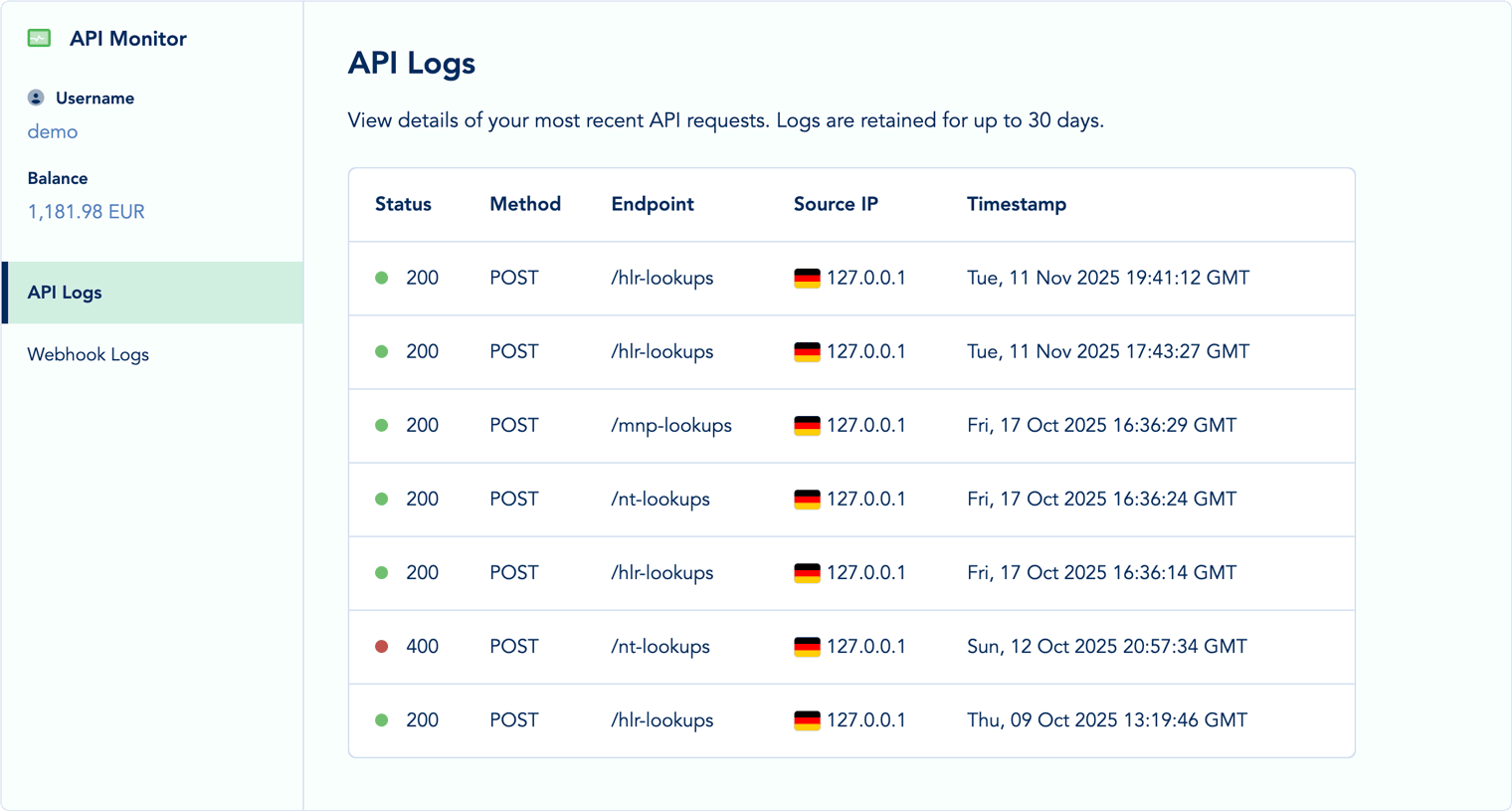
All API requests are logged with detailed metadata including timestamps, response times, status codes, and client identification. Access API logs through the dashboard for debugging, audit compliance, and usage analysis.
Debugging Support
Log entries include request payloads and response bodies (with sensitive data redacted), enabling detailed debugging of integration issues without reproducing problems in production. Filter logs by time range, endpoint, status code, or client IP to isolate specific issues or analyze patterns.
Webhooks and Callbacks
Configure webhook endpoints to receive notifications when asynchronous operations complete, eliminating the need for polling. Webhooks deliver JSON payloads to your specified URLs upon bulk job completion, enabling event-driven architectures that respond immediately to results availability.
Webhook Security
Webhook payloads include cryptographic signatures for authenticity verification, preventing spoofed notifications from unauthorized sources. Implement signature validation in your webhook handlers to ensure notifications originate from our platform before processing.
Integration Best Practices
Caching Strategies
Portability status changes infrequently - most numbers maintain their current operator for months or years. Implement client-side caching to reduce redundant lookups for recently verified numbers. Cache duration should balance freshness requirements against cost savings. A 24-hour cache catches most repeat queries while maintaining acceptable accuracy for typical use cases.
Graceful Degradation
Design integrations to handle API unavailability gracefully. When portability lookup fails, fall back to prefix-based routing or queue messages for retry rather than blocking operations entirely. Implement circuit breakers that temporarily bypass portability verification during extended outages, restoring normal operation when service recovers.
Batch Optimization
For high-volume applications, batch multiple lookups into single API calls where possible. Bulk endpoints process batched requests more efficiently than individual calls, reducing latency and cost. Balance batch size against latency requirements - larger batches are more efficient but increase response time for the first result.
Number Portability Lookup Business Applications
Real-World Use Cases for Carrier Identification and Routing Optimization
Number portability lookup delivers measurable business value across telecommunications, marketing, financial services, and technology industries. By providing accurate current carrier identification regardless of number prefix patterns, portability verification enables cost optimization, delivery improvement, fraud detection, and operational efficiency.
Below are detailed examples of how organizations leverage number portability lookup to solve critical business challenges.
VoIP Providers and Least-Cost Routing
The Challenge: Prefix-Based Routing Fails in Ported Markets
VoIP termination costs vary dramatically based on destination network operator - interconnection rates to premium carriers may be 3-5x higher than economy operators, while bilateral agreements offer preferential pricing for specific carrier relationships. Traditional routing systems based on number prefix patterns fail in markets with substantial portability adoption. A number originally allocated to low-cost Carrier A might now be served by premium Carrier B after porting, causing routing decisions to miss cost optimization opportunities. In mature European markets where 30-50% of mobile numbers have been ported, prefix-based routing becomes essentially random for cost optimization, resulting in 15-30% routing inefficiency and corresponding margin erosion.
Portability-Driven Intelligent Routing
Query portability status immediately before call initiation to determine the current network operator with certainty. Use accurate MCCMNC data to dynamically select the most cost-effective termination route for each specific carrier from your routing table. Detect portability status to route calls to current serving networks rather than original number allocations, ensuring optimal path selection regardless of number history.
Measurable Cost Savings
VoIP providers implementing portability-driven routing achieve cost reductions of 10-30% on mobile termination through accurate least-cost routing that reflects actual network destinations. Improved call completion rates emerge from routing to correct networks - calls misrouted due to portability assumptions generate failures, while verified routing ensures first-attempt success. Competitive advantage materializes through ability to offer lower per-minute rates while maintaining profitability, capturing market share from competitors relying on static routing tables.
SMS Aggregators and Delivery Optimization
The Challenge: Carrier-Specific Delivery Requirements
SMS delivery success depends on routing messages through correct carrier channels. Some carriers require specific sender ID formats, support different character encodings, or impose varying rate limits based on origination. Ported numbers complicate carrier-specific handling - a number that appears to belong to Carrier A based on prefix may actually require Carrier B's delivery channel after porting. Incorrect carrier assumptions cause delivery failures, encoding errors, and sender ID rejections that degrade campaign performance and harm sender reputation.
Portability-Aware Message Routing
Verify current carrier before message submission to ensure correct channel selection, sender ID configuration, and encoding parameters. Route messages through carrier-specific SMSC connections that match the actual serving network, not prefix-based assumptions. Apply carrier-specific business rules (rate limits, character sets, concatenation handling) based on verified current operator.
Delivery Rate Improvements
SMS platforms implementing portability verification achieve delivery rate improvements of 5-15% through correct carrier routing, eliminating failures from mismatched channels and configurations. Reduced delivery latency as messages route directly to correct carriers rather than traversing incorrect networks that must redirect traffic. Improved sender reputation with carriers as message rejection rates decline, supporting sustained delivery performance and preferential routing treatment.
Telecommunications Billing and Interconnection
The Challenge: Accurate Traffic Attribution
Telecommunications interconnection billing requires accurate attribution of traffic to destination carriers. Billing errors from incorrect carrier identification cause revenue leakage, dispute resolution overhead, and strained carrier relationships. Ported numbers create attribution complexity - traffic to ported numbers must be billed to current serving carriers, not original allocating networks indicated by number prefixes.
Portability-Based Billing Accuracy
Use portability lookup to determine exact destination carrier with MCCMNC precision for interconnection billing, ensuring traffic attributes to correct operators. Verify carrier assignments before generating interconnection invoices, eliminating billing disputes from ported number misattribution. Maintain audit trails documenting carrier verification for each billable transaction, supporting dispute resolution and regulatory compliance.
Revenue Protection
More accurate interconnection billing reduces revenue leakage by 5-15% through elimination of misattributed traffic and improved settlement accuracy. Faster dispute resolution as carrier assignments are verifiable rather than debatable, reducing administrative overhead and maintaining positive carrier relationships.
Marketing Database Quality
The Challenge: Stale Carrier Information
Marketing databases accumulate outdated carrier information as subscribers port numbers over time. Network segmentation based on stale data produces incorrect targeting, inefficient routing, and missed optimization opportunities. Carrier-specific campaign strategies (timing optimization, content localization, channel selection) fail when underlying carrier data no longer reflects reality.
Systematic Carrier Data Validation
Periodically validate carrier assignments across marketing databases using bulk portability lookup to identify and correct stale data. Update CRM records with current carrier information, enabling accurate network-based segmentation and carrier-specific strategy execution. Track carrier changes over time to understand subscriber migration patterns and anticipate future porting trends affecting your customer base.
Database Quality Improvements
Marketing teams implementing systematic portability validation achieve database accuracy improvements of 15-30% for carrier attribution, enabling confident execution of carrier-specific strategies. Campaign performance improves through accurate targeting and optimized routing based on verified carrier data rather than outdated assumptions.
Fraud Detection and Risk Assessment
The Challenge: Anomalous Porting Patterns
Fraudsters exploit number portability for various schemes: SIM swap attacks leverage unauthorized porting to intercept authentication codes, while number parking schemes use rapid porting between carriers to evade detection or exploit promotional offers. Traditional fraud detection systems may not incorporate portability signals, missing valuable indicators of suspicious activity.
Portability-Enhanced Fraud Signals
Monitor portability status during sensitive transactions - recent porting events may indicate elevated fraud risk warranting additional verification. Track porting frequency patterns to identify numbers exhibiting suspicious behavior such as rapid carrier changes or unusual migration paths. Correlate porting events with transaction patterns to detect potential SIM swap attacks or account takeover attempts.
Risk Mitigation Benefits
Financial institutions implementing portability-based fraud signals report improved detection rates for SIM swap attacks and unauthorized account access attempts. Early warning from porting status changes enables proactive security measures before fraud materializes, reducing losses and protecting customer accounts.
Customer Service and Support
The Challenge: Carrier Information for Troubleshooting
Customer service teams troubleshooting communication issues need accurate carrier information to diagnose problems. Delivery failures, call quality issues, and billing questions often require understanding which carrier serves a customer's number. Relying on customers to provide carrier information is unreliable - many subscribers don't know their current carrier after porting, and prefix-based assumptions are frequently incorrect.
Instant Carrier Verification
Use Quick Lookup to instantly verify current carrier during support interactions, enabling accurate troubleshooting without relying on customer knowledge. Confirm carrier assignments for billing disputes, identify routing issues affecting specific carriers, and validate customer-reported information.
Support Efficiency Gains
Support teams implementing portability verification reduce troubleshooting time and improve first-contact resolution by eliminating carrier ambiguity from diagnostic processes. Accurate carrier information enables targeted escalation to correct carrier technical contacts when inter-carrier issues require resolution.
Regulatory Compliance and Reporting
The Challenge: Portability Documentation Requirements
Telecommunications regulators in many jurisdictions require operators to maintain accurate records of number portability, report porting volumes, and demonstrate compliance with portability regulations. Manual compliance processes relying on periodic snapshots miss dynamic portability changes and create documentation gaps.
Automated Compliance Data Collection
Use portability lookup to maintain continuously updated carrier records for regulatory reporting, creating audit trails documenting verification activities. Generate compliance reports showing portability verification volumes, accuracy metrics, and trend analysis for regulatory submissions. Document carrier assignments at transaction time for billing compliance and dispute resolution support.
Compliance Assurance
Simplified regulatory compliance through automated data capture eliminates manual reporting errors and reduces compliance overhead by 40-60%. Verifiable audit trails demonstrate systematic compliance efforts, satisfying regulatory oversight and reducing finding risk during audits.
Getting Started
Every portability implementation begins with understanding your specific requirements - lookup volumes, latency constraints, integration preferences, and accuracy thresholds. Our platform provides flexible access options from simple Quick Lookup web interface for exploratory verification to sophisticated API integrations for production-scale automation.
Start with pilot campaigns to validate that portability data delivers the routing optimization, delivery improvement, or fraud detection signals your application needs. Contact our team to discuss how number portability lookup can address your specific business requirements.

