

Mobile Network Detection
Mobile Network Detection Platform
Identify Which Carrier Serves Any Phone Number
Mobile network detection identifies which carrier currently serves any mobile phone number, providing the network intelligence businesses need for routing optimization, billing accuracy, and fraud prevention. Whether you're routing voice calls, delivering SMS messages, or analyzing customer demographics, knowing the actual serving network enables smarter business decisions.
Our mobile network detection platform combines multiple detection technologies to accurately identify network operators worldwide, delivering carrier information through intuitive interfaces and powerful APIs.
The Network Identification Challenge
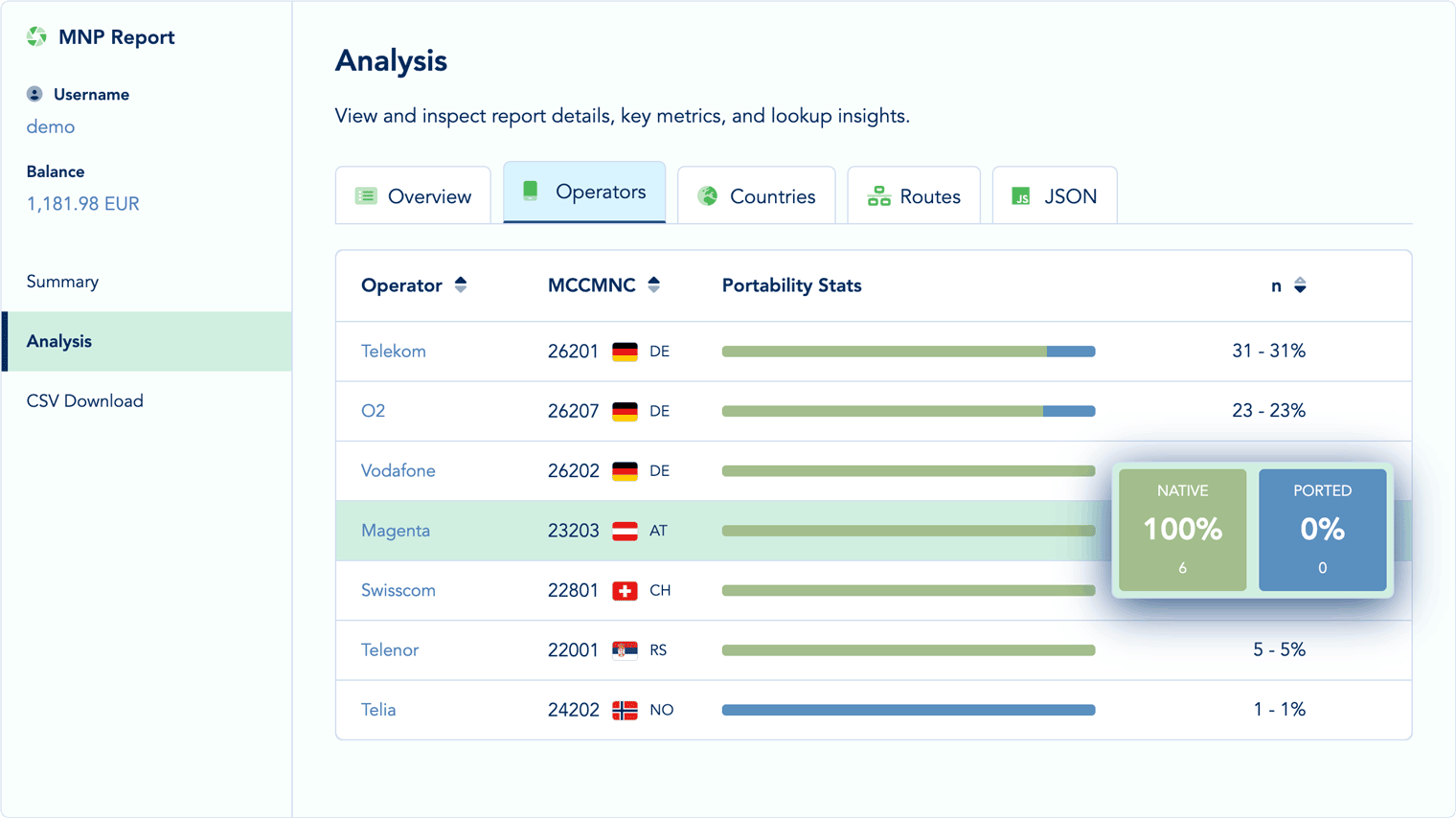
Mobile phone numbers don't reveal which network actually serves the subscriber. Number prefixes that once indicated specific carriers have become unreliable as subscribers port between networks while keeping their numbers. In markets with high portability rates, 30-50% of mobile numbers are no longer served by the network that originally issued them.
This creates significant challenges for businesses that depend on accurate carrier information:
VoIP providers routing calls based on number prefixes send traffic to the wrong networks, paying premium termination rates when cheaper routes exist. Each incorrectly routed call represents unnecessary cost that compounds across millions of connections.
SMS aggregators delivering messages without network verification experience higher failure rates on ported numbers, damaging delivery metrics and customer relationships. Messages routed through incorrect network paths may be delayed, filtered, or rejected entirely.
Billing systems attributing interconnection costs to original carriers rather than current serving networks accumulate accounting errors that complicate reconciliation and partner relationships.
What Mobile Network Detection Provides
Mobile network detection transforms uncertain carrier assumptions into verified network intelligence, providing definitive answers about which operator serves each subscriber.
Current Network Operator
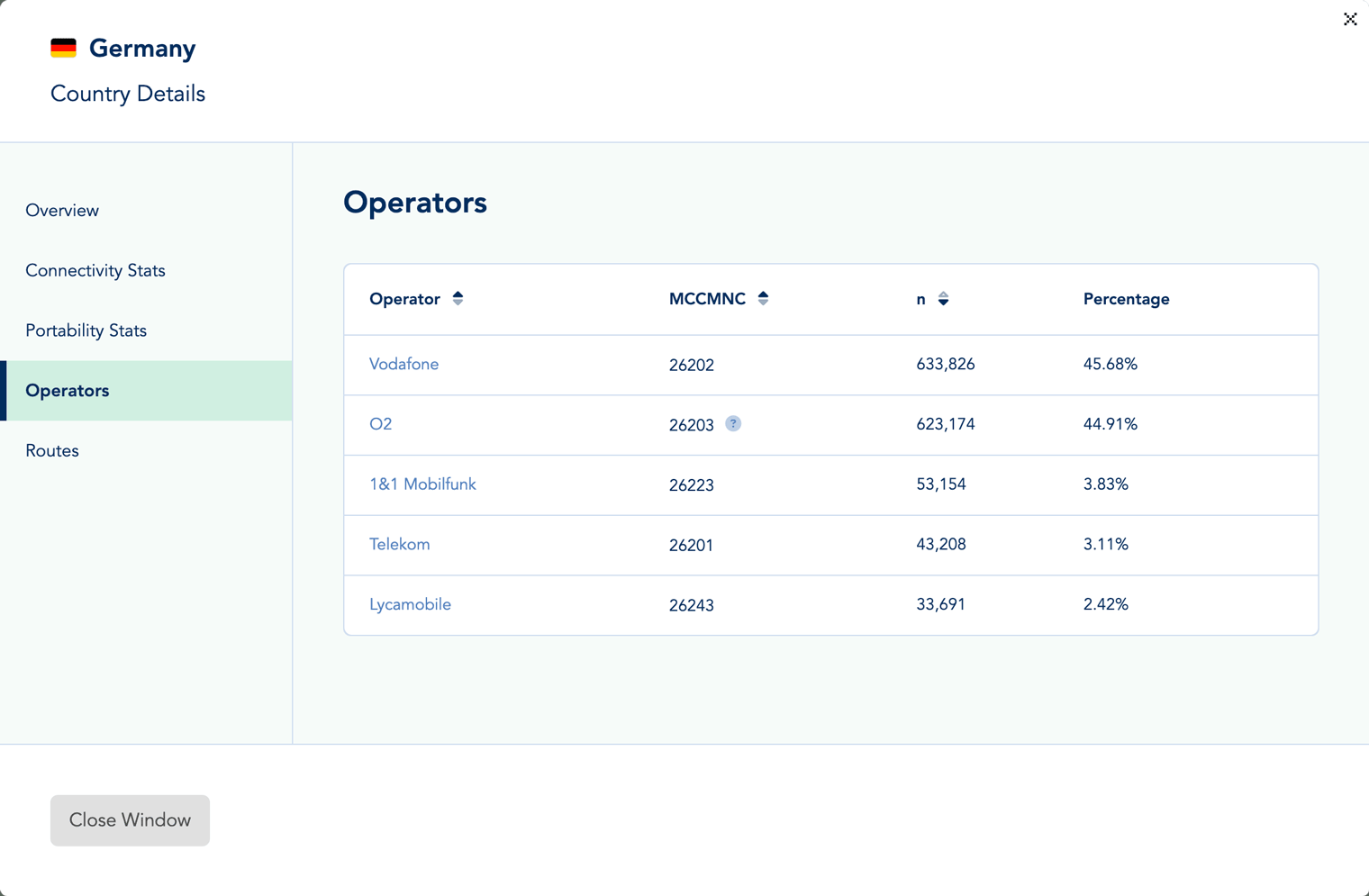
Identify the mobile network operator currently serving any phone number, regardless of which carrier originally issued it. Detection returns the operator's commercial name, country, and standardized MCCMNC code for automated routing decisions.
MCCMNC Identification
Receive standardized Mobile Country Code (MCC) and Mobile Network Code (MNC) combinations that uniquely identify network operators worldwide. MCCMNC codes enable automated integration with routing tables, billing systems, and carrier databases without ambiguous name matching.
Portability Detection
Determine whether phone numbers have been ported between carriers by comparing current serving network against original allocation. Portability detection through number portability lookup reveals porting history that impacts routing and billing decisions.
Network Coverage Intelligence
Access detection capabilities across global network coverage spanning hundreds of mobile operators in countries worldwide. Our detection infrastructure maintains connections to carrier networks globally, ensuring accurate identification regardless of subscriber location.
Unified Detection Platform
Our mobile network detection platform integrates multiple detection technologies through a single interface, providing accurate carrier identification regardless of the underlying data source.
Real-Time HLR Detection
Query mobile network operators directly through HLR Lookup to identify which network currently serves each subscriber. HLR-based detection provides the most current information available - direct confirmation from carrier infrastructure at the moment of query.
MNP Database Detection
Access national MNP databases that track number portability events to identify current serving carriers. Database-based detection offers faster response times and lower costs for high-volume identification where real-time status isn't critical.
Intelligent Method Selection
Our platform automatically selects the optimal detection method based on your requirements, balancing accuracy, speed, and cost for each use case. Explore detection methods to understand the characteristics of each approach.
Detection Access Methods
Access mobile network detection capabilities through multiple interfaces optimized for different use cases:
Quick Detection Interface
Identify network operators for individual phone numbers instantly through our web interface. Perfect for customer service agents, support teams, and ad-hoc carrier verification needs.
Bulk Detection
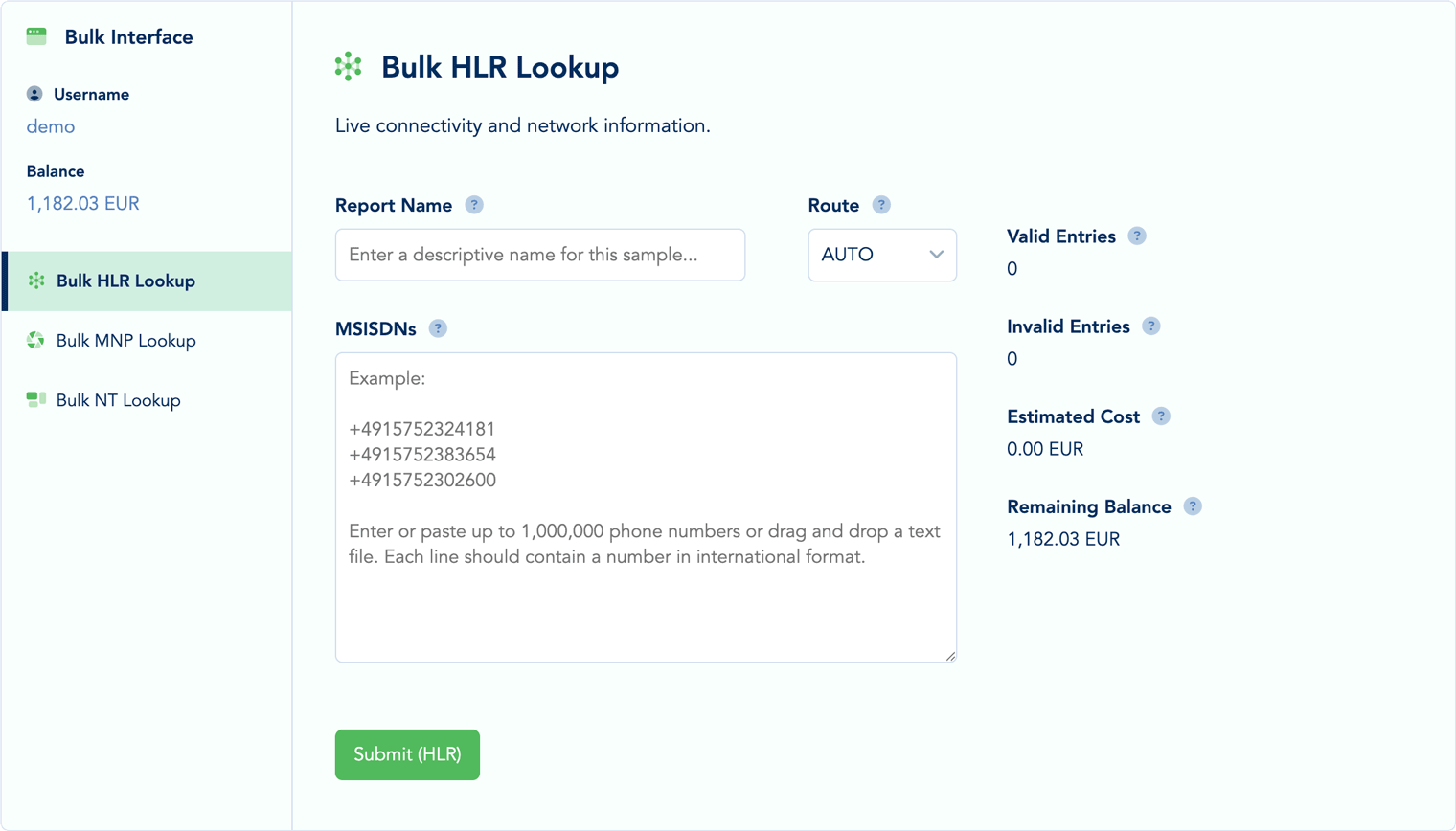
Upload files containing thousands or millions of phone numbers for batch network detection. Essential for database enrichment, routing table updates, and carrier segmentation projects.
Network Intelligence API
Integrate mobile network detection directly into your applications using our REST API. Enable automated routing decisions, real-time billing attribution, and programmatic carrier identification. Comprehensive API documentation and SDKs accelerate integration.
Analytics and Reporting
Every network detection is automatically logged and aggregated into comprehensive analytics reports. Monitor detection activity through real-time dashboards, analyze network distribution across your contact base, and generate reports documenting carrier composition for business intelligence.
Explore the detailed sections on this page to discover the full capabilities of our mobile network detection platform, including business justification, detection methods, integration options, and real-world applications.
Why Detect Mobile Networks
The Business Case for Network Intelligence
Mobile network detection isn't just a technical capability - it's a strategic business tool that directly impacts cost efficiency, operational accuracy, and competitive advantage. Organizations that leverage network intelligence report measurable improvements in routing costs, delivery rates, billing accuracy, and fraud prevention.
Understanding the specific business impacts of carrier identification helps justify investment and optimize implementation strategies across your operations.
Routing Optimization and Cost Reduction
The Least-Cost Routing Imperative
Telecommunications costs vary dramatically by destination carrier. Termination rates to different mobile networks can differ by 50-200% even within the same country. Without accurate carrier identification, routing systems rely on number prefixes that no longer reflect actual serving networks, systematically selecting suboptimal - and more expensive - termination paths.
VoIP providers processing millions of call minutes annually lose substantial revenue to routing inefficiency. If 30% of numbers are ported and half of those route through premium paths instead of least-cost alternatives, the accumulated waste compounds to significant financial impact.
Quantifiable Routing Savings
Mobile network detection enables true least-cost routing by identifying actual serving carriers before route selection. Organizations implementing carrier-aware routing typically report 10-25% reduction in termination costs, with higher savings in markets with high portability rates.
The ROI calculation is straightforward: compare detection costs against routing savings. For most high-volume operators, network detection pays for itself many times over through optimized carrier selection.
Billing Accuracy and Revenue Assurance
The Carrier Attribution Problem
Billing systems that attribute interconnection costs based on number prefixes rather than actual carriers accumulate systematic errors. When 30% of numbers have ported to different networks, 30% of your carrier cost attribution may be incorrect - creating reconciliation problems with partners and potential disputes over settlement amounts.
Accurate Carrier-Specific Billing
Network detection provides the carrier identification data that billing systems need for accurate cost attribution and customer invoicing. Carrier-accurate billing eliminates reconciliation disputes, improves partner relationships, and ensures customers are charged correctly based on actual termination costs.
Delivery Optimization
Network-Aware Message Routing
SMS delivery rates vary by carrier. Some networks have stricter filtering, others have capacity constraints, and interconnection quality differs across termination partners. Network detection enables carrier-specific routing strategies that maximize delivery by selecting optimal paths for each destination network.
Carrier-Specific Formatting
Different carriers may require different sender IDs, support different character encodings, or have varying requirements for message content. Identifying the serving network before message submission enables carrier-specific formatting that improves delivery success and message rendering.
Fraud Detection and Risk Assessment
Network Patterns as Fraud Signals
Fraudsters often exhibit distinctive network patterns: concentration on specific carriers, numbers from networks associated with virtual operators, or geographic mismatches between claimed location and carrier registration. Mobile network detection provides carrier data that enriches fraud scoring models, enabling network-aware risk assessment.
MVNO and Virtual Carrier Detection
Mobile Virtual Network Operators (MVNOs) and virtual carriers may have different risk profiles than traditional MNOs. Detection identifies not just the host network but often the specific MVNO, enabling risk models that distinguish between carrier types.
Geographic Consistency Verification
When users claim one location but their phone number is registered to a carrier in a different region, network detection reveals this inconsistency as a potential fraud indicator. Combined with phone number verification, network data strengthens fraud prevention workflows.
Marketing Segmentation
Carrier Demographics
Different mobile carriers serve different demographic segments. Premium carriers may correlate with higher income brackets, while budget MVNOs attract price-sensitive customers. Network detection enables carrier-based segmentation that enriches customer profiles with implicit demographic signals.
Campaign Targeting
Marketing campaigns can be optimized based on carrier distribution, targeting specific networks or excluding others based on historical response patterns. Carrier data helps segment audiences beyond explicit demographics, adding behavioral and economic signals inferred from network choice.
Regulatory Compliance
Interconnection Reporting
Regulatory frameworks often require accurate reporting of traffic volumes and termination patterns by carrier. Mobile network detection provides the carrier attribution data needed for compliant interconnection reporting and regulatory submissions.
Data Accuracy Requirements
Regulations like GDPR require that personal data be accurate. Maintaining carrier information based on outdated prefix assumptions rather than current network data may constitute a data accuracy issue. Regular network detection ensures carrier records reflect current reality rather than historical assumptions.
When to Detect Networks
Before Routing Decisions
Detect carrier before routing calls or messages to ensure optimal path selection based on actual serving network.
During Database Enrichment
Periodically detect networks for your entire contact database to maintain current carrier information for analytics and segmentation.
At Point of Collection
Detect carrier when phone numbers are first collected to capture network information at registration or lead acquisition.
Before Billing Attribution
Verify carrier before attributing interconnection costs to ensure billing accuracy and correct settlement calculations.
Mobile Network Detection Methods
Choosing the Right Approach for Your Use Case
Mobile network detection can be accomplished through multiple technologies, each with distinct characteristics that make them optimal for different use cases. Understanding these detection methods helps you select the right approach - balancing accuracy, speed, cost, and coverage for your specific requirements.
Our platform supports two primary detection methods that can be used individually or combined for comprehensive carrier identification.
HLR-Based Network Detection
HLR Lookup queries mobile network operators' Home Location Registers directly to identify which network currently serves each subscriber. This real-time detection method provides the most authoritative carrier information available - direct confirmation from live carrier infrastructure.
How HLR Detection Works
HLR queries traverse the SS7 signaling network to reach mobile operators' home location registers, which maintain current subscriber location and network registration. The response identifies which network the subscriber is currently registered with, regardless of which carrier originally issued the phone number.
HLR Detection Characteristics
Accuracy: Highest available - direct from carrier infrastructure at moment of query
Response time: 0.3-1.5 seconds (real-time network query)
Coverage: Mobile numbers globally (requires SS7 network access)
Additional data: Connectivity status, IMSI (where available), roaming indicators
When to Use HLR Detection
HLR-based detection is ideal when you need maximum accuracy and additional subscriber information:
Real-time routing decisions where cost of incorrect routing exceeds detection cost - such as high-value voice termination or premium SMS delivery.
Combined connectivity and carrier verification when you need both reachability status and network identification in a single query.
Fraud assessment where additional HLR data (IMSI, roaming status) provides risk signals beyond basic carrier identification.
MNP Database Detection
MNP Lookup accesses national number portability databases that track which carrier currently serves each ported number. Database-based detection provides fast, cost-effective carrier identification for high-volume applications.
How MNP Detection Works
National portability databases maintain records of all number porting events - which numbers have moved between carriers and their current serving network. MNP queries check these databases to identify current carrier, returning results much faster than real-time network queries.
MNP Detection Characteristics
Accuracy: High - reflects portability database records (typically updated within 24-48 hours of porting)
Response time: 50-500 milliseconds (database lookup)
Coverage: Countries with number portability databases
Additional data: Original allocating carrier, porting timestamp (where available)
When to Use MNP Detection
MNP-based detection is ideal for high-volume carrier identification where speed and cost matter most:
Bulk database enrichment where millions of numbers need carrier identification and real-time accuracy isn't critical.
Routing table maintenance where carrier data is pre-fetched and cached rather than queried per-transaction.
Cost-sensitive applications where detection volume is high and the slight latency in MNP data (vs real-time HLR) is acceptable.
Comparing Detection Methods
Each detection method offers distinct tradeoffs:
Accuracy vs Speed
HLR detection provides real-time accuracy but takes longer. MNP detection is faster but may lag recent porting events by 24-48 hours. For most use cases, this difference is negligible - recently ported numbers represent a small fraction of any database, and the 24-48 hour window rarely impacts business decisions.
Cost vs Coverage
HLR detection typically costs more per query but provides global coverage. MNP detection is more economical but coverage depends on national portability database availability. Many countries have excellent MNP coverage; others require HLR detection for reliable carrier identification.
Data Richness
HLR detection returns additional data beyond carrier: connectivity status, IMSI, roaming indicators. MNP detection focuses specifically on carrier identification, with porting history where available. If you need only carrier data, MNP may be sufficient. If you need connectivity or roaming information, HLR provides more comprehensive results.
Combined Detection Strategy
Many use cases benefit from combining detection methods strategically:
Tiered Detection
Use MNP detection as the primary method for cost efficiency, escalating to HLR detection when MNP coverage is unavailable or when real-time accuracy is specifically needed. This approach optimizes cost while maintaining accuracy where it matters most.
Pre-Caching with Real-Time Verification
Use bulk MNP detection to pre-populate routing tables, then verify with HLR detection at transaction time for high-value connections. Cached MNP data handles most traffic efficiently; real-time HLR ensures accuracy for important transactions.
Detection with Verification
Combine network detection with phone number verification for comprehensive intelligence: carrier identification plus connectivity status plus number validity.
Choosing Your Detection Strategy
The optimal detection strategy depends on your specific requirements:
For real-time routing with maximum accuracy, use HLR detection. The additional cost is justified by routing savings on high-value traffic.
For bulk database enrichment, use MNP detection. The speed and cost advantages outweigh the minor latency in data freshness.
For mixed workloads, implement tiered detection that uses the optimal method based on transaction value, coverage requirements, and freshness needs.
Quick Network Detection
Instant Carrier Identification Through Web Interface
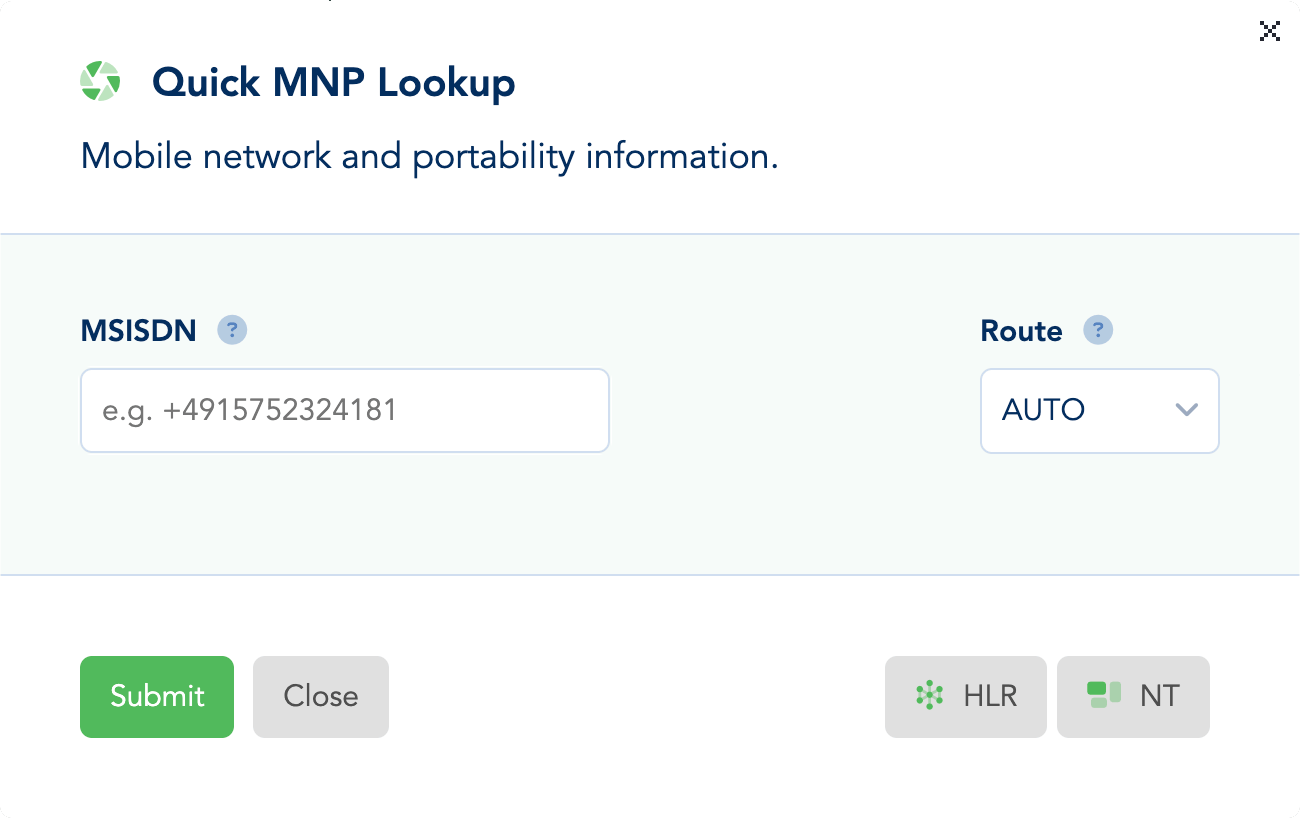
The Quick Detection interface provides immediate mobile network identification for individual phone numbers through an intuitive web-based form. Designed for customer service representatives, support teams, and anyone needing instant carrier verification without API integration, this streamlined tool delivers network operator information within seconds.
Simply enter a phone number in international format, select your preferred detection method, and receive detailed carrier information including operator name, MCCMNC code, and country.
Interface Features
Flexible Number Input
The system accepts phone numbers in various formats: with or without country codes, with spaces or hyphens, using leading zeros or plus signs. Automatic normalization converts any input to E.164 international format before detection, eliminating format friction when copying numbers from emails, CRM fields, or customer communications.
Detection Method Selection
Choose the detection method that matches your accuracy and speed requirements:
HLR Detection provides real-time carrier identification directly from mobile network infrastructure - ideal when you need maximum accuracy and additional data like connectivity status.
MNP Detection queries portability databases for fast carrier identification - suitable when speed matters and near-real-time accuracy is sufficient.
Instant Results
Detection results appear within seconds - typically under 500 milliseconds for MNP detection and 0.3-1.5 seconds for HLR detection. Results display in an organized format showing carrier name, MCCMNC code, country, and additional metadata depending on detection method.
Understanding Detection Results
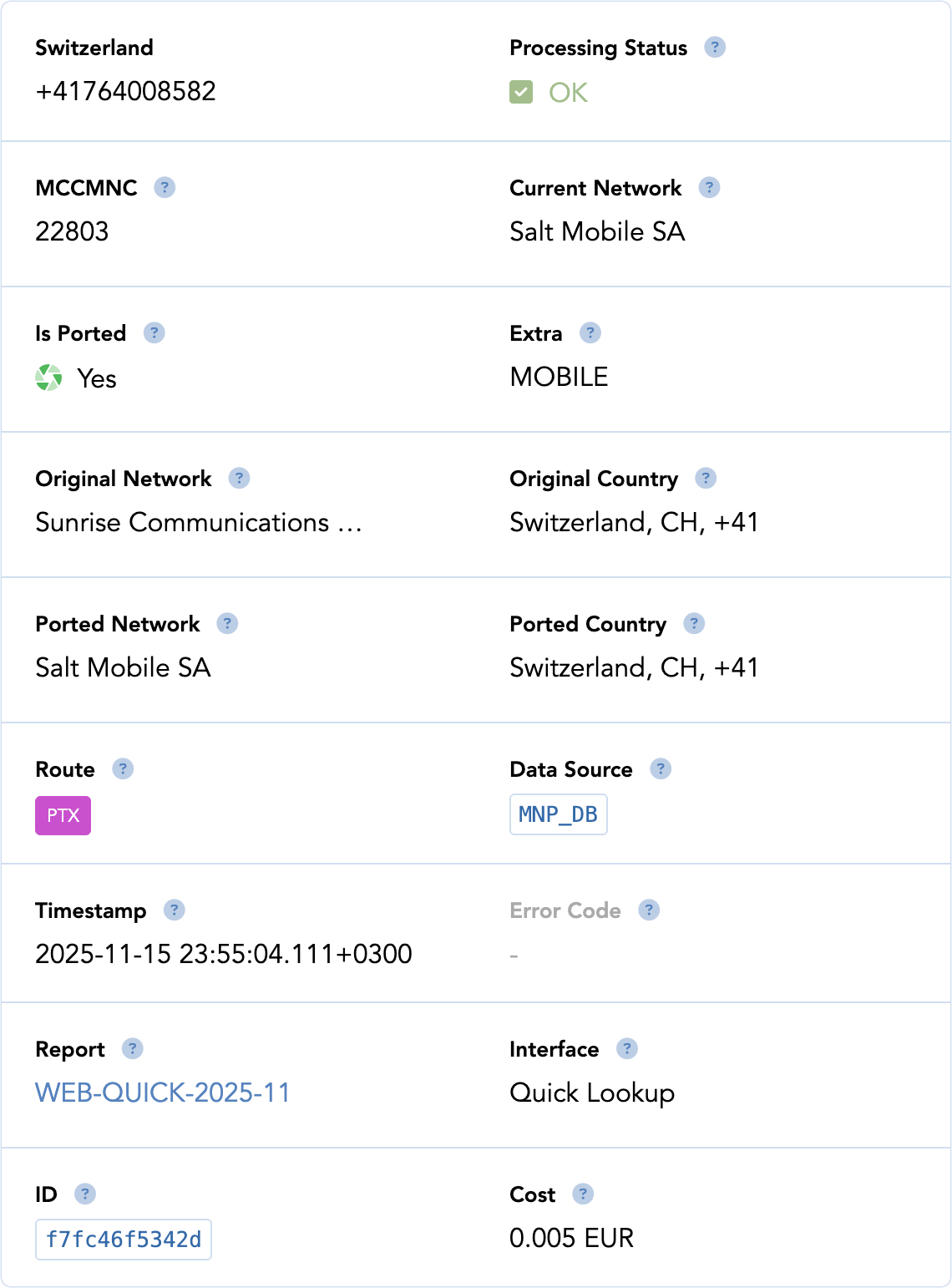
Quick detection results provide comprehensive network operator intelligence in an easy-to-read format:
Current Network Operator
The primary result: which mobile network operator currently serves this subscriber. Displayed as both the operator's commercial name (e.g., 'Vodafone Germany') and the technical MCCMNC code (e.g., '26202') for automated processing.
MCCMNC Code
The standardized Mobile Country Code + Mobile Network Code combination that uniquely identifies the network operator worldwide. MCCMNC codes enable direct integration with routing tables and billing systems without ambiguous name matching.
Country Information
The country where the network operator is registered, derived from the MCC portion of the MCCMNC code. Country data confirms geographic attribution and supports compliance requirements.
Original Network (MNP Detection)
For MNP-based detection, results include the original allocating network - the carrier that first issued this phone number. Comparing current and original networks reveals whether the number has been ported through number portability.
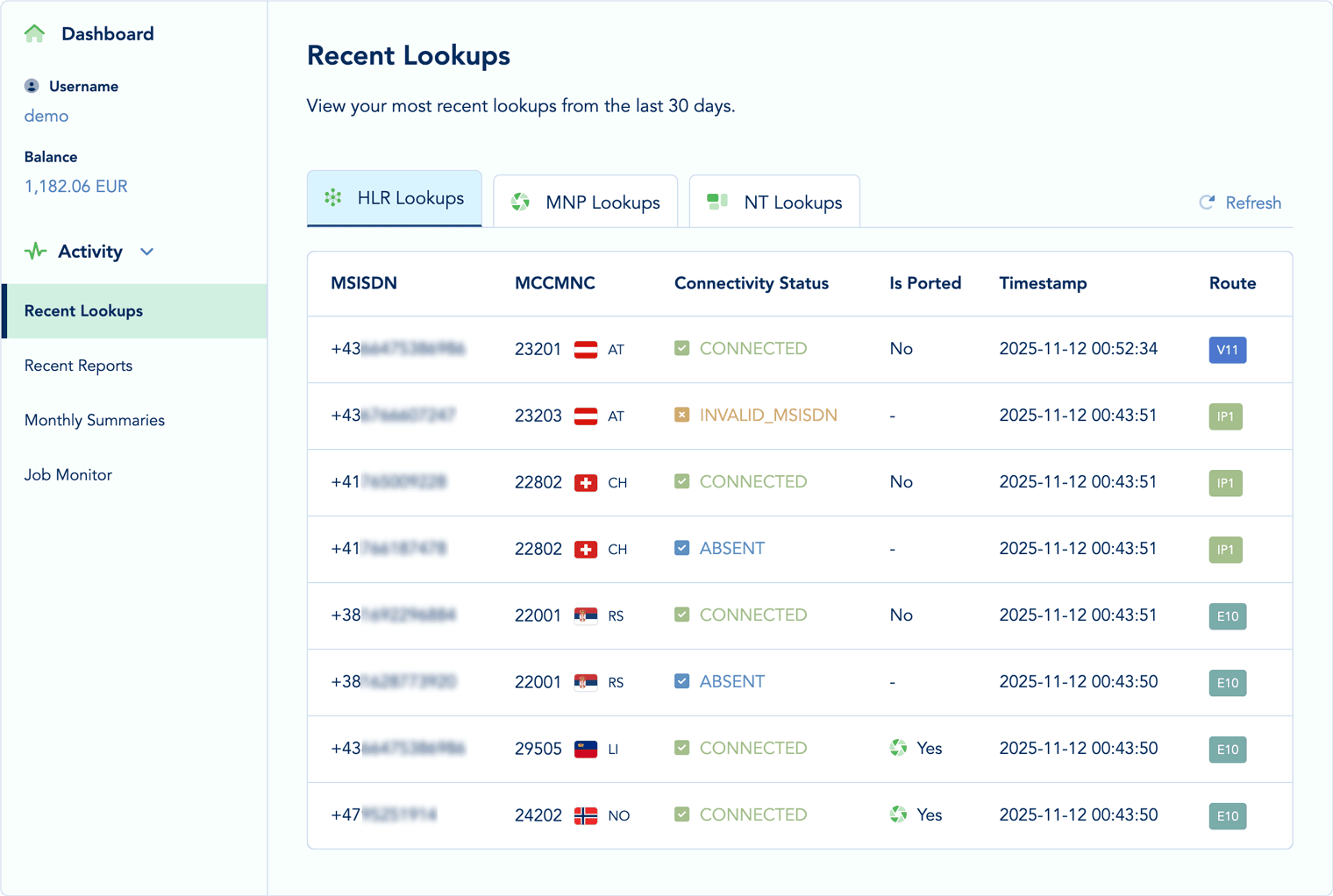
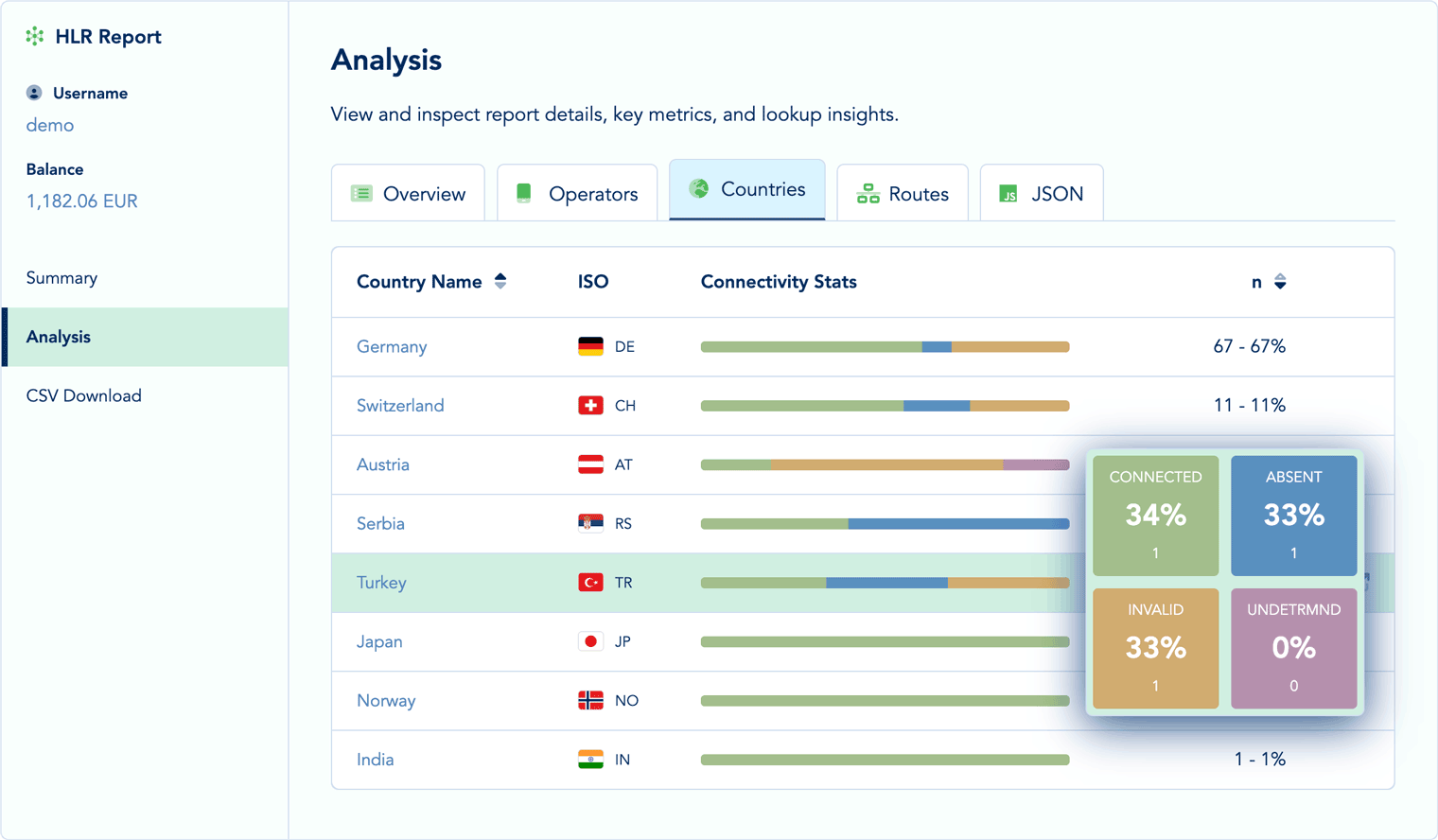
Connectivity Status (HLR Detection)
For HLR-based detection, results include current connectivity status indicating whether the subscriber is reachable:
CONNECTED indicates the device is online and registered with the network.
ABSENT indicates temporary unavailability - the subscriber may be reachable later.
Quick Detection Use Cases
Customer Service Verification
Support agents can instantly identify which carrier serves a customer's phone number during interactions. Carrier identification helps troubleshoot network-specific issues, verify correct routing, and provide informed support responses.
Routing Verification
Operations teams can verify carrier identification before or after routing decisions, confirming that traffic reached the expected destination network. Quick detection helps diagnose routing issues and verify least-cost routing optimization.
Billing Dispute Resolution
When billing discrepancies arise, quick detection provides authoritative carrier identification to resolve disputes about which network should have been charged.
Ad-Hoc Carrier Research
Sales and marketing teams can quickly identify carrier demographics for individual leads or customers without waiting for database updates. Quick detection enables real-time carrier-based segmentation decisions during customer interactions.
Fraud Investigation
Security teams investigating suspicious activity can quickly identify carrier patterns, checking whether phone numbers are served by expected networks or potentially problematic carriers.
Result Storage and History
All Quick Detections are automatically logged and accessible through your Dashboard, providing detection history and audit trails. Optionally assign detections to named storage containers for project-specific organization and aggregated reporting.
Detection results contribute to your analytics reports, enabling trend analysis of carrier distribution across your detection activity.
Bulk Network Detection
High-Volume Carrier Identification and Database Enrichment
Bulk detection enables carrier identification for thousands or millions of phone numbers, supporting database enrichment, routing table updates, and comprehensive carrier segmentation projects. Upload your contact lists, monitor processing in real-time, and download comprehensive results that identify the serving network for every number in your database.
Our enterprise bulk processing infrastructure handles massive workloads efficiently, processing large files with parallel execution while maintaining accuracy and providing detailed progress tracking.
Database Enrichment Workflow
Export Your Contact Database
Export phone numbers from your CRM, marketing platform, or contact database into CSV, TXT, or Excel format. The bulk processor automatically detects number columns in multi-column files, handling files with headers or raw number lists.
Upload for Detection
Upload your file through the web interface using drag-and-drop or file browser selection. The system validates file format, parses content, and displays detected number count for confirmation before processing begins. Select your preferred detection method (HLR for maximum accuracy, MNP for speed and cost efficiency) based on your requirements.
Monitor Processing Progress
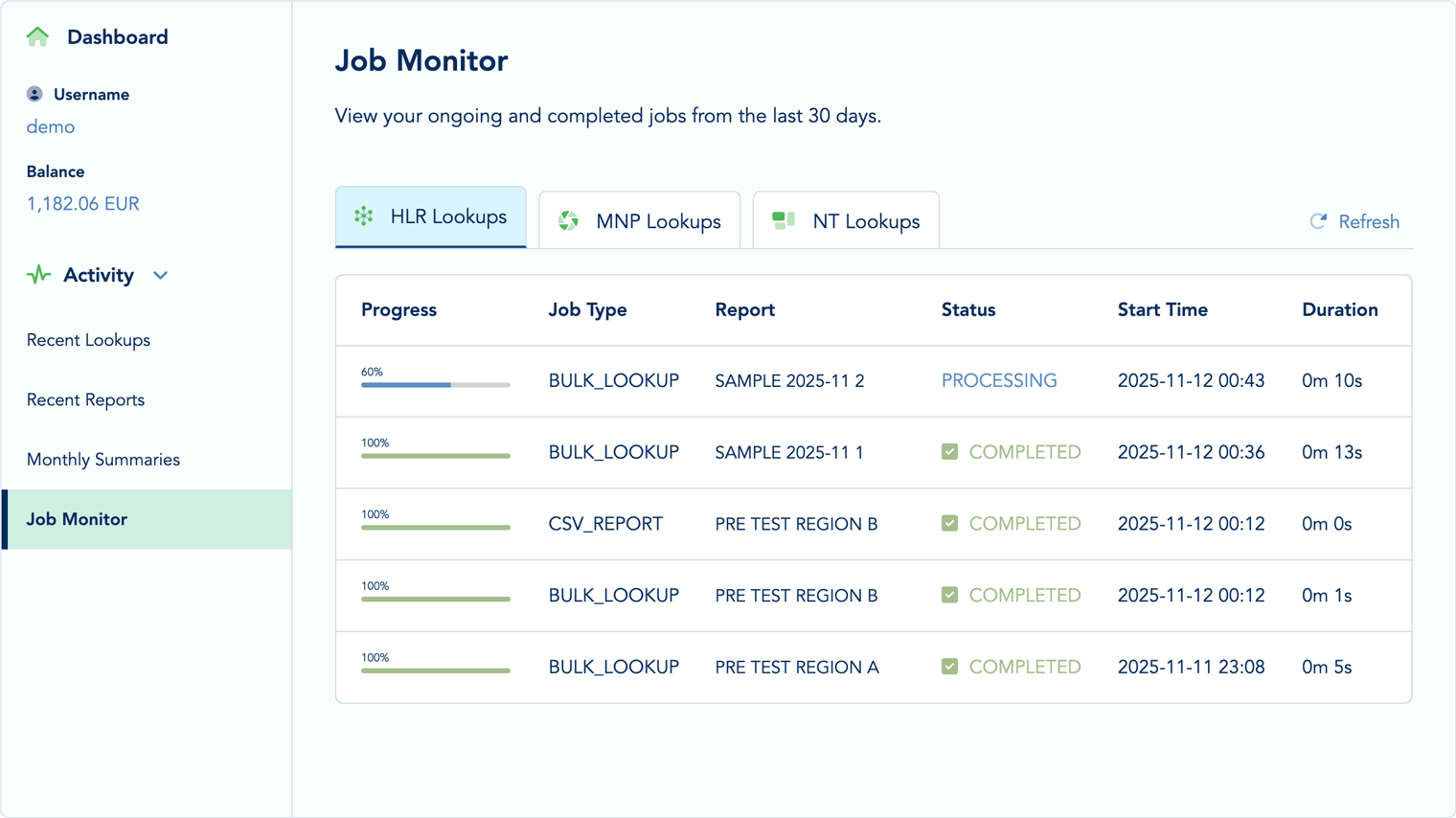
Track detection progress in real-time through the job monitor. Visual indicators show completion percentage, numbers processed, and estimated time remaining. Receive email notifications when processing completes, eliminating the need for continuous monitoring.
Download and Apply Results
Download comprehensive results in CSV format containing all input numbers with their detected carrier, MCCMNC code, country, and additional metadata. Import results back into your systems to update carrier fields, enrich customer records, and refresh routing tables with current network data.
Routing Table Maintenance
Automated Routing Updates
Use bulk detection to refresh routing tables with current carrier data, ensuring least-cost routing decisions reflect actual serving networks rather than outdated prefix assumptions. Schedule periodic bulk detection runs to catch porting events and maintain routing accuracy over time.
Pre-Caching for Real-Time Systems
Bulk-detect your entire number database to pre-populate carrier caches, enabling real-time routing decisions without per-transaction lookups. Pre-caching reduces latency and cost for high-volume systems while maintaining carrier accuracy through periodic refresh.
Carrier Segmentation
Network Distribution Analysis
Bulk detection reveals the carrier composition of your contact database, showing which networks serve your customers and in what proportions. Network distribution insights inform marketing segmentation, routing optimization, and carrier relationship decisions.
Marketing Segmentation
Segment your audience by carrier for targeted marketing campaigns. Different carriers serve different demographics, enabling carrier-based targeting strategies. Bulk detection enriches your marketing database with carrier attributes that support sophisticated segmentation beyond traditional demographics.
Enterprise Features
Parallel Processing
Distributed processing infrastructure executes detections in parallel across multiple workers, maximizing throughput while maintaining result accuracy. Large files process at sustained high rates, typically completing within hours rather than days regardless of volume.
Storage Organization
Assign bulk jobs to named storage containers for organized result management. Storage names like 'ROUTING-TABLE-UPDATE-Q1' or 'MARKETING-SEGMENTATION-2025' keep results organized and retrievable. Storage containers aggregate results from related jobs, enabling cumulative analysis across multiple detection activities.
Analytics Integration
Bulk detection results automatically feed into the analytics platform, generating aggregate statistics on carrier distribution, detection success rates, and trend analysis. Visualize how carrier composition changes over time, compare network distribution across different customer segments, and quantify porting rates in your database.
Supported File Formats
CSV Files
Comma-separated value files are the most common format. The system auto-detects number columns in multi-column files with or without headers.
Text Files
Plain text files with one number per line are processed directly without column parsing complexity.
Excel Files
Microsoft Excel files (.xlsx, .xls) are supported for users working primarily in spreadsheet environments.
API-Based Bulk Processing
For programmatic integration, our REST API supports asynchronous bulk submission endpoints that accept number arrays or file uploads. API-based bulk processing enables automated workflows where detection jobs trigger based on schedule, data changes, or upstream system events. Comprehensive API documentation provides detailed specifications for bulk submission, status polling, and result retrieval.
Network Intelligence API
Integrate Mobile Network Detection Into Your Applications
Our REST API enables real-time mobile network detection during routing decisions, billing attribution, fraud assessment, and any workflow requiring programmatic carrier identification. Synchronous endpoints return detection results within milliseconds, enabling inline carrier identification that powers automated routing tables and real-time decision systems.
Comprehensive API documentation provides detailed specifications, code examples, and integration patterns for common use cases.
Real-Time Routing Integration
Integrate network detection into your routing infrastructure to enable true least-cost routing based on actual serving carriers.
Pre-Route Detection
Query carrier before routing each call or message. The API returns network operator identification within milliseconds, enabling route selection based on current carrier rather than prefix assumptions. For high-value traffic where routing cost exceeds detection cost, per-transaction detection ensures optimal path selection for every connection.
Routing Table Automation
Use bulk API endpoints to automatically refresh routing tables with current carrier data. Schedule automated detection runs that update routing configurations, ensuring cached carrier data stays current without manual intervention.
Billing System Integration
Integrate carrier detection into billing workflows to ensure accurate interconnection cost attribution.
Real-Time Billing Attribution
Query carrier at transaction time to attribute costs correctly from the start, rather than reconciling errors after billing cycles complete. Real-time attribution eliminates the accumulated errors that arise from prefix-based carrier assumptions.
Post-Transaction Verification
Verify carrier attribution for completed transactions before final billing, catching any discrepancies before they become customer-facing issues.
API Integration Patterns
Synchronous Detection
The synchronous API endpoint accepts individual phone numbers and returns detection results in real-time. Typical response times: 50-500ms for MNP detection, 0.3-1.5 seconds for HLR detection.
200 OK
{
   "id":"e428acb1c0ae",
   "msisdn":"+14156226819",
   "query_status":"OK",
   "mccmnc":"310260",
   "mcc":"310",
   "mnc":"260",
   "is_ported":true,
   "original_network_name":"Verizon Wireless:6006 - SVR/2",
   "original_country_name":"United States",
   "original_country_code":"US",
   "original_country_prefix":"+1415",
   "ported_network_name":"T-Mobile US:6529 - SVR/2",
   "ported_country_name":"United States",
   "ported_country_code":"US",
   "ported_country_prefix":"+1",
   "extra":"LRN:4154250000",
   "cost":"0.0050",
   "timestamp":"2020-08-05 21:21:33.490+0300",
   "storage":"API-MNP-2025-01",
   "route":"PTX",
   "error_code":null
}
Asynchronous Bulk Detection
For high-volume detection, the asynchronous API accepts arrays of phone numbers or file uploads, returning job identifiers for status polling and result retrieval. Asynchronous processing enables detection of large datasets without blocking application threads or hitting timeout limits.
Developer SDKs
Accelerate integration with native SDKs for PHP, Node.js, Python, and other popular languages. SDKs provide pre-built functions that handle authentication, request formatting, response parsing, and error management.
 PHP
PHP
 NodeJS
 Ruby
Ruby
1   include('HLRLookupClient.class.php');
2
3   $client = new HLRLookupClient(
4       'YOUR-API-KEY',
5       'YOUR-API-SECRET',
6       '/var/log/hlr-lookups.log'
7   );
8
9   $params = array('msisdn' => '+14156226819');
10 $response = $client->post('/hlr-lookup', $params);NodeJS SDK
Instant API Integration for NodeJS1 require('node-hlr-client');
2
3 let response = await client.post('/hlr-lookup', {msisdn: '+491788735000'});
4
5 if (response.status === 200) {
6 // lookup was successful
7 let data = response.data;
8 }Ruby SDK
Instant API Integration for Ruby1 require 'ruby_hlr_client/client'
2
3 client = HlrLookupsSDK::Client.new(
4 'YOUR-API-KEY',
5 'YOUR-API-SECRET',
6 '/var/log/hlr-lookups.log'
7 )
8
9 params = { :msisdn => '+14156226819' }
10 response = client.get('/hlr-lookup', params)Authentication and Security
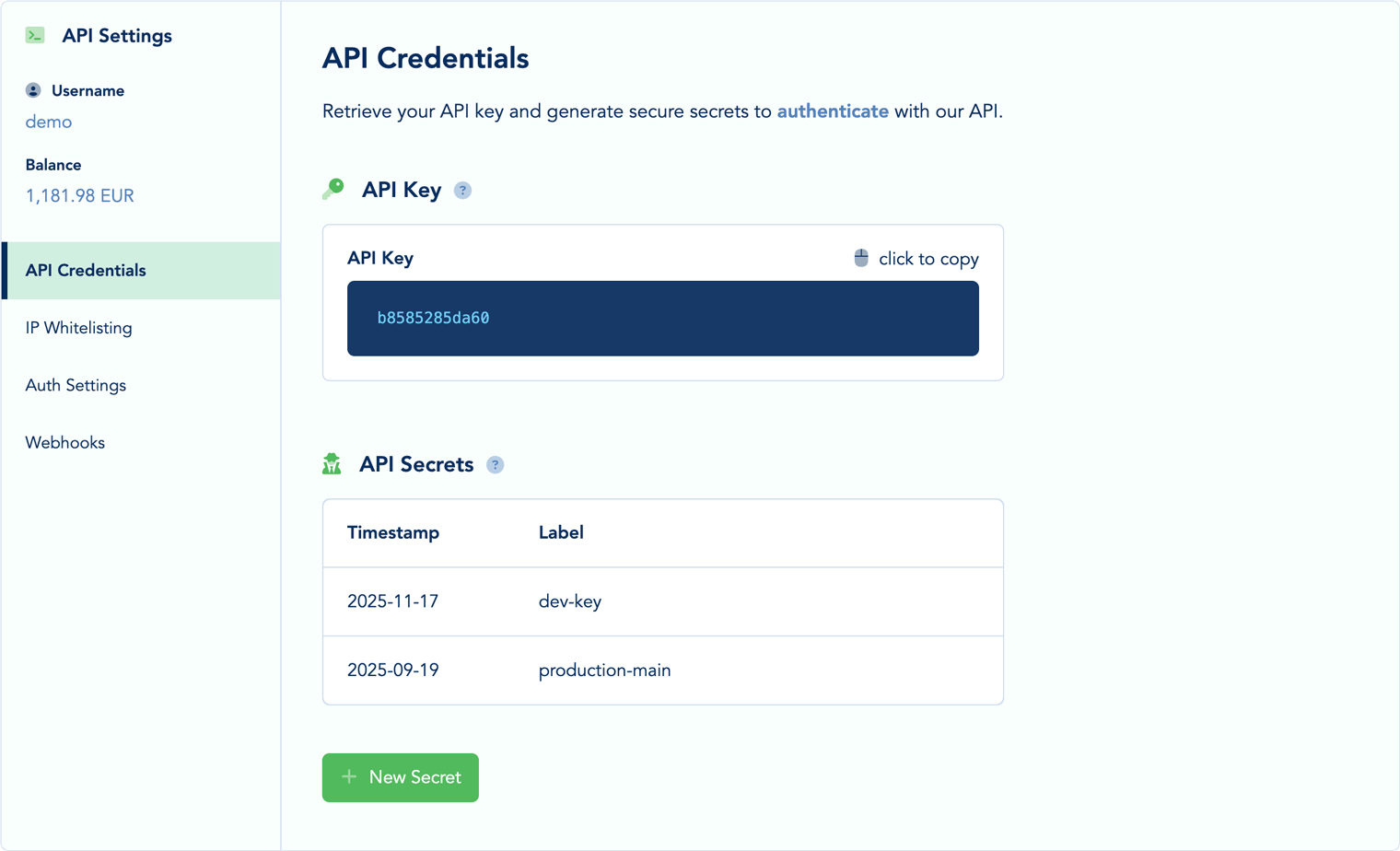
API Key Authentication
Authenticate API requests using API keys generated through your account settings. Keys can be scoped to specific capabilities and IP address ranges for security hardening.
IP Whitelisting
Restrict API access to specific IP addresses, preventing unauthorized access even if credentials are compromised. Configure whitelists through account settings, supporting individual addresses and CIDR ranges for distributed systems.
Best Practices
Caching Strategies
Implement client-side caching for recently detected carriers to reduce redundant lookups. Carrier information changes relatively slowly - a 24-72 hour cache provides excellent cost efficiency while maintaining accuracy for most use cases. For frequently-accessed numbers (e.g., regular customers), caching dramatically reduces API calls without sacrificing accuracy.
Graceful Degradation
Design integrations to handle API unavailability gracefully. When detection fails, consider falling back to prefix-based routing rather than blocking traffic entirely. Prefix assumptions are imperfect but functional when detection is temporarily unavailable.
Rate Limit Awareness
Monitor rate limit headers in API responses to stay within quota limits. Implement intelligent throttling that spreads requests over time rather than bursting. For predictable high-volume periods, consider pre-detection using bulk processing rather than real-time API during peak traffic.
Method Selection Logic
Implement intelligent method selection that chooses HLR or MNP detection based on use case requirements. Use MNP for cost-sensitive bulk operations; use HLR when maximum accuracy or connectivity data justifies the additional cost.
Network Detection Dashboard & Analytics
Monitor Detection Activity and Carrier Distribution
The Dashboard provides centralized visibility into your mobile network detection activity, offering real-time monitoring of detection results, bulk processing status, and carrier distribution metrics. Track detection patterns over time, analyze network composition across your contact base, and generate reports documenting carrier intelligence for business decisions.
Recent Detections Feed
The recent detections feed displays your most recent mobile network identifications in chronological order, providing immediate visibility into detection activity across all submission methods. Each entry shows the phone number, detected carrier, MCCMNC code, detection method, and timestamp.
Click any detection entry to expand detailed results including full operator information, portability status, and detection metadata. The feed updates in real-time as new detections complete, providing continuous visibility without manual refresh.
Filtering and Search
Filter the recent detections feed by date range, carrier, detection method, or storage container to focus on specific detection activity. Search functionality enables quick location of specific phone numbers within your detection history, supporting customer service inquiries and audit requests.
Bulk Processing Monitor
The job monitor tracks all active and recent bulk detection jobs, displaying progress status, completion percentages, and estimated completion times. Monitor multiple concurrent jobs simultaneously with visual indicators distinguishing queued, processing, completed, and failed states.
Job Details
Click any job to view detailed statistics: total numbers processed, carrier distribution discovered, detection success rates, and direct links to download results. Job details provide insight into network composition for each batch, helping identify carrier patterns across different data sources.
Carrier Distribution Analytics
Analytics aggregate detection results into meaningful carrier metrics that reveal network patterns in your phone number data:
Network Operator Distribution
Visualize which carriers serve your contacts, displayed as both absolute counts and percentages of total detected numbers. Network distribution reveals carrier concentration, enabling targeted optimization for high-volume carriers and identifying opportunities for carrier-specific strategies.
Geographic Distribution
Analyze carrier distribution by country to understand international network composition. Geographic analysis helps identify markets with carrier concentration and reveals opportunities for regional routing optimization.
Portability Analysis
Track what percentage of detected numbers have been ported versus remaining with original carriers. Portability rates vary significantly by market - high portability rates indicate greater importance of detection versus prefix-based assumptions.
Detection Method Distribution
Monitor usage patterns across HLR and MNP detection methods, tracking cost and accuracy tradeoffs in your detection strategy.
Monthly Summaries
Monthly summary cards provide at-a-glance visibility into aggregate detection activity across billing periods. Each summary displays total detections performed, carrier breakdown, cost totals, and comparison against previous periods.
Trend Indicators
Visual trend indicators highlight changes from previous periods: shifting carrier distributions, changing detection volumes, and evolving portability rates. Trend analysis helps identify seasonal patterns, market changes, and anomalies requiring investigation.
Reports and Exports
Generate comprehensive reports documenting detection activity for management review, carrier negotiations, and business intelligence.
Scheduled Reports
Configure automated report generation on daily, weekly, or monthly schedules. Reports are generated automatically and delivered via email or made available for download.
Custom Exports
Export detection data in CSV format for integration with external business intelligence tools, routing systems, and analysis platforms. Custom exports support specific date ranges, carrier filters, and field selections tailored to your reporting requirements.
Integration with Platform Analytics
Dashboard data feeds into the comprehensive analytics platform, enabling deeper analysis of carrier patterns and detection trends. Navigate from Dashboard overview to detailed analytics for specific time periods, carriers, or storage containers.
Mobile Network Detection Use Cases
Real-World Applications Across Industries
Mobile network detection delivers measurable value across telecommunications, marketing, fraud prevention, and any industry where carrier identification drives business decisions. From optimizing least-cost routing to enriching customer databases with carrier demographics, network detection transforms uncertain assumptions into verified intelligence.
VoIP Least-Cost Routing
The Challenge: Suboptimal Termination Costs
VoIP providers route calls based on destination number prefixes, assuming prefixes reliably indicate serving carriers. In markets with high number portability, this assumption systematically fails. When 30-50% of numbers have ported to different carriers, prefix-based routing selects suboptimal termination paths for a significant portion of traffic, accumulating unnecessary interconnection costs.
Detection Solution
Integrate mobile network detection into routing infrastructure to identify actual serving carriers before route selection. Real-time detection via API enables per-call carrier lookup, ensuring optimal path selection for every connection. Alternatively, use bulk detection to pre-populate routing caches with current carrier data.
Business Impact
VoIP providers implementing carrier-aware routing typically report 10-25% reduction in termination costs. For operators processing millions of minutes monthly, this represents substantial annual savings that far exceed detection costs.
SMS Aggregator Network Optimization
The Challenge: Delivery Rate Degradation
SMS aggregators experience delivery failures when messages route through incorrect network paths due to ported numbers. Messages submitted to wrong carriers may be delayed, filtered, or rejected entirely, damaging delivery metrics and customer satisfaction.
Detection Solution
Detect carrier before message submission to ensure correct routing and carrier-specific formatting. Some carriers require specific sender IDs, support different character encodings, or have varying content policies - carrier identification enables compliant message formatting.
Business Impact
SMS aggregators implementing network detection report 15-25% improvement in delivery rates for campaigns involving ported numbers. Reduced delivery failures translate to better customer relationships and fewer credits issued for failed messages.
Telecommunications Billing Systems
The Challenge: Incorrect Cost Attribution
Billing systems that attribute interconnection costs based on number prefixes accumulate systematic errors as databases age and portability events go undetected. Incorrect carrier attribution creates reconciliation disputes with partners and may result in under- or over-charging customers based on wrong termination assumptions.
Detection Solution
Integrate carrier detection into CDR processing workflows to verify destination carrier before billing attribution. Real-time detection ensures billing accuracy from the start; batch detection validates historical records before settlement.
Business Impact
Billing systems with network detection eliminate carrier attribution errors, improving partner relationships and ensuring customers are charged correctly based on actual termination costs. Reduced reconciliation disputes and faster settlement cycles further improve operational efficiency.
Fraud Prevention
The Challenge: Network-Based Fraud Patterns
Fraudsters exhibit distinctive network patterns: concentration on specific carriers, use of MVNOs associated with prepaid anonymity, geographic mismatches between claimed location and carrier registration. Without carrier intelligence, fraud detection systems miss network-based risk signals that could identify suspicious activity.
Detection Solution
Integrate carrier detection into fraud scoring workflows to enrich risk assessment with network intelligence. Combined with phone number verification, network data provides comprehensive risk signals: is the number valid, is it reachable, and is it served by an expected carrier?
Business Impact
Fraud prevention systems enriched with carrier data identify additional risk patterns, improving detection rates while maintaining low false-positive rates. Network intelligence adds a dimension to fraud scoring that's difficult for fraudsters to manipulate.
Marketing Database Enrichment
The Challenge: Missing Carrier Demographics
Marketing databases contain phone numbers without carrier information, missing demographic signals that could improve segmentation and targeting. Different carriers serve different customer segments - premium carriers correlate with higher income, budget MVNOs attract price-sensitive customers, business-focused carriers indicate B2B audiences.
Detection Solution
Use bulk network detection to enrich marketing databases with carrier attributes. Carrier data adds implicit demographic signals that enhance customer profiling and enable carrier-based segmentation strategies.
Business Impact
Marketing teams report improved campaign performance when targeting or excluding specific carrier segments. Carrier-enriched databases enable more sophisticated audience analysis and reveal patterns invisible in traditional demographic data.
Customer Service and Support
The Challenge: Unknown Carrier Context
Support teams troubleshooting delivery issues need to know which carrier serves customers, but this information is rarely available in CRM systems. Without carrier context, support interactions lack the intelligence needed for effective troubleshooting.
Detection Solution
Integrate quick detection into support workflows, enabling agents to instantly identify customer carriers during interactions. Carrier information helps diagnose network-specific issues and provides context for escalation to carrier partners.
Business Impact
Support teams with carrier visibility resolve issues faster and provide more informed responses. Reduced escalation rates and improved first-contact resolution improve customer satisfaction and support efficiency.
Regulatory Compliance
The Challenge: Accurate Interconnection Reporting
Regulatory frameworks require accurate reporting of traffic volumes and termination patterns by carrier. Prefix-based carrier assumptions produce inaccurate reports that may not satisfy compliance requirements.
Detection Solution
Use network detection to verify carrier attribution for regulatory reporting, ensuring compliance documentation reflects actual traffic patterns.
Business Impact
Accurate carrier data supports compliant regulatory reporting and reduces audit risk from inaccurate interconnection records.
Getting Started
Every mobile network detection implementation begins with understanding your specific requirements: detection volumes, accuracy thresholds, integration preferences, and use case priorities. Our platform provides flexible access from Quick Detection for exploratory identification to sophisticated API integration for production-scale automation.
Start with pilot detection to validate that our platform delivers the routing optimization, billing accuracy, or fraud prevention your application needs. Contact our team to discuss how mobile network detection can address your specific business requirements.

