

Phone Number Verification
Phone Number Verification Platform
Validate Phone Numbers Before You Reach Out
Phone number verification ensures that the contact numbers in your database are valid, active, and capable of receiving your communications. Whether you're sending SMS campaigns, making sales calls, or verifying user registrations, knowing that phone numbers are real and reachable before you attempt contact saves money, protects your sender reputation, and improves customer experience.
Our phone number verification platform combines multiple verification technologies into a unified service that answers the fundamental questions businesses need answered: Is this phone number valid? Is it currently active? Can I reach the subscriber? What type of number is it?
The Phone Number Data Quality Crisis
Phone number databases degrade constantly. Subscribers change carriers, deactivate SIM cards, abandon numbers that get reassigned to new users, or simply provide incorrect information during registration. Research shows that contact databases experience 2-5% monthly decay - meaning a database of 100,000 phone numbers loses 2,000-5,000 valid contacts every month without any visible indication that the data has become stale.
The consequences of poor phone number data quality are measurable and significant:
Failed SMS deliveries waste message credits and harm sender reputation with carriers. Each undeliverable message represents wasted spend while accumulating negative delivery signals that can trigger throttling or blocking of your messaging traffic.
Sales teams waste hours dialing disconnected numbers. A single invalid contact attempt costs 30-90 seconds of agent time - multiply that across thousands of calls and the productivity impact becomes substantial.
Marketing campaigns report inflated audience sizes. When 20% of your contact list contains invalid numbers, your actual reach is 20% lower than reported, skewing campaign analytics and ROI calculations.
What Phone Number Verification Solves
Phone number verification transforms uncertain contact data into actionable intelligence by providing definitive answers about number validity and reachability.
Identify Invalid Numbers
Detect phone numbers that are malformed, unallocated, or permanently disconnected before attempting communication. Remove these invalid entries from your database to focus resources on contacts that can actually receive your messages.
Verify Active Subscribers
Confirm that phone numbers are currently active and registered to live mobile network subscribers. Real-time verification through HLR Lookup queries mobile network operators directly to determine current connectivity status.
Detect Number Types
Distinguish between mobile phones, landlines, VoIP numbers, and other line types using Number Type Lookup. This classification is essential when your communication channel (SMS) only works with certain number types.
Identify Network Operators
Determine which carrier currently serves each phone number through MNP Lookup and number portability lookup. Carrier identification enables network-specific routing optimization and helps detect ported numbers.
Unified Verification Platform
Our phone number verification platform integrates multiple verification technologies through a single interface, eliminating the complexity of managing separate services for different verification needs.
Real-Time Connectivity Verification
Query mobile network operators' Home Location Registers (HLR) to determine if subscribers are currently connected, temporarily unavailable, or permanently unreachable. Connectivity verification provides the most accurate reachability assessment available - direct confirmation from the networks that actually serve the subscribers.
Number Type Classification
Identify whether phone numbers are mobile, landline, VoIP, toll-free, or other specialized types based on numbering plan analysis. Number type detection prevents wasted SMS attempts to landlines and helps segment contact databases by communication capability.
Carrier Identification
Determine the current network operator serving each phone number, including detection of numbers that have been ported between carriers. Carrier data enables network-specific message formatting, optimal routing selection, and accurate attribution for billing and analytics.
Verification Access Methods
Access phone number verification capabilities through multiple interfaces optimized for different use cases:
Quick Verification Interface
Verify individual phone numbers instantly through our web interface. Perfect for customer service agents, support teams, and ad-hoc verification needs.
Bulk Verification
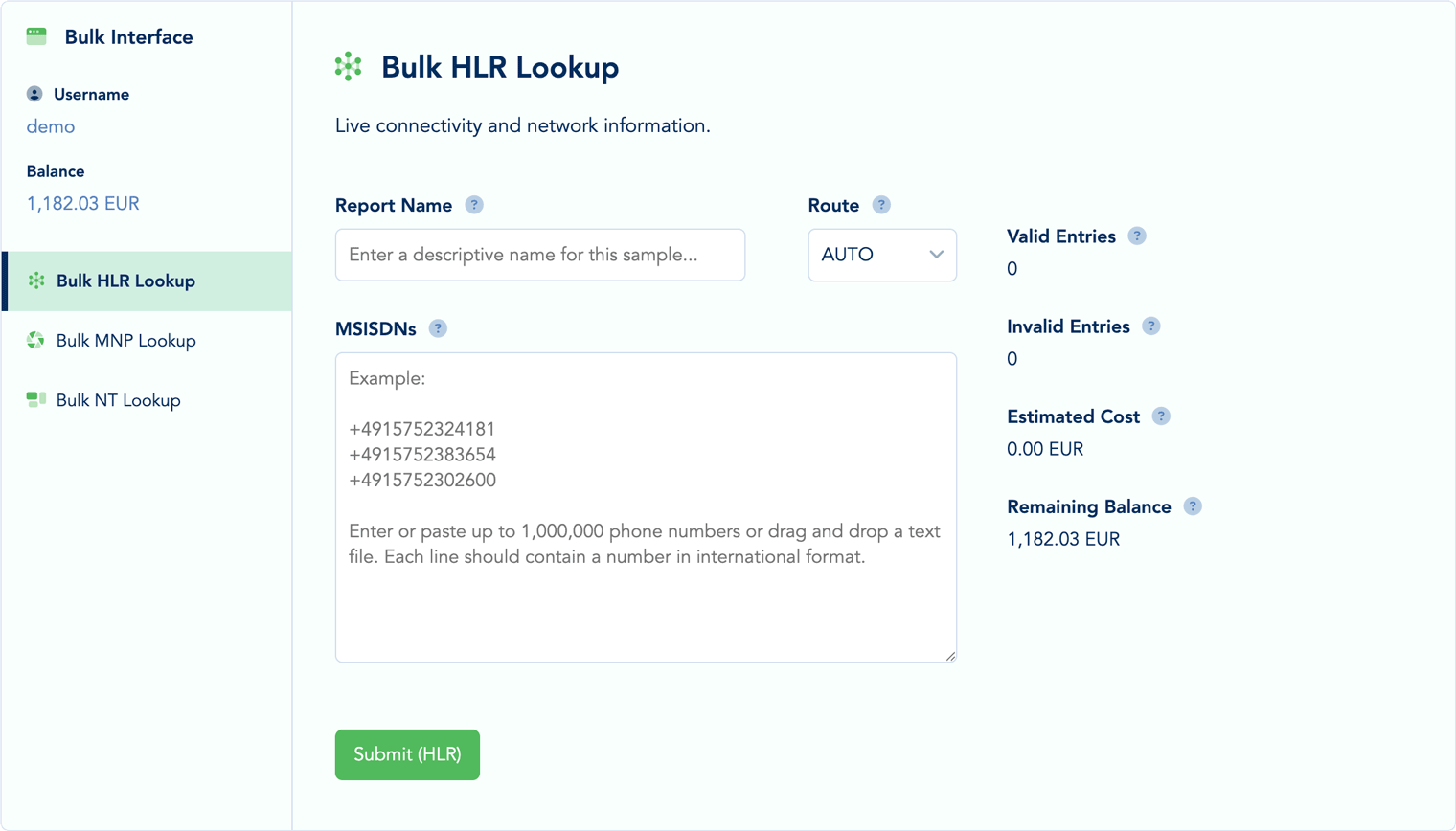
Upload files containing thousands or millions of phone numbers for batch verification with real-time progress monitoring. Essential for database cleansing, campaign preparation, and periodic data quality maintenance.
Real-Time API
Integrate phone number verification directly into your applications using our REST API. Enable verification during user registration, checkout flows, and any workflow requiring programmatic phone validation. Comprehensive API documentation and SDKs accelerate integration.
Analytics and Reporting
Every phone number verification is automatically logged and aggregated into comprehensive analytics reports. Monitor verification activity through real-time dashboards, track data quality trends over time, and generate reports documenting verification results for compliance and business intelligence.
Explore the detailed sections on this page to discover the full capabilities of our phone number verification platform, including business justification, verification methods, integration options, and real-world use cases.
Why Verify Phone Numbers
The Business Case for Phone Number Verification
Phone number verification is not just a technical capability - it's a business necessity that directly impacts revenue, efficiency, compliance, and customer experience. Organizations that implement systematic phone verification report measurable improvements across multiple business metrics, while those that neglect data quality suffer ongoing costs from failed communications, wasted resources, and missed opportunities.
Understanding the specific business impacts of phone number data quality helps justify verification investment and optimize implementation strategies.
The Hidden Cost of Invalid Phone Numbers
Database Decay is Constant and Invisible
Contact databases degrade at rates of 2-5% monthly - a figure that compounds dramatically over time. A database of 500,000 phone numbers loses 10,000-25,000 valid contacts every month without any visible indication of deterioration. After one year without validation, 25-45% of your phone number database may contain invalid or unreachable contacts, yet your systems continue treating every number as equally valid.
This decay occurs through multiple mechanisms: subscribers port numbers between carriers, deactivate service, switch to new numbers, move internationally, or simply abandon SIM cards without formal cancellation. Number reassignment adds another dimension - disconnected numbers eventually get reissued to new subscribers, meaning your 'customer contact' may now reach a completely different person.
Financial Impact of Failed Deliveries
Every failed SMS delivery represents direct financial waste. Message credits consumed by undeliverable messages provide zero value while accumulating costs that scale with sending volume. For high-volume senders processing millions of messages monthly, even small percentages of invalid numbers translate to significant waste. A 15% invalid rate on 1 million messages wastes 150,000 message credits every month.
The indirect costs compound the problem: failed deliveries generate negative signals with carrier networks, potentially triggering throttling or filtering that impacts delivery rates to valid recipients as well. Sender reputation damage from high failure rates can take weeks or months to recover, affecting campaign performance long after the immediate waste occurs.

Productivity Loss from Invalid Contacts
Sales and support teams dialing invalid numbers waste 30-90 seconds per failed contact attempt. For call centers processing thousands of outbound calls daily, this represents substantial productivity loss. A 100-agent call center where each agent wastes 30 minutes daily on invalid numbers loses 50 agent-hours per day - equivalent to employing 6+ additional agents just to absorb the waste from bad data.
Beyond direct time waste, invalid contacts frustrate agents, skew performance metrics, and prevent accurate capacity planning when actual contact rates differ significantly from database contact counts.
Fraud Prevention and Risk Reduction
Fake Numbers Enable Account Fraud
Fraudsters routinely use temporary, virtual, or fake phone numbers to create fraudulent accounts, bypass SMS verification, and exploit promotional offers. Without verification, your registration systems cannot distinguish legitimate phone numbers from disposable services, VoIP numbers masquerading as mobile lines, or numbers that don't exist at all.
Phone number verification during registration creates friction for fraudulent account creation while remaining transparent to legitimate users. Validating that numbers are real mobile numbers registered to actual subscribers blocks many common fraud vectors.
Detect High-Risk Number Patterns
Verification data reveals patterns associated with fraud: recently activated SIM cards, numbers showing frequent portability events, VoIP numbers presented as mobile, or geographic mismatches between claimed location and number registration. These signals enable risk-based verification where suspicious registrations receive additional scrutiny while low-risk submissions proceed without friction.
Regulatory Compliance
GDPR Data Accuracy Requirements
The General Data Protection Regulation (GDPR) Article 5 requires that personal data be accurate and kept up to date. Maintaining databases full of invalid or outdated phone numbers may constitute a compliance violation. Regular phone number verification demonstrates systematic data accuracy efforts that satisfy regulatory requirements and reduce compliance risk during audits or investigations.
TCPA and Communication Consent
The Telephone Consumer Protection Act (TCPA) and similar regulations require consent for marketing communications. When phone numbers are reassigned to new subscribers, previous consent becomes invalid. Verification helps identify numbers that may have been reassigned, enabling proactive consent re-verification rather than risking complaints from recipients who never opted in.
Industry-Specific Compliance
Financial services, healthcare, and other regulated industries face specific requirements for customer contact verification. Phone number validation supports Know Your Customer (KYC) and identity verification compliance. Audit trails from verification activities provide documentation demonstrating compliance efforts to regulators and auditors.
Return on Investment
Quantifiable Cost Savings
Phone number verification ROI is directly calculable: compare verification costs against savings from eliminated waste, improved delivery rates, and recovered productivity. For most organizations, verification pays for itself many times over. If verification costs EUR 0.005 per number and prevents a EUR 0.05 wasted SMS delivery, the 10:1 return justifies universal pre-send verification.
Improved Campaign Performance
Marketing campaigns targeting verified contacts show higher engagement rates because every message reaches a real, reachable subscriber. Response rates calculated against verified audiences reflect actual campaign performance rather than inflated denominators. Accurate performance metrics enable confident optimization decisions and realistic forecasting based on true audience reach.
Enhanced Customer Experience
Verification prevents the poor customer experience of failed communications: undelivered order confirmations, missed appointment reminders, failed password resets. Customers expect reliable communication from businesses they interact with. Verification ensures you can actually reach customers through the phone numbers they provide.
When to Verify Phone Numbers
At Point of Collection
Verify phone numbers when they're first collected - during registration, checkout, or data import. Real-time verification prevents invalid data from entering your systems in the first place.
Before Communication Campaigns
Validate contact lists before launching SMS or voice campaigns. Pre-campaign verification identifies invalid numbers, enabling suppression before wasting message credits or incurring failed delivery penalties.
Periodic Database Maintenance
Schedule regular verification sweeps of your entire database to catch decay over time. Monthly or quarterly validation maintains data quality and identifies trends in database degradation.
Before Critical Communications
For high-value communications (transaction confirmations, security alerts, time-sensitive notifications), verify immediately before sending to ensure maximum deliverability.
Phone Number Verification Methods
Choosing the Right Verification Approach for Your Use Case
Phone number verification encompasses multiple technologies, each providing different types of intelligence about phone numbers. Understanding these verification methods helps you select the right approach for your specific requirements - balancing data depth, speed, cost, and coverage.
Our platform offers three primary verification methods that can be used individually or combined for comprehensive phone number validation.
HLR Lookup - Real-Time Connectivity Verification
HLR Lookup queries mobile network operators' Home Location Registers (HLR) to determine real-time connectivity status of mobile phone numbers. This is the most authoritative method for verifying whether a mobile subscriber is currently reachable on the cellular network.
What HLR Verification Provides
Connectivity status indicates whether the mobile device is currently connected to the network:
CONNECTED - The device is powered on and registered with the network, able to receive SMS and voice calls immediately.
ABSENT - The device is temporarily unavailable (powered off, out of coverage, airplane mode). The subscriber may become reachable later.
INVALID_MSISDN - The number is deactivated, unallocated, or permanently unreachable. This number should be removed from active contact lists.
When to Use HLR Verification
HLR verification is ideal when you need to confirm that mobile numbers are currently reachable before attempting communication:
Pre-send SMS validation to filter unreachable subscribers before message submission, improving delivery rates and protecting sender reputation.
Real-time registration verification to confirm that phone numbers provided during account creation are active mobile lines, not disconnected or invalid numbers.
Database cleansing to identify which contacts remain valid versus those that have become unreachable since last verification.
HLR Verification Characteristics
Response time: 0.3-1.5 seconds (real-time network query)
Coverage: Mobile numbers globally (requires SS7 network access)
Data freshness: Real-time - reflects current network status at moment of query
Number Type Lookup - Line Classification
Number Type (NT) Lookup classifies phone numbers by line type based on numbering plan analysis, identifying whether numbers are mobile, landline, VoIP, or other specialized types.
What Number Type Verification Provides
Line type classification distinguishes between different phone number categories:
MOBILE - Mobile phone numbers capable of receiving SMS messages and mobile-specific communications.
LANDLINE - Fixed-line telephone numbers that cannot receive SMS (voice calls only).
VOIP - Voice over IP numbers that may have different delivery characteristics or security risk profiles.
When to Use Number Type Verification
Number type verification is essential when your communication channel has line type requirements:
SMS campaign preparation to filter out landlines before sending, preventing wasted message attempts to numbers that cannot receive SMS.
Registration security to identify VoIP numbers that may indicate higher fraud risk compared to traditional mobile subscriptions.
Channel routing to direct voice communications to landlines and text-based communications to mobile numbers.
Number Type Verification Characteristics
Response time: Near-instant (database lookup)
Coverage: All phone number types globally
Data source: Numbering plan databases and carrier range allocations
MNP Lookup - Carrier Identification
MNP Lookup and number portability lookup identify which network operator currently serves a phone number, including detection of numbers that have been ported between carriers.
What Carrier Verification Provides
Current operator identification shows which carrier currently serves the subscriber, regardless of which carrier originally issued the number.
Portability status indicates whether the number has been transferred between carriers: PORTED (number has changed operators) or NOT_PORTED (number remains with original carrier).
MCCMNC codes provide machine-readable carrier identification for routing tables and billing systems.
When to Use Carrier Verification
Carrier verification supports routing optimization and network-specific handling:
Least-cost routing for VoIP providers to select optimal termination paths based on actual current carrier rather than outdated prefix assumptions.
Carrier-specific message formatting when different networks require different sender IDs, encoding, or content formats.
Billing and attribution to ensure interconnection costs are attributed to correct destination carriers.
Carrier Verification Characteristics
Response time: 50-500 milliseconds
Coverage: Countries with number portability databases
Data source: National portability databases and carrier registries
Combining Verification Methods
Many use cases benefit from combining multiple verification methods to build comprehensive phone number intelligence:
Registration Verification Stack
For user registration, combine Number Type (confirm mobile) + HLR (confirm active) to ensure users provide valid, reachable mobile numbers. This combination blocks invalid numbers, landlines, and disconnected mobiles from completing registration.
SMS Campaign Preparation
For campaign preparation, use Number Type (filter landlines) + HLR (filter unreachable) + MNP (optimize routing) to maximize delivery while minimizing cost. Each verification layer adds value: type filtering prevents impossible deliveries, connectivity filtering prevents wasted attempts, carrier data enables optimal routing.
Database Cleansing
For periodic database maintenance, HLR verification identifies numbers that have become unreachable since last validation, while carrier verification updates routing data for ported numbers.
Choosing Your Verification Strategy
The optimal verification strategy depends on your specific requirements:
For SMS deliverability focus, prioritize HLR verification to identify reachable subscribers before sending.
For fraud prevention focus, combine Number Type (detect VoIP) + HLR (detect recent activations via advanced data) for risk assessment.
For cost optimization focus, use MNP/portability verification to ensure correct routing paths and carrier attribution.
For comprehensive data quality, implement all verification methods based on data sensitivity and communication criticality.
Quick Phone Number Verification
Instant Single-Number Verification Through Web Interface
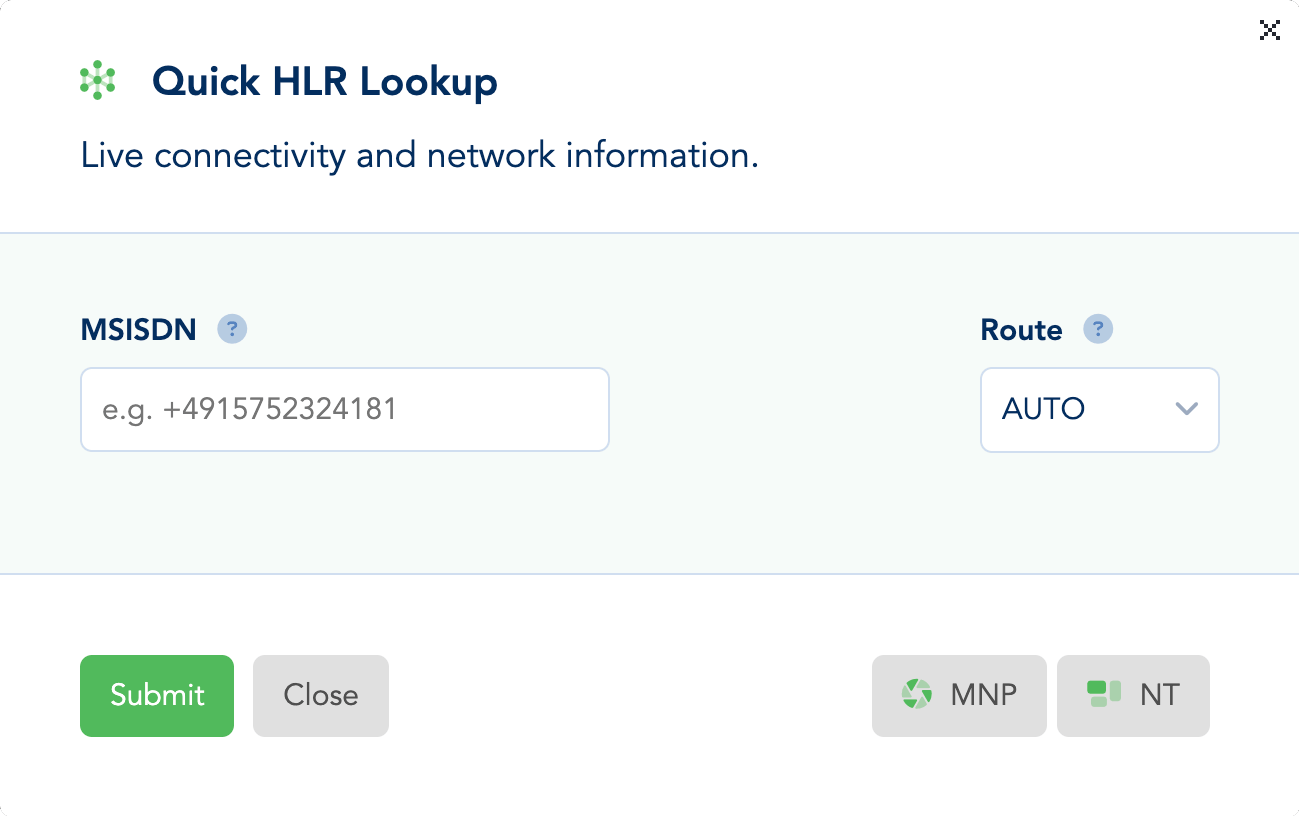
The Quick Verification interface provides immediate phone number validation for individual numbers through an intuitive web-based form. Designed for customer service representatives, support teams, and anyone needing instant verification without API integration, this streamlined tool delivers comprehensive validation results within seconds.
Simply enter a phone number in international format, select your preferred verification type, and receive detailed status information including connectivity, number type, and carrier identification.
Interface Features
Flexible Number Input
The system accepts phone numbers in various formats: with or without country codes, with spaces or hyphens, using leading zeros or plus signs. Automatic normalization converts any input to E.164 international format before verification, eliminating format friction when copying numbers from emails, CRM fields, or customer communications. Supported formats include: +491234567890, 00491234567890, 01234567890 (with country context), and variations with spaces or hyphens.
Verification Type Selection
Choose the verification type that matches your information needs:
HLR Verification provides real-time connectivity status - ideal when you need to confirm the number is currently active and reachable.
Number Type Verification identifies whether the number is mobile, landline, or VoIP - useful when verifying SMS-capable numbers.
Carrier Verification identifies the current network operator - important for routing decisions or carrier-specific requirements.
Instant Results
Verification results appear within seconds, typically 0.3-1.5 seconds depending on verification type and target network. Results display in an organized format showing all relevant data fields with color-coded status indicators for quick interpretation.
Understanding Verification Results
Quick verification results provide comprehensive phone number intelligence in an easy-to-read format:
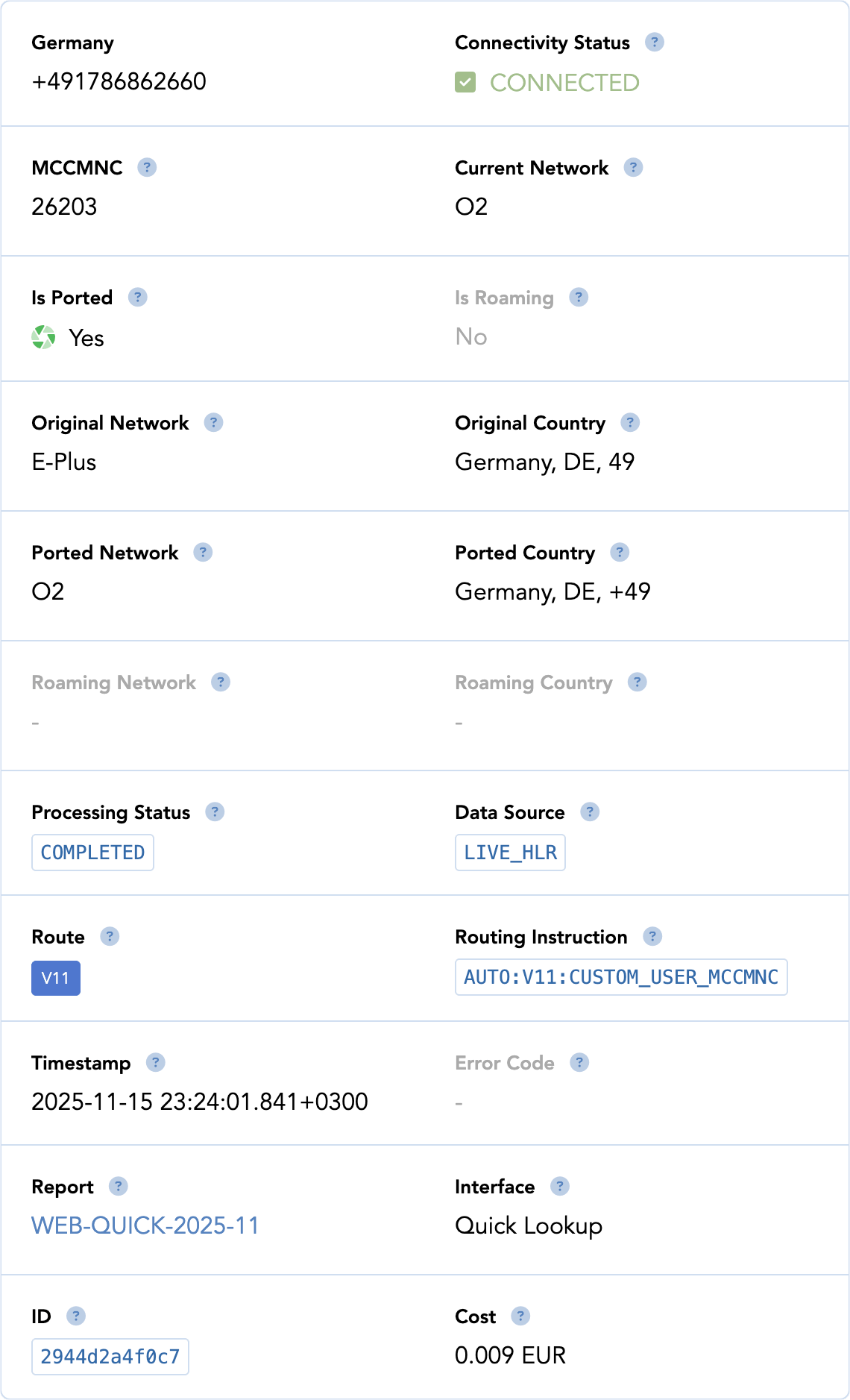
Connectivity Status
For HLR verification, connectivity status shows whether the subscriber is currently reachable:
CONNECTED indicates the device is online and can receive communications immediately. This is the ideal status for any planned outreach.
ABSENT indicates temporary unavailability. The subscriber may be reachable later - consider scheduling retry or queuing for later delivery.
INVALID_MSISDN indicates the number is permanently unreachable. This number should be flagged for removal from active contact lists.
Network Operator Information
Results include the current network operator serving the subscriber, displayed as both commercial name (e.g., 'Vodafone Germany') and technical MCCMNC code (e.g., '26202'). For ported numbers, the original allocating operator is also shown, enabling comparison to detect portability.
Number Classification
Number type classification indicates whether the number is mobile, landline, VoIP, or another specialized type. This information is essential when your communication channel requires specific number types - for example, SMS can only be delivered to mobile numbers.
Quick Verification Use Cases
Customer Service Verification
Support agents can instantly verify customer phone numbers during interactions, confirming that contact information is valid before updating records or attempting callbacks. When customers report "I am not receiving your messages," agents can use Quick Verification to diagnose whether the issue is an unreachable number versus a delivery system problem.
Registration Spot-Checks
Verify suspicious registrations by checking whether provided phone numbers are valid, active, and appropriately typed (mobile vs VoIP) for your service requirements. Quick verification helps identify potentially fraudulent registrations using invalid or high-risk phone numbers.
Lead Qualification
Sales teams can validate high-value lead phone numbers before investing time in outreach, ensuring contact information is accurate and the prospect is reachable. Verification reveals whether leads have provided valid numbers or whether contact attempts will fail.
Troubleshooting Delivery Issues
When messages or calls fail to reach specific numbers, Quick Verification reveals whether the issue stems from number validity, connectivity status, or carrier routing. This diagnostic capability enables targeted troubleshooting rather than generic responses to delivery complaints.
Ad-Hoc Data Quality Checks
Spot-check random samples from your database to assess overall data quality, identifying whether verification rates suggest broader database hygiene issues. Quick sampling helps justify and scope larger bulk verification projects.
Result Storage and History
All Quick Verifications are automatically logged and accessible through your Dashboard, providing verification history and audit trails. Optionally assign verifications to named storage containers for project-specific organization and aggregated reporting.
Verification results contribute to your analytics reports, enabling trend analysis of verification patterns over time.
Bulk Phone Number Verification
Database Cleansing and High-Volume Validation
Bulk verification enables validation of thousands or millions of phone numbers for data quality management, campaign preparation, and systematic database cleansing. Upload your contact lists, monitor processing in real-time, and download comprehensive results that identify which numbers are valid, active, and reachable.
Our enterprise bulk processing infrastructure handles massive workloads efficiently, processing large files with parallel execution while maintaining accuracy and providing detailed progress tracking.
Database Cleansing Workflow
Export Your Contact Database
Export phone numbers from your CRM, marketing platform, or contact database into CSV, TXT, or Excel format. The bulk processor automatically detects number columns in multi-column files, handling files with headers or raw number lists.
Upload for Verification
Upload your file through the web interface using drag-and-drop or file browser selection. The system validates file format, parses content, and displays detected number count for confirmation before processing begins. Select your preferred verification type (HLR for connectivity, NT for number type, MNP for carrier) based on your data quality objectives.
Monitor Processing Progress
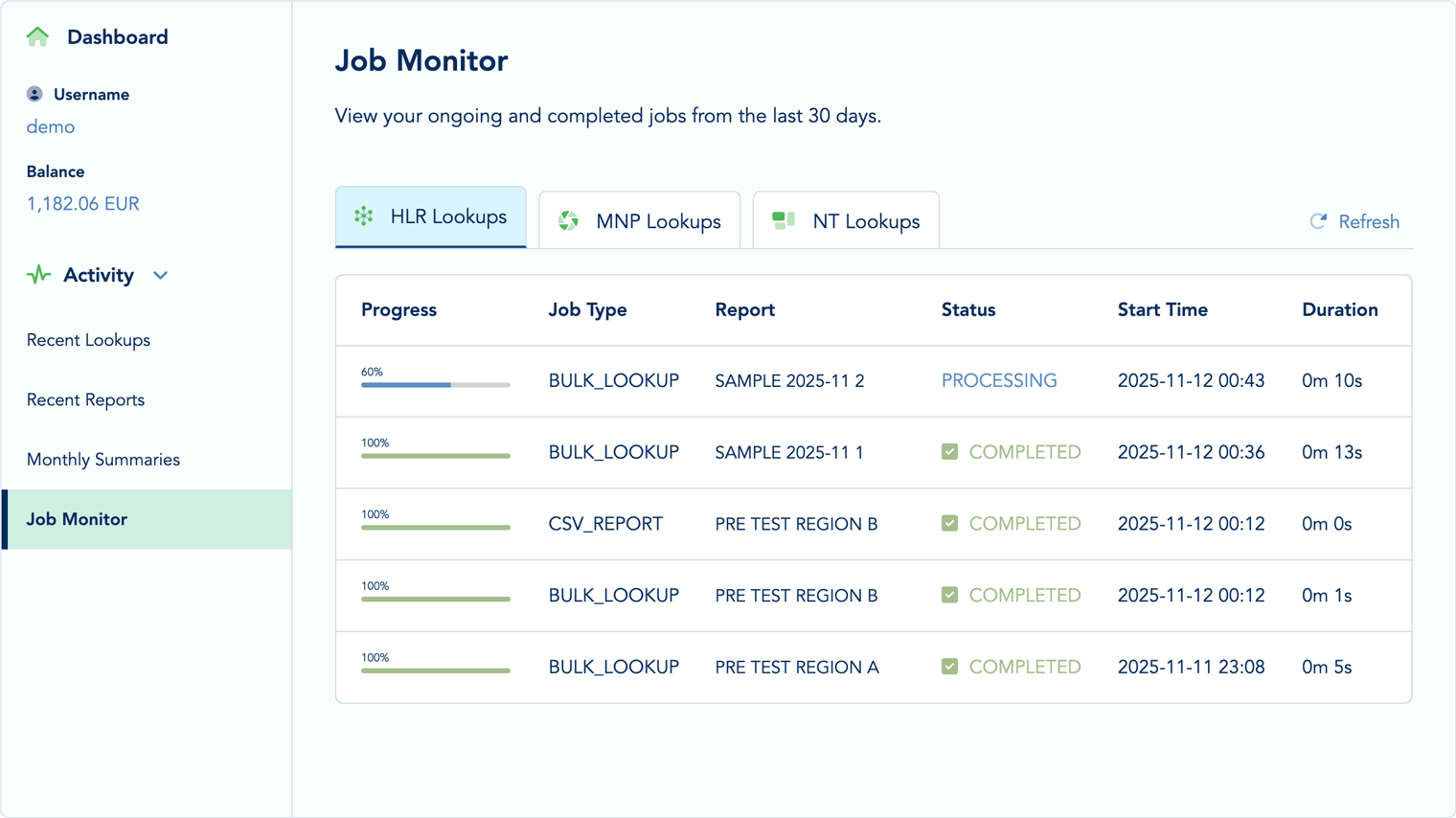
Track verification progress in real-time through the job monitor. Visual indicators show completion percentage, numbers processed, and estimated time remaining. Receive email notifications when processing completes, eliminating the need for continuous monitoring.
Download and Apply Results
Download comprehensive results in CSV format containing all input numbers with their verification status, connectivity information, number type, and carrier details. Import results back into your systems to flag invalid numbers, update contact records, and segment your database by reachability status.
Data Hygiene Best Practices
Regular Verification Schedules
Implement periodic verification sweeps to catch database decay before it accumulates. Monthly validation of active contact lists identifies newly invalid numbers before they impact campaigns. Quarterly full-database verification reveals degradation trends and helps calibrate acquisition channel quality by comparing validity rates across data sources.
Pre-Campaign Validation
Verify contact lists before every major campaign launch. Pre-send validation removes invalid numbers from send lists, maximizing delivery rates and protecting sender reputation. Even databases verified recently may contain newly invalid contacts - verification closer to send time captures recent changes.
Segmentation by Status
Use verification results to segment your database by contact quality:
CONNECTED contacts are immediately reachable - prioritize for time-sensitive communications.
ABSENT contacts may be temporarily unavailable - schedule for retry windows or lower-priority campaigns.
INVALID_MSISDN contacts should be suppressed from active campaigns and flagged for removal or re-collection.
Acquisition Quality Monitoring
Track verification rates by data source to identify acquisition channels delivering poor-quality contact information. If leads from certain sources show high invalid rates, investigate collection methods or consider source quality when prioritizing outreach.
Enterprise Features
Parallel Processing
Distributed processing infrastructure executes verifications in parallel across multiple workers, maximizing throughput while maintaining result accuracy. Large files process at sustained high rates, typically completing within hours rather than days regardless of volume.
Storage Organization
Assign bulk jobs to named storage containers for organized result management. Storage names like 'DATABASE-CLEANUP-Q1' or 'CAMPAIGN-SPRING-2025' keep results organized and retrievable. Storage containers aggregate results from related jobs, enabling cumulative analysis across multiple verification activities.
Analytics Integration
Bulk verification results automatically feed into the analytics platform, generating aggregate statistics on data quality, validity rates, and trend analysis. Visualize how your database quality changes over time, compare validity rates across different segments, and quantify the ROI of your data hygiene investments.
Supported File Formats
CSV Files
Comma-separated value files are the most common format. The system auto-detects number columns in multi-column files with or without headers.
Text Files
Plain text files with one number per line are processed directly without column parsing complexity.
Excel Files
Microsoft Excel files (.xlsx, .xls) are supported for users working primarily in spreadsheet environments. Specify worksheet and column or use auto-detection.
API-Based Bulk Processing
For programmatic integration, our REST API supports asynchronous bulk submission endpoints that accept number arrays or file uploads. API-based bulk processing enables automated workflows where verification jobs trigger based on schedule, data changes, or upstream system events. Comprehensive API documentation provides detailed specifications for bulk submission, status polling, and result retrieval.
Real-Time Phone Verification API
Integrate Phone Number Verification Into Your Applications
Our REST API enables real-time phone number verification during user registration, checkout flows, 2FA enrollment, and any workflow requiring programmatic phone validation. Synchronous endpoints return verification results within milliseconds, enabling inline validation that blocks invalid numbers before they enter your systems.
Comprehensive API documentation provides detailed specifications, code examples, and integration patterns for common use cases.
Registration Flow Integration
Integrate phone verification into user registration to ensure customers provide valid, reachable phone numbers from the start. Real-time validation during registration prevents invalid data from entering your systems and blocks fraudulent registrations using fake or disconnected numbers.
Inline Validation Pattern
Verify phone numbers as users enter them, providing immediate feedback before form submission. This approach catches errors while users can easily correct them, improving completion rates and data quality.
When verification indicates INVALID, display an error prompting the user to enter a valid phone number before proceeding. When verification shows the number is a landline but your service requires mobile (for SMS), prompt for a mobile number.
Pre-Submit Verification
Verify phone numbers during form submission, before creating user accounts. This approach adds minimal friction while ensuring only valid numbers complete registration. Invalid numbers trigger validation errors that return users to the form with specific guidance on the issue detected.
2FA Enrollment Validation
Before enabling SMS-based two-factor authentication, verify that the enrolled phone number is valid, active, and capable of receiving SMS messages. Pre-enrollment verification prevents users from locking themselves out by associating invalid numbers with their accounts.
Verification Before Enrollment
When users provide phone numbers for 2FA, verify connectivity (CONNECTED status) and number type (mobile, not landline) before proceeding with enrollment. If verification shows ABSENT status, prompt users to ensure their phone is powered on: "Your phone appears to be offline. Please ensure it is powered on to complete 2FA setup."
Ongoing 2FA Verification
Re-verify 2FA numbers before security-sensitive operations (password resets, payment method changes). Numbers valid at enrollment may have become invalid months later. Proactive re-verification before critical operations ensures authentication codes will deliver when users need them most.
Checkout Verification
Verify phone numbers during checkout to confirm customer contact information before order fulfillment, reducing delivery failures and fraud risk.
Contact Validation
Verify that phone numbers provided for delivery coordination are valid and reachable, enabling proactive customer contact when delivery issues arise. Invalid contact numbers discovered during checkout can be corrected immediately rather than causing fulfillment problems later.
Fraud Signal Integration
Use verification data as fraud signals: VoIP numbers instead of mobile, recently activated SIMs, or geographic mismatches between billing address and number registration may indicate elevated risk. Risk-based workflows can require additional verification for suspicious phone number patterns while processing low-risk orders normally.
API Integration Patterns
Synchronous Verification
The synchronous API endpoint accepts individual phone numbers and returns verification results in real-time, typically within 0.3-1.5 seconds. Ideal for inline form validation, registration flows, and any use case requiring immediate verification feedback.
200 OK
{
   "id":"f94ef092cb53",
   "msisdn":"+14156226819",
   "connectivity_status":"CONNECTED",
   "mccmnc":"310260",
   "mcc":"310",
   "mnc":"260",
   "imsi":"***************",
   "original_network_name":"Verizon Wireless",
   "original_country_name":"United States",
   "original_country_code":"US",
   "original_country_prefix":"+1",
   "is_ported":true,
   "ported_network_name":"T-Mobile US",
   "ported_country_name":"United States",
   "ported_country_code":"US",
   "ported_country_prefix":"+1",
   "is_roaming":false,
   "roaming_network_name":null,
   "roaming_country_name":null,
   "roaming_country_code":null,
   "cost":"0.0100",
   "timestamp":"2020-08-07 19:16:17.676+0300",
   "storage":"SYNC-API-2020-08",
   "route":"IP1",
   "processing_status":"COMPLETED",
   "error_code":null,
   "data_source":"LIVE_HLR"
}
Asynchronous Bulk Verification
For high-volume verification, the asynchronous API accepts arrays of phone numbers or file uploads, returning job identifiers for status polling and result retrieval. Asynchronous processing enables verification of large datasets without blocking application threads or hitting timeout limits.
Developer SDKs
Accelerate integration with native SDKs for PHP, Node.js, Python, and other popular languages. SDKs provide pre-built functions that handle authentication, request formatting, response parsing, and error management.
 PHP
PHP
 NodeJS
 Ruby
Ruby
1   include('HLRLookupClient.class.php');
2
3   $client = new HLRLookupClient(
4       'YOUR-API-KEY',
5       'YOUR-API-SECRET',
6       '/var/log/hlr-lookups.log'
7   );
8
9   $params = array('msisdn' => '+14156226819');
10 $response = $client->post('/hlr-lookup', $params);NodeJS SDK
Instant API Integration for NodeJS1 require('node-hlr-client');
2
3 let response = await client.post('/hlr-lookup', {msisdn: '+491788735000'});
4
5 if (response.status === 200) {
6 // lookup was successful
7 let data = response.data;
8 }Ruby SDK
Instant API Integration for Ruby1 require 'ruby_hlr_client/client'
2
3 client = HlrLookupsSDK::Client.new(
4 'YOUR-API-KEY',
5 'YOUR-API-SECRET',
6 '/var/log/hlr-lookups.log'
7 )
8
9 params = { :msisdn => '+14156226819' }
10 response = client.get('/hlr-lookup', params)Authentication and Security
API Key Authentication
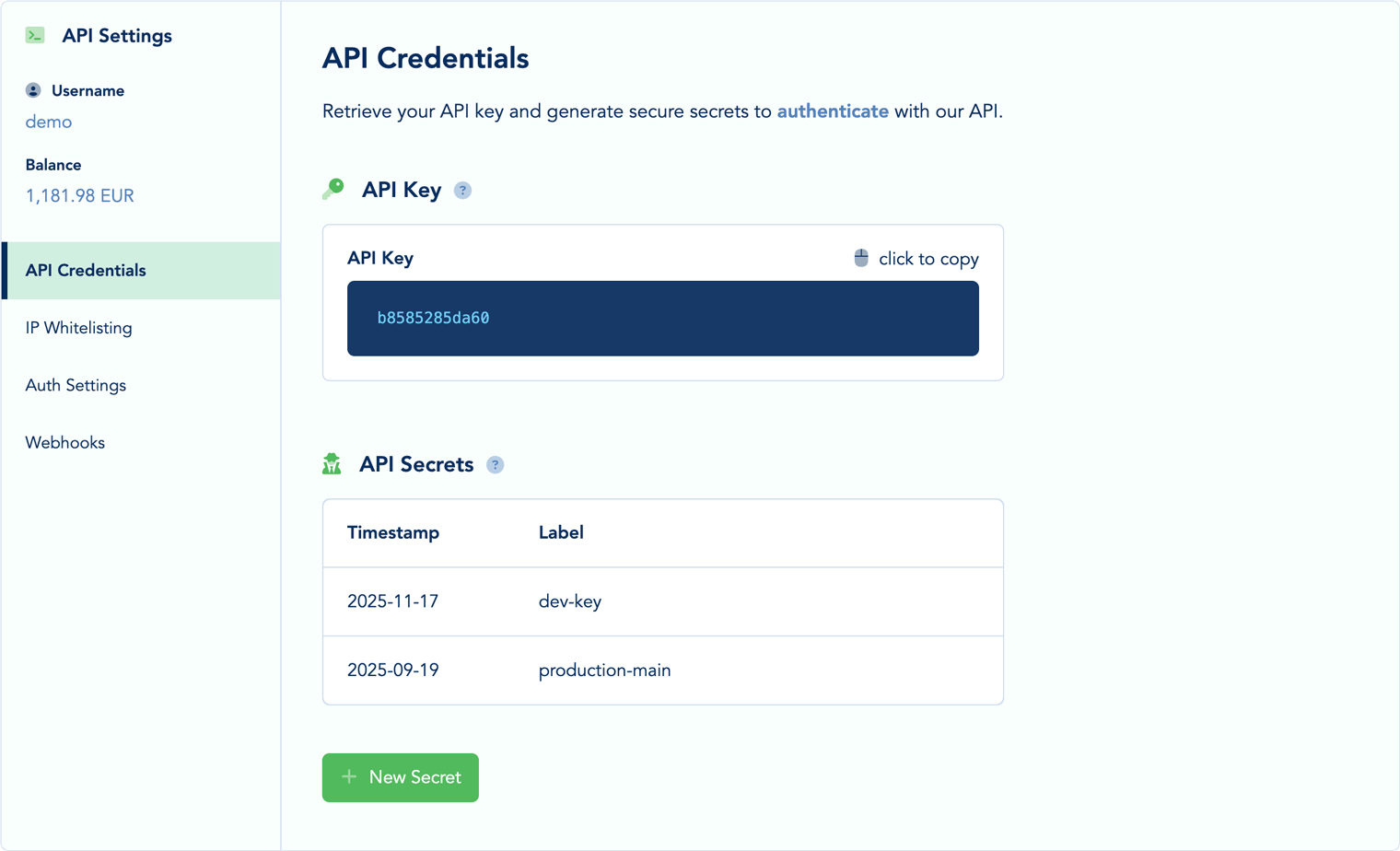
Authenticate API requests using API keys generated through your account settings. Keys can be scoped to specific capabilities and IP address ranges for security hardening.
IP Whitelisting
Restrict API access to specific IP addresses, preventing unauthorized access even if credentials are compromised. Configure whitelists through account settings, supporting individual addresses and CIDR ranges for distributed systems.
Best Practices
Caching Strategies
Implement client-side caching for recently verified numbers to reduce redundant lookups. A 24-hour cache balances freshness against cost for most use cases. For high-frequency verification of the same numbers (e.g., login flows), short-term caching dramatically reduces API calls without sacrificing accuracy.
Graceful Degradation
Design integrations to handle API unavailability gracefully. When verification fails, consider allowing transactions to proceed with additional monitoring rather than blocking all activity. Implement circuit breakers that temporarily bypass verification during extended outages, restoring normal operation when service recovers.
Rate Limit Awareness
Monitor rate limit headers in API responses to stay within quota limits. Implement intelligent throttling that spreads requests over time rather than bursting. For predictable high-volume periods, consider pre-verification using bulk processing rather than real-time API during peak traffic.
Phone Verification Dashboard & Analytics
Monitor Verification Activity and Data Quality Trends
The Dashboard provides centralized visibility into your phone number verification activity, offering real-time monitoring of verification results, bulk processing status, and data quality metrics. Track verification patterns over time, identify data quality trends, and generate reports that document your phone number validation efforts.
Recent Verifications Feed
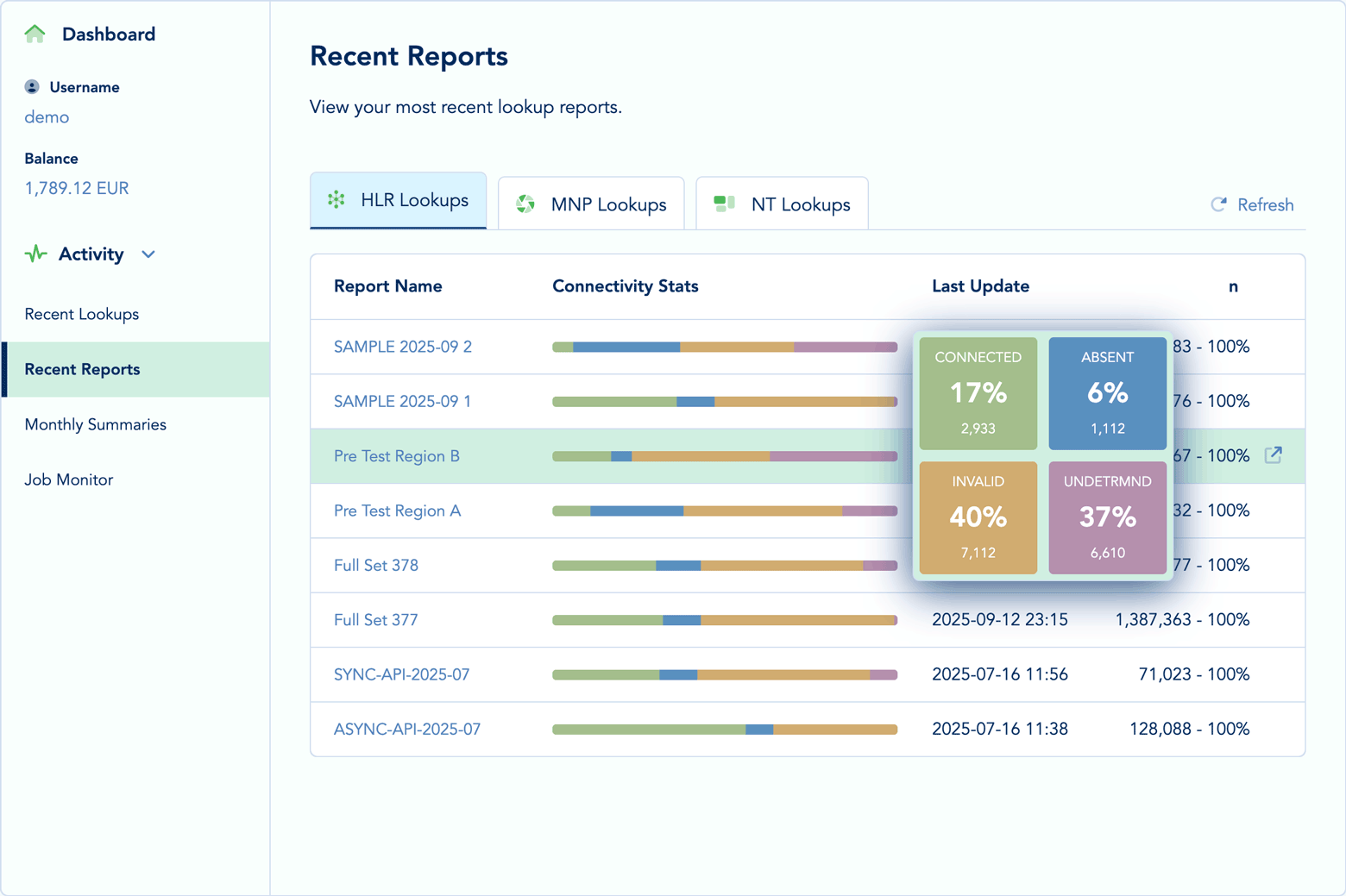
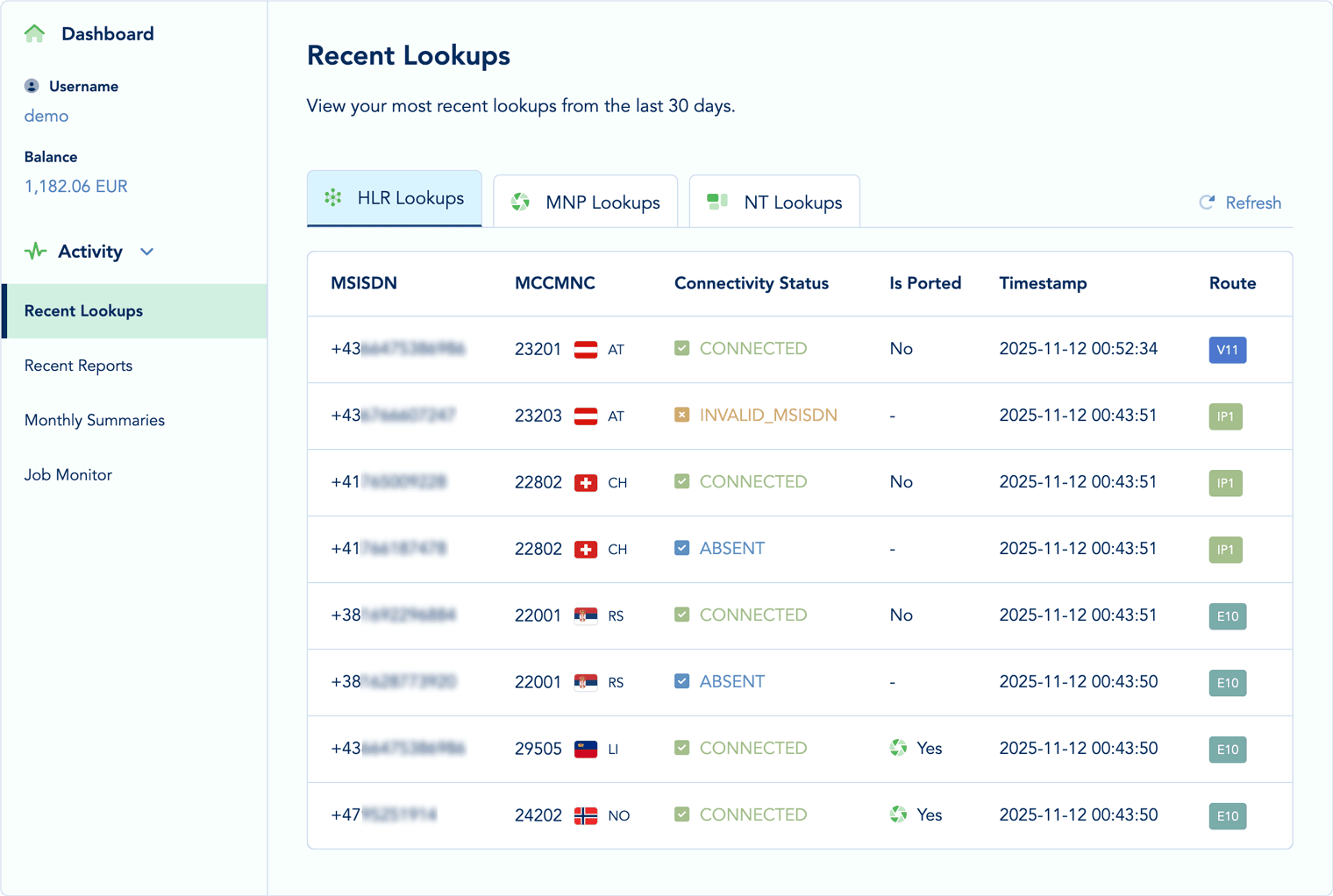
The recent verifications feed displays your most recent phone number validations in chronological order, providing immediate visibility into verification activity across all submission methods. Each entry shows the verified phone number, validation status, number type, carrier identification, and timestamp.
Click any verification entry to expand detailed results including network operator information, connectivity status, and verification metadata. The feed updates in real-time as new verifications complete, providing continuous visibility without manual refresh.
Filtering and Search
Filter the recent verifications feed by date range, status, verification type, or storage container to focus on specific verification activity. Search functionality enables quick location of specific phone numbers within your verification history, supporting customer service inquiries and audit requests.
Bulk Processing Monitor
The job monitor tracks all active and recent bulk verification jobs, displaying progress status, completion percentages, and estimated completion times. Monitor multiple concurrent jobs simultaneously with visual indicators distinguishing queued, processing, completed, and failed states.
Job Details
Click any job to view detailed statistics: total numbers processed, verification success rates, status distribution, and direct links to download results. Job details provide insight into data quality for each batch, helping identify sources of invalid or low-quality phone number data.
Data Quality Metrics
Analytics aggregate verification results into meaningful quality metrics that reveal patterns in your phone number data:
Validity Rate Tracking
Track what percentage of verified numbers are valid (CONNECTED or ABSENT) versus invalid (INVALID) over time. Declining validity rates may indicate database aging, while sudden drops could signal acquisition channel quality issues.
Connectivity Distribution
Visualize how verified numbers distribute across connectivity states: what percentage are immediately reachable, temporarily unavailable, or permanently invalid. Connectivity distribution helps calibrate communication strategies - high absent rates may suggest optimal timing for outreach differs from current scheduling.
Number Type Breakdown
Analyze the distribution of number types in your database: mobile, landline, VoIP percentages reveal communication channel opportunities and limitations. High landline percentages in SMS contact lists indicate wasted delivery attempts; high VoIP rates may suggest fraud risk patterns.
Carrier Distribution
See which network operators serve your contacts, enabling carrier-specific optimization and helping identify any carrier-correlated data quality issues.
Monthly Summaries
Monthly summary cards provide at-a-glance visibility into aggregate verification activity across billing periods. Each summary displays total verifications performed, validity rates observed, cost totals, and comparison against previous periods.
Trend Indicators
Visual trend indicators highlight changes from previous periods: improving or declining validity rates, shifting verification volumes, and changing status distributions. Trend analysis helps identify seasonal patterns, growth trajectories, and anomalies requiring investigation.
Reports and Exports
Generate comprehensive reports documenting verification activity for management review, compliance requirements, and business intelligence.
Scheduled Reports
Configure automated report generation on daily, weekly, or monthly schedules. Reports are generated automatically and delivered via email or made available for download.
Custom Exports
Export verification data in CSV format for integration with external business intelligence tools, databases, and analysis platforms. Custom exports support specific date ranges, status filters, and field selections tailored to your reporting requirements.
Integration with Platform Analytics
Dashboard data feeds into the comprehensive analytics platform, enabling deeper analysis of verification patterns and data quality trends. Navigate from Dashboard overview to detailed analytics for specific time periods, verification types, or storage containers.
Phone Number Verification Use Cases
Real-World Applications Across Industries
Phone number verification delivers measurable value across diverse industries and applications. From preventing fraudulent registrations to optimizing marketing campaigns, verification ensures your phone number data supports rather than undermines your business objectives.
User Registration and Account Creation
The Challenge: Fake and Invalid Registrations
User registration forms accept whatever phone numbers users provide, including typos, invalid formats, landlines for SMS-dependent services, and deliberately fake numbers from fraudsters or users avoiding verification. Invalid phone numbers create downstream problems: failed authentication codes, unreachable customers, and compromised account security when numbers can't receive 2FA messages.
Verification Solution
Integrate real-time phone verification into registration flows to validate numbers before account creation. Verify that numbers are valid format, correct type (mobile for SMS-based verification), and currently active. Reject or flag registrations with invalid, disconnected, or high-risk phone numbers.
Business Impact
Organizations implementing registration verification report 30-50% reduction in fake account creation and 90%+ success rates on subsequent SMS verification attempts, versus 70-80% without pre-verification. Reduced support burden from users locked out due to invalid 2FA numbers, and cleaner customer databases from the start.
Marketing Campaign Optimization
The Challenge: Wasted Campaign Spend
Marketing databases accumulate invalid contacts over time. Sending campaigns to degraded databases wastes message credits on undeliverable numbers while inflating audience metrics and distorting campaign analytics. A 20% invalid rate on a 100,000-recipient campaign means 20,000 wasted messages - significant cost with zero return, plus reputation damage from high failure rates.
Verification Solution
Verify contact lists before campaign launch using bulk verification to identify and suppress invalid numbers. Segment contacts by reachability status: send to CONNECTED numbers immediately, schedule ABSENT numbers for retry windows, and exclude INVALID numbers entirely.
Business Impact
Marketing teams implementing pre-campaign verification achieve 15-25% improvement in delivery rates and 20-35% reduction in wasted message spend. Accurate audience metrics enable confident campaign optimization based on true reach rather than inflated denominators that mask performance.
CRM Data Quality Management
The Challenge: Invisible Database Decay
CRM databases degrade silently at 2-5% monthly as contacts change numbers, switch carriers, or deactivate service. Sales teams waste hours dialing disconnected numbers with no indication the data has become stale. Poor data quality distorts pipeline metrics, undermines forecasting accuracy, and reduces team productivity through wasted contact attempts.
Verification Solution
Implement periodic database verification to identify invalid contacts and update reachability status in CRM records. Flag unreachable contacts for data remediation, trigger workflows to request updated contact information, and update routing preferences based on carrier identification.
Business Impact
Sales teams improve productivity 20-35% by focusing on reachable contacts rather than chasing disconnected numbers. Pipeline accuracy improves as metrics reflect actual contactable prospects rather than inflated counts including invalid entries.
Fraud Prevention at Checkout
The Challenge: Fraudulent Transactions
Fraudsters use temporary phone numbers, VoIP services, and recently activated SIMs to complete fraudulent transactions while evading identity verification. Without verification, checkout systems cannot distinguish legitimate customers from fraud attempts using disposable or synthetic contact information.
Verification Solution
Verify phone numbers during checkout as part of fraud risk assessment. Flag orders with VoIP numbers (instead of mobile), recently activated SIMs, or geographic mismatches between billing address and phone number registration for additional review.
Business Impact
E-commerce merchants report 20-35% reduction in fraudulent orders and 15-30% decline in chargeback rates after implementing checkout verification. Legitimate customers experience minimal friction while high-risk transactions receive appropriate scrutiny.
Two-Factor Authentication Reliability
The Challenge: 2FA Delivery Failures
SMS-based two-factor authentication fails when enrolled phone numbers become unreachable, leaving users locked out of accounts and generating support escalations. Users often don't realize their 2FA number has become invalid until they urgently need account access, creating frustrating experiences at critical moments.
Verification Solution
Verify phone numbers during 2FA enrollment to ensure they're valid, active, and capable of receiving SMS. Periodically re-verify enrolled 2FA numbers to detect degradation before users encounter authentication failures.
Business Impact
2FA-related support tickets decline 40-60% when enrollment verification prevents invalid number association. Authentication success rates improve from 70-80% to 95%+ when only verified numbers receive authentication codes.
Call Center Efficiency
The Challenge: Wasted Dial Attempts
Call center agents waste significant time dialing invalid numbers that immediately disconnect or reach wrong parties due to number reassignment. Without reachability data, dialer systems treat all contacts equally, mixing valid numbers with disconnected ones in call queues.
Verification Solution
Pre-verify outbound call lists to identify reachable contacts, enabling prioritization of CONNECTED numbers and suppression of INVALID entries. Display verification status to agents, enabling informed decisions about which contacts to attempt based on current reachability.
Business Impact
Call centers improve agent productivity 15-25% by eliminating invalid dial attempts. Contact rates improve 20-40% when calls target verified reachable numbers rather than random selection from degraded lists.
Healthcare Patient Communication
The Challenge: Missed Appointments and Notifications
Healthcare providers rely on phone communication for appointment reminders, test results, and care coordination. Invalid patient contact information leads to missed appointments, delayed care, and compliance risks.
Verification Solution
Verify patient phone numbers at registration and periodically during visits to maintain accurate contact information. Flag unreachable patient contacts for update during next interaction, ensuring communication channels remain functional.
Business Impact
Healthcare organizations reduce appointment no-show rates by 10-20% through reliable reminder delivery to verified numbers. Patient communication compliance improves as contact attempts document verified delivery rather than uncertain transmission to potentially invalid numbers.
Getting Started
Every phone verification implementation begins with understanding your specific requirements: verification volumes, accuracy thresholds, integration preferences, and use case priorities. Our platform provides flexible access from Quick Verification for exploratory validation to sophisticated API integration for production-scale automation.
Start with pilot verification to validate that our platform delivers the data quality improvement, fraud prevention, or efficiency gains your application needs. Contact our team to discuss how phone number verification can address your specific business requirements.

